

The government linked the cost of university teaching to funding and student fees, but the numbers don't add up
- Written by: Keith A Houghton, Emeritus Professor, Australian National University
Our newly published research on the costs of university study fails to support estimates used by the Australian government to justify its Job-Ready Graduates Package. The legislated policy directly linked funding to the cost of teaching, which the government also used to justify increased HECS student contributions in some subjects. Our findings indicate teaching costs could be significantly lower than the government policy settings imply.
In June 2020, the then federal education minister, Dan Tehan, announced an extra 39,000 university places by 2023 and 100,000 by 2030. To fund these places, he said:
“[…] we will address the misalignment between the cost of teaching a degree and the revenue that a university receives to teach it. We will reform the system so that the student contribution and the Commonwealth contribution actually equals the cost of teaching that degree.”
For our research, we took one discipline, business, for which tuition fees increased by 30%. We sought to investigate whether an undergraduate degree did cost the claimed A$15,600 a year to teach.
Course costings were questioned from the start
The proposed mechanisms of the Job-Ready Graduates legislation were criticised in many of the 280 submissions to the Education and Employment Legislation Committee inquiry into the bill.
In its submission, the Department of Education, Skills and Employment (DESE) said its consultant’s (Deloitte) costings “informed” the calibration by the Commonwealth. Deloitte’s data collection used questionnaires for a sample of universities.
Opposition Senator Kim Carr questioned these costings:
“The underlying data used to calculate [the] cost of provision [of education] far exceeds the limitations of the data identified in the Deloitte report […] What further work has the department conducted to ensure this policy change is based on reliable data?”
The department referred the senator back to the 2019 Deloitte report. It gave no response about data reliability.
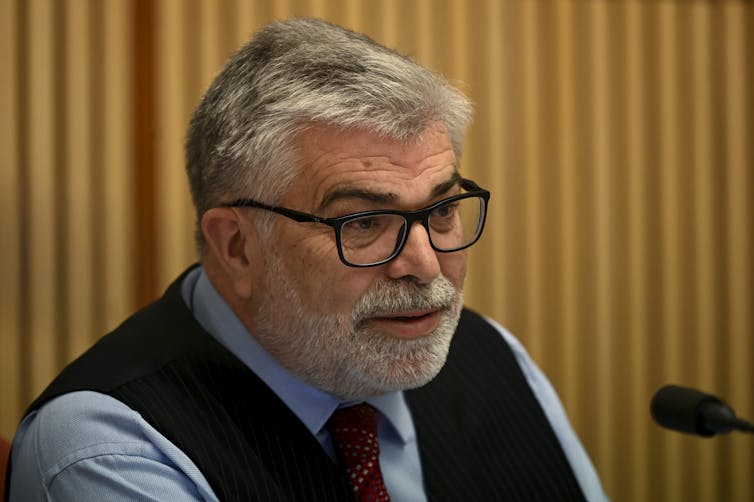 Labor Senator Kim Carr did not get a response from the department to his question about the reliability of costings data used for the Job-Ready Graduates Package.
Lukas Coch/AAP
Labor Senator Kim Carr did not get a response from the department to his question about the reliability of costings data used for the Job-Ready Graduates Package.
Lukas Coch/AAP
A DESE official advised one author on May 10 2021 that the consultants were unaware of the Job-Ready Graduates legislation when undertaking their analysis.
One commentator wrote: “Few people in the higher education sector found the figures plausible (and to be fair, Deloitte themselves put caveats around the data). A common complaint is that the report over-estimates the cost to universities of delivering business, law and many humanities courses.”
The report’s caveats were understandable and reasonable. The critical question becomes: why was a questionnaire-based dataset, with several significant caveats disclosed, used as the basis for the multi-billion-dollar funding program?
Data on costs exist, but requests for access failed
Studying the production costs of education is complex and requires valid and reliable data because of the joint and common costs. DESE holds a significant dataset known as “Datamart”. This was not used for its costing analysis. When we were not given access to this data, we needed an alternative to examine the cost of business education.
Budgetary data from 283 US public university business schools was used instead. While not optimal, this dataset is a reasonable proxy. The US public higher education system is not a low-cost provider, so its costs are likely higher than Australia’s.
Using actual budgetary data allowed us to control for the impact of the costs of:
- graduate education
- research training (PhDs)
- university research.
A limitation of our dataset is the absence of university-level overhead costs. A positive is that we could measure potentially differing costs between research-intensive and teaching-focused institutions.
Our results show that, excluding all overheads (at university and school levels), the average (mean) cost per undergraduate student per year is about $A2,700. Significant differences exist between research and teaching-focused universities.
An intriguing result was the high cost of research publications, ranging from $A110,000 when published in “regular” scholarly journals to over $A400,000 for “elite” publications, and varying between research and teaching-focused schools.
What about overheads?
We re-estimated our results in several ways. Only when the school’s overheads, research and research training costs are “loaded” into the cost of education did the cost of undergraduate business education increase to something greater than $A5,000 a year. This amount is likely over-estimated since this approach treats research and research training as valueless byproducts of teaching.
We provided our preliminary results to DESE. The department correctly noted the exclusion of university-level overheads, saying overheads “would presumably be a reasonably large component of the cost”. However, the difference between our estimate of A$2,700 and DESE’s A$15,600 is substantial.
If DESE’s observations on overheads explain this difference, more than eight dollars in ten is spent on “overheads” (at university and school levels). If such a small percentage of teaching costs is directed to “frontline” teaching activities, that implies considerable inefficiency in our universities. We do not believe these inefficiencies exist on such a scale.
An alternative position is that these eight dollars are not all spent on “overheads”. Instead, some of this money subsidises other activities, potentially including teaching of other disciplines and/or research.
Of the many implications of our findings, we raise only one. If the cost of business education is actually much lower than estimated, and if one believes university funding is a “zero-sum” game – meaning there are no large overall surpluses or deficits – then could other fields be undercosted and therefore underfunded? Such fields might include science or technology or involve clinical and practical components, such as nursing.
Why transparency about costings matters
A policy of identifying the cost of education and linking it to funding allows for a more transparent and open market. However, the implementation needs repair.
Who cares? Australian business undergraduates should because their tuition fees are paying for activities other than their education.
Universities should care. This study raises the prospect that their activities in science, technology and clinical care fields may be undercosted and underfunded.
The government should also care. False costings will undermine the very misalignment it wanted to eliminate.
Authors: Keith A Houghton, Emeritus Professor, Australian National University


















