

Why Shayna Jack is likely to successfully defend her doping ban appeal — but still won't be at the Tokyo Olympics
- Written by: James Duffy, Associate Professor, Queensland University of Technology
Despite the excitement of the Australian swimming trials to determine which athletes will go to the Tokyo Olympics, it was still hard to overlook the absence of swimmer Shayna Jack.
Jack is a 22-year-old Australian swimming star. She has represented Australia at the world championships and the 2018 Commonwealth Games, where she was part of the women’s 4x100m freestyle relay team that won gold and set a new world record.
Jack tested positive for the banned substance Ligandrol before the 2019 World Aquatics Championships. Her four-year ban was reduced to two years, but the World Anti-Doping Agency and Sports Integrity Australia have appealed that decision and are seeking to have the four-year ban reinstated.
The appeal hearing begins today. Even if Jack successfully defends the appeal, her two-year period of ineligibility ends in July. This is before the Olympics begin, but just after the Australian swimming trials.
This means no matter what happens, Jack cannot compete in Tokyo.
 Jack has vigorously denied intentionally ingesting anything that would have contained Ligandrol.
Darren England/AAP
Jack has vigorously denied intentionally ingesting anything that would have contained Ligandrol.
Darren England/AAP
Background of the case
Much has been written in the media about Jack’s doping ban. This reporting is seldom incorrect, though it often omits key details that make her case difficult to fully appreciate.
Here’s the background. In June 2019, Jack participated in an out-of-competition drug test. A month later, she was informed she had returned a positive result for Ligandrol, which works in a similar way to testosterone and anabolic steroids, but with fewer side effects.
Read more: What is Ligandrol, the drug swimmer Shayna Jack had in her system?
In December 2019, the Australian Sports Anti-Doping Authority (now Sports Integrity Australia) issued an infraction notice, informing Jack she would be ineligible to compete and train with other swimmers for four years.
Last November, Alan Sullivan QC, an arbitrator for the Court of Arbitration for Sport (CAS), ruled a four-year ban was not the appropriate sanction, on the basis that Jack’s violation was not intentionally committed.
Jack has been unwavering in her assertion she would never take a performance enhancing drug knowingly. The difficulty for her is that she has never been able to show how the Ligandrol entered her system.
Negligent versus unintentional rule violations
We believe Jack will be successful in having the appeal dismissed. Our conclusion is based on our belief she is telling the truth about her inadvertent ingestion of Ligandrol, combined with Sullivan’s legally sound arbitral decision in the CAS.
In the original CAS hearing, Jack’s lawyer argued her four-year ban should be overturned on the basis there was “no fault or negligence” on her behalf.
Establishing “no fault or negligence” is very hard to do. According to the Swimming Australia Policy, this requires athletes to prove they “could not reasonably have known or suspected even with the exercise of utmost caution” they violated an anti-doping rule.
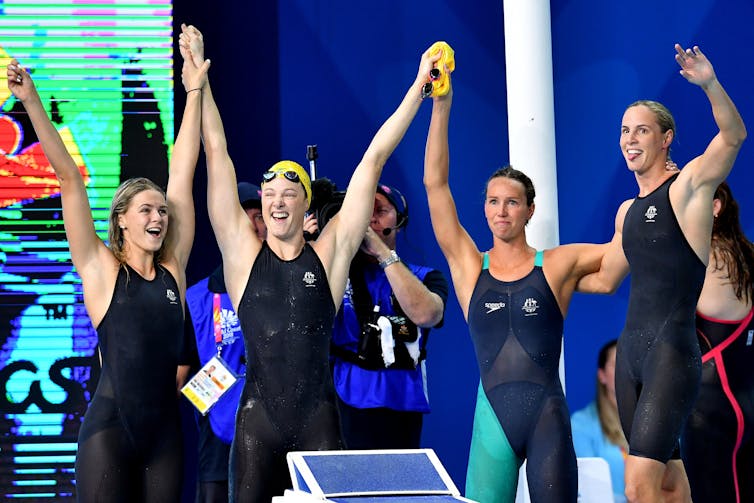 Jack (far left) celebrating winning the women’s 4x100m freestyle relay at the 2018 Commonwealth Games.
Darren England/AAP
Jack (far left) celebrating winning the women’s 4x100m freestyle relay at the 2018 Commonwealth Games.
Darren England/AAP
In addition, when a prohibited substance is detected, athletes must establish how it entered their bodies. As Jack could not establish how the Ligandrol entered her system, she was not able to overturn her ban on this ground.
However, athletes can have a ban reduced from four to two years if they can establish the anti-doping rule violation was not intentional. This is what Jack’s lawyer argued, and her sanction was ultimately reduced.
The complication in Jack’s case was whether she had to establish how the Ligandrol entered her body in order to prove (on the balance of probabilities) that she did not take the substance intentionally.
The precise wording of the Swimming Australia Policy was key here: it does not explicitly require an athlete to establish the source of a prohibited substance when proving the violation was not intentional. This is a requirement only when proving “no fault or negligence” with respect to an anti-doping violation.
Key points in the appeal
Previous CAS panels have produced conflicting decisions on this point.
The arbitrator in the Jack case relied on two previous decisions to rule in her favour.
In the first case — filed by Peruvian swimmer Mauricio Fiol Villanueva — the CAS panel made clear that when an athlete cannot establish the source of a prohibited substance, it leaves the “narrowest of corridors” through which he or she could argue the violation was not intentional. According to the panel, such cases would be extremely rare.
Read more: Sun Yang ban shows world swimming body must establish an integrity commission
The outcome of Jack’s CAS appeal rests on whether her case is one of these rare instances. Therefore, the factors that convinced Sullivan to reduce her ban will likely be key:
1) Jack was considered to be an articulate and impressive witness. She did not manufacture a story as to how the Ligandrol entered her system. She simply claimed she did not know. Sullivan described her as one of the most impressive witnesses he had seen in 40 years of legal practice.
2) Her testimony also showed she was a diligent athlete who followed all protocols from the swimming governing body and anti-doping authorities.
3) Numerous character witnesses were also persuasive, including coaches, doctors, officials, and other athletes. These included statements from Cate and Bronte Campbell, who were teammates of Jack’s in the freestyle relay event and her competitors in individual events.
4) Jack had never received a positive drug result before. She was tested on ten previous occasions between February 2018 and June 2019.
5) Jack spent considerable money and time attempting to ascertain the source of the Ligandrol.
6) The amount of Ligandrol found in her sample was classified as “low”, and considered to be pharmacologically irrelevant. It would have no performance enhancing effects at this level.
7) There was no evidence of any long-term use of a prohibited substance.
The World Anti-Doping Agency and Sports Integrity Australia have brought their appeal, based on the need for clarity in applying anti-doping principles to cases of inadvertent doping. It is unfortunate for Jack that the facts of her case represent an excellent opportunity to test some of these legal principles.
Authors: James Duffy, Associate Professor, Queensland University of Technology


















