

Lawyers challenge New Zealand's proposed emissions budgets as inconsistent with the 1.5℃ goal
- Written by: Robert McLachlan, Professor in Applied Mathematics, Massey University
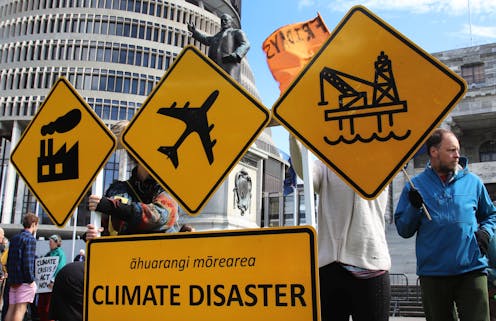
New Zealand’s Climate Change Commission is facing its first legal hurdle, as a group of 300 climate-concerned lawyers seek judicial review of the processes it used to calculate carbon budgets in its recently released advice to government.
Carbon budgets are a cornerstone of New Zealand’s climate change response under the Zero Carbon Act and lie at the heart of the commission’s advice package. They specify the allowed emissions over successive five-year periods, initially up to 2035. The advice calls for net emissions of all greenhouse gases to fall 27% between 2019 and 2030.
The Lawyers 4 Climate Action group claims the commission has misinterpreted pathways in Intergovernmental Panel on Climate Change (IPCC) reports in its calculations, making its advice inconsistent with the act, especially regarding the goal to limit global temperature rise to 1.5℃.
Pending the outcome of the legal challenge, the government is likely to adopt the recommended budgets, which would then flow into the settings of the Emissions Trading Scheme and all other aspects of climate policy.
The commission has engaged extensively with the more than 15,000 submissions it received on its draft advice. So it was surprising that in its final advice, the budgets were increased, allowing higher emissions.
The commission’s immediate reason for the increase was the significant blow-out of emissions in 2019, up by three million tonnes of CO₂-equivalent emissions. It judged this was not a one-off, and has allowed another two million tonnes in each year to 2030.
The commission also had to balance a long list of requirements, including that the budgets be ambitious, achievable and fair to both present and future generations, while supporting the global effort to limit warming to 1.5℃. The commissioners write:
A transition that is fair, inclusive and equitable for people is crucial so that it is acceptable to New Zealanders. Putting the values of manaakitanga, tikanga, whanaungatanga and kotahitanga at the forefront means having a deep ethic of care for people and the land. Having support and buy-in from New Zealanders is vital for meeting and sustaining emissions reduction targets.
But consider Ireland. Like New Zealand, Ireland has high agricultural emissions and a poor climate track record to date. Yet Ireland recently adopted a new climate law that requires net zero emissions of all greenhouse gases by 2050 and cuts of at least 51% between 2018 and 2030. This is unquestionably much stronger than New Zealand’s act.
Many goals, but no easy options
New Zealand is indeed in a tight spot. Decades of delay and spurious manoeuvring have seen emissions rise steadily, with few transition plans in place.
The main emitting sectors are often also key export industries, which should not face unfair competition, while consumption sectors (like private cars) lie broadly across the whole society.
Some key approaches from the past — international carbon trading, and extensive forest planting — have fallen out of favour. Following a collapse in credibility, international carbon trading will need new rules to allow it to restart, while afforestation, though still playing a part, pushes the transition out to future generations.
Read more: How children are taking European states to court over the climate crisis – and changing the law
The scope of the transition is challenging, and the commission argues its budgets are the best combination of ambitious and achievable.
A path towards lower emissions
A major part of the report describes in detail how the budgets could be met. For example, a relatively easy first step is to phase out coal burning for electricity generation.
Coal and gas use in the food industry, mostly for the production of milk powder, has to rapidly decrease. So far, one plant, at Te Awamutu, has been converted from gas to biomass, saving 83,000 tonnes of CO₂-equivalent emissions per year. But by 2030, the industry needs to cut more than 20 times as much.
Fossil fuel use in buildings, like coal boilers in schools, gets a lot of attention, but only adds up to a small part of the cuts needed. All other industries (including steel, aluminium, methanol, cement, mining, hydrogen, and ammonia) need to cut fossil fuel use substantially, preferably without all having to close.
The table below shows the proposed emissions reductions for different sectors, under the commission’s demonstration path.
The transport sector has finally seen government action, with the introduction of an extensive system of fuel efficiency standards and fees and discounts for newly imported vehicles. The commission argued for all of these and more, with a substantial shift away from private cars to active and public transport on a scale beyond New Zealand’s experience.
This transformation is sure to be contentious, from local battles over car parking and cycleways to the entire operation of the public transport system.
New Zealand’s Paris commitments
Another significant piece of advice the commission was asked to give was whether New Zealand’s Nationally Determined Contribution (NDC) is adequate. Climate change minister James Shaw had punted this question to the commission, which has passed it right back like in a game of hot potato.
There are two difficulties. First, the commission has already identified the biggest domestic emission cuts; anything further must come from overseas. That will be expensive, and there are no rules yet on how these “internationally transferred mitigation outcomes” will be conducted. This will be on the agenda at the 26th UN Climate Change Conference of the Parties (COP26) in Glasgow later this year.
Second, the entire basis for the NDC stems from the requirements to balance equity, responsibility and need. For New Zealand, that points towards much higher ambition than at present.
The commission did advise the NDC should involve an international mitigation effort of “much more than” 10% of current gross emissions, at a cost of many billions of dollars per decade. But it argued this required political, social and ethical considerations only the government could determine.
All of these matters will now fall under the scrutiny of the High Court.
Authors: Robert McLachlan, Professor in Applied Mathematics, Massey University


















