
The Olympic movement claims political neutrality. In reality, that ideal is often selectively applied
- Written by: Daryl Adair, Associate Professor of Sport Management, University of Technology Sydney
More than 200 nations are represented at the Tokyo 2021 Olympics. As ever, the International Olympic Committee (IOC) asserts the games are a means of unifying humanity through elite sport. At the same time, though, IOC president Thomas Bach concedes:
The Olympic Games cannot prevent wars and conflicts.
Instead, he says, the games are unifying by way of symbolism:
[…] they can set an example for a world where everyone respects the same rules and one another.
The inference here is that the Olympics, with a rule-based platform for nations and athletes to come together respectfully and cohesively, provide an opportunity for dialogue and friendship that resonates beyond sport.
The confluence of nations at the Olympics also underscores the IOC’s much-vaunted position that the games must be politically neutral. Indeed, as a practical demonstration of that aspiration, both the IOC and the United Nations promulgate the goal of an Olympic Truce for a period of seven days before the Olympics until seven days after the Paralympics.
Thus, there is an expectation that UN member states will “cease hostilities”, ostensibly to protect athletes competing at the Tokyo games.
However, that anti-political idealism is confounded by a sobering reality: nations and athletes come together to compete at the Olympics, but they can hardly leave behind a range of tensions and conflicts in global geopolitics.
Indeed, beneath the hubris of Olympic evangelism, the realpolitik of corruption, conflict, domination or genocide permeate numerous countries that are an integral part of the so-called “Olympic family”. Among them, Myanmar and Iran provide compelling examples.
Myanmar
The Facebook site of the Myanmar Olympic Committee highlights an invitation to athletes at Tokyo to sign the Olympic Truce Mural. However, this hardly seems a straightforward matter for the three qualified athletes from Myanmar.
Back home, the country’s military dictatorship has shown genocidal intent against the (largely) Muslim Rohingya community, while Myanmar’s armed forces, reacting against pro-democracy activists, have reportedly “killed more than 900 people since the coup and detained thousands”.
The IOC, meanwhile, will welcome to Tokyo 2021 Myanmar’s deputy minister for health and sports, U Myo Hlaing, thereby providing sanction to the country’s repressive regime.
Read more: Explainer: why the UN has found Myanmar’s military committed genocide against the Rohingya
For Win Htet Oo, an expatriate swimmer living in Melbourne with his family from Myanmar, the hypocrisy of representing a country that is wantonly killing its own people proved too much to bear. Win Htet initially wrote to the IOC with a request that he be allowed to swim as a “neutral athlete”, independent of any country.
But this was denied, presumably because he was not a refugee. The “politically neutral” IOC was not about to allow a citizen-athlete to claim neutrality from their country. Unable to disassociate himself from a murderous regime, Win Htet withdrew from selection for the Tokyo games, declaring: “I shall not march in the parade of nations under a flag steeped in my people’s blood.”
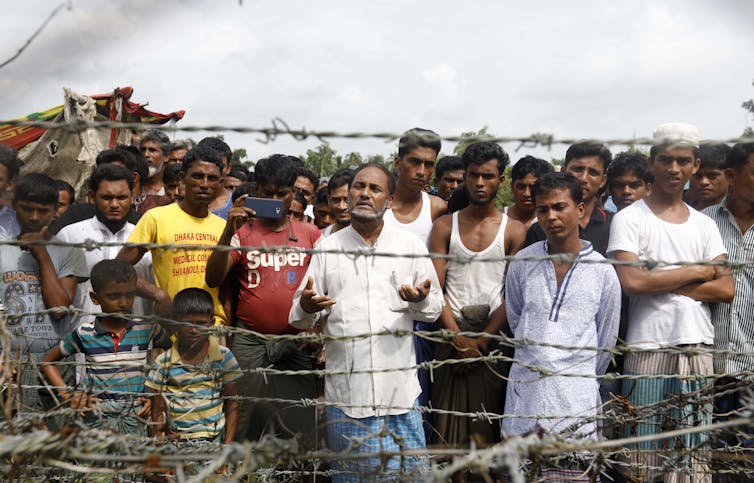 Rohingya refugees at the border of Myanmar and Bangladesh in 2020.
Nyein Chan Naing/EPA/AAP
Rohingya refugees at the border of Myanmar and Bangladesh in 2020.
Nyein Chan Naing/EPA/AAP
By contrast, Thet Htar Thuzar, a badminton player, is committed to representing Myanmar at the Tokyo Olympics. In a social media post, she wrote that her “long-cherished dream has come true”. Thet Htar was not merely self-absorbed: she hoped to “make her compatriots smile even for just a moment amid the hardships they are facing”.
However, many respondents on social media were unimpressed, seeing “participation in the games by local athletes as a gesture of subservience to the Myanmar military”.
Unlike Win Htet, though, Thet Htar and her family live in Myanmar under a dictatorship. With the military regime talking up her role in the Olympics, she may have been in no position to talk it down.
Iran
Wrestling is a sport in which Iranians have performed extremely well. The country’s official news agency reports that six wrestlers will represent the republic at Tokyo 2021.
However, champion Greco-Roman wrestler Navid Afkari cannot be among them. In September 2020, he was executed by the Iranian government. The execution was widely seen by critics as retribution for Navid’s high-profile participation in mass protests against an oppressively authoritarian regime.
The IOC was deeply disappointed that its diplomatic representations to the Iranian government, seeking clemency for Navid, were ignored. Capital punishment is, of course, part of state power in many countries that take part in the Olympics. But critics contended that Navid’s trial was a sham. For them, this punishment amounted to a political execution.
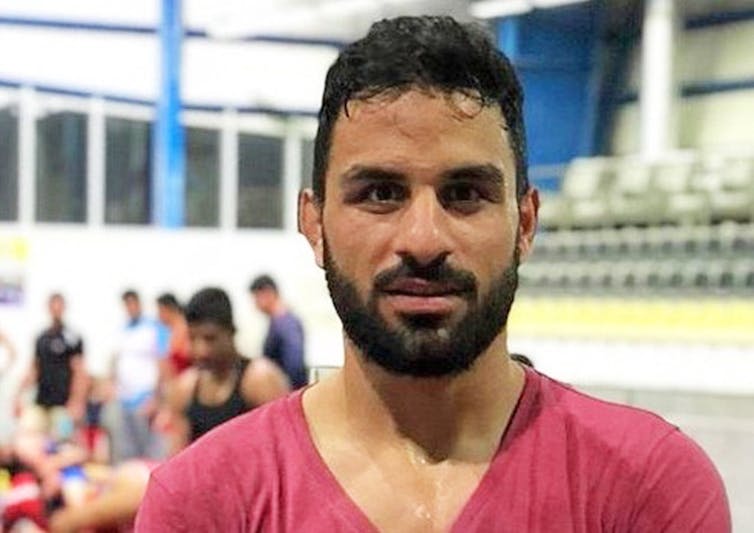 Champion Iranian wrestler Navid Afkari had hoped to compete in Tokyo. However, he was executed in September 2020.
AAP/EPA/NWRI handout
Champion Iranian wrestler Navid Afkari had hoped to compete in Tokyo. However, he was executed in September 2020.
AAP/EPA/NWRI handout
Navid had aspired to be at the Tokyo Olympics. Exiled Iranian activists argued that, in the wake of this athlete’s execution, the IOC should ban their country from the 2021 games.
Yet this did not happen. Discussing the case, the IOC vice president, John Coates, personified the IOC’s naïveté when he noted:
The difficulty for us is this execution didn’t relate to a sporting event.
However, he pointed out that when Iranian athletes refused to compete against Israeli athletes, a suspension ensued. In terms of Navid, though, Coates sat firmly on the IOC’s neutrality fence:
We’ve been getting two sides to the story as to whether he got a fair go or didn’t get a fair go.
Gaming the Olympics
Although the Olympic Truce is a public relations metaphor rather than a declaration with practical salience, the games environment may inadvertently provide safe haven opportunities for athletes from countries with repressive political regimes.
The best-known example of this was the 1956 Melbourne Olympics, which featured the defection of some 55 Hungarian athletes to the West in the wake of the Soviet invasion of Hungary. However, political asylum at the Olympics is relatively uncommon and, in the context of the Tokyo games, unlikely. The Japanese government has no appetite for political refugees, with long-term detention the norm.
The IOC, meanwhile, has conceived its own safe haven for a small number of Olympic athletes who have fled conflict and assumed the status of refugees. The IOC Refugee Olympic Team, which began at the Rio Olympics of 2016, has now been selected for Tokyo. It features 29 athletes, of whom four are originally from Iran. The best known of the Iranians is taekwondo star Kimia Alizadeh, who absconded during athletic competition in Europe.
Notwithstanding the IOC’s commitment to “political neutrality”, Kimia’s claims of oppression by the Iran regime are manifest in their profile of her as a “refugee Olympian. So, in a decidedly political pivot, the IOC welcomes Iran to the Tokyo Olympics, along with four Iranian athletes who fled to seek political asylum.
Notwithstanding the Olympic ideals of friendly dialogue during the games, the schism between political refugees and their original countries is hardly going to evaporate.
More generally, the IOC’s selectively applied position of political neutrality is certain to provide ongoing consternation given that the world’s most repressive regimes are welcomed into the Olympic family. Arguably, the IOC’s apolitical position actually emboldens dictatorships and human rights abuses. It offers no consequences except in the case of athletes prevented from playing sport.
Authors: Daryl Adair, Associate Professor of Sport Management, University of Technology Sydney


















