

What Olympic gymnasts can teach us about improving our balance
- Written by: Anthony Blazevich, Professor of Biomechanics, Edith Cowan University
The acrobatic handsprings, somersaults and twists performed by world-class gymnasts at the Tokyo Olympics are among the most complex skills humans can perform.
But at their heart is an instinctive process that can help teach us mere mortals how to stay safe from falls as we move much less spectacularly around our own environment.
To complete acrobatic manoeuvres, gymnasts need energy. In most cases, this energy comes from the jump performed at the start of the element, often after a run-up to gain momentum.
But the power in the jump has less to do with the power output of the gymnast’s muscles, and more to do with the power generated by the springy floor, or by the springboard in the case of a vault, as well as the elasticity of the gymnast’s own tendons.
To optimise the power of the spring from the floor or springboard, the gymnasts have to perfectly set the stiffness of their own spring — the spring of their legs — to get the most power. You can see this process in slow motion in this video.
When walking or running on a hard surface such as concrete, our joints flex and extend a lot in each jump as our muscles control the joints — compare the video below to the one linked above. But on a springy trampoline we don’t flex our joints much, instead keeping our legs straighter and using less muscle work. That’s why we can jump for much longer without tiring on a trampoline.
When jumping on a hard surface, we flex the joints considerably so our ‘leg spring’ is less stiff than on a sprung surface.To perfectly “tune” their leg spring to make the most of the springy surface, gymnasts pre-activate their muscles before hitting the floor to begin their jump, using dozens of muscles to adopt a very specific joint configuration that delivers the perfect leg stiffness.
Then, when hitting the ground immediately before takeoff, a variety of reflexes can be triggered that can influence muscle force and alter leg spring stiffness. The gymnast has to compensate for these in advance because the contact time with the ground is too short to make any reactive adjustments during takeoff.
Getting this right takes countless hours of practice, over many years.
What happens when the gymnast then moves to the beam, which is much less springy? They have to adapt their muscle activation to generate a different amount of leg stiffness. They have to be able to tailor their jumping technique with exquisite accuracy to cope with different surfaces.
It sounds technical, but we all do it to a certain extent. We walk, run and jump on surfaces with vastly different stiffnesses, from concrete to carpet, to grass or sand. Failing to adjust our own leg spring stiffness can increase the energy cost of moving, leading to fatigue, and potentially increase our risk of falling. This can be life-threatening – falls leading to hip fractures in older people massively increase the risk of death in following months and years.
Both in early childhood, when we’re first learning to move, and in older age, when walking costs more energy and the risk of falling is greater, it’s hugely valuable to practise walking across a range of different surfaces. You can do it by taking walks along forest tracks (especially if rocks and concrete paths intermingle with dirt or grass) or sandy beaches (walking in shallow moving water is also a nice way to stay cool in summer while honing your balance). Your local park might also have equipment designed to practise balancing.
 Hiking on rough terrain is a great way to keep your legs working at their best.
Toomas Tartes/Unsplash, CC BY-SA
Hiking on rough terrain is a great way to keep your legs working at their best.
Toomas Tartes/Unsplash, CC BY-SA
Gymnasts need to know how to complete a variety of somersaults and twists. For this they need lots of rotational energy, most of which comes from the initial run-up and jump. Once airborne, you can’t grab more energy!
So gymnasts have to launch off the floor, springboard or beam with the perfect amount of rotation to execute their acrobatic manoeuvre. This requires tremendous precision — “sticking” the landing requires completing the planned number of rotations in perfect time for their feet to hit the floor and avoid toppling over.
Read more: How do Olympic athletes stack up against invertebrates? Not very well
Amazingly, elite gymnasts can also transition in mid-air between different types of tumbling, perhaps moving from a straight somersault to an angled twist. But how do they do this, if they can’t take on more energy halfway?
They do it by rotating their arms to change their direction of rotation. This can be seen clearly in this slow-motion video.
We all do the same thing, especially if we’re trying not to fall over. Newton’s third law says every action has an equal and opposite reaction. So by rotating our arms in the opposite direction to the way we’re falling, we can attempt to push our body back upright. Notice how a gymnast on a beam uses their arms to make sure they don’t fall off.
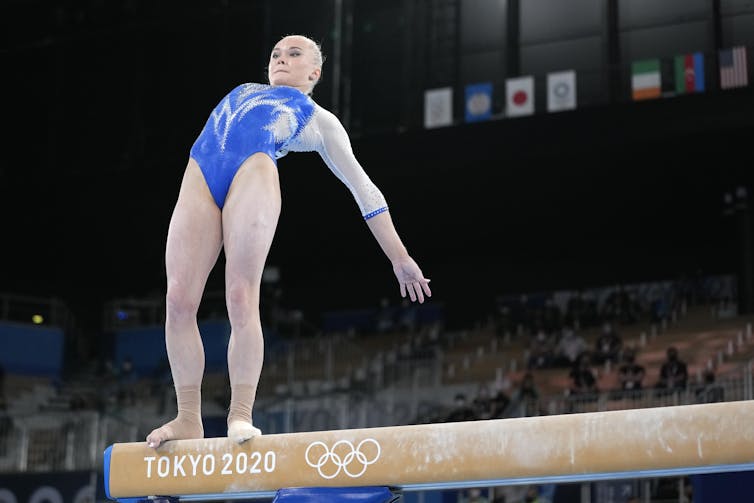 Russian gymnast Angelina Melnikova, demonstrating the importance of arms.
Ashley Landis/AP
Russian gymnast Angelina Melnikova, demonstrating the importance of arms.
Ashley Landis/AP
This is another tip we can all learn from elite gymnasts. Using your arms is an important part of maintaining balance, particularly during exercise.
Read more: Explainer: how do our bodies balance themselves?
You can practise balancing every day by standing on one leg to do daily tasks, walking along lines in the concrete or on balance beams in the play area at your local park, or even by standing up to put on pants and socks rather than sitting on the bed or a chair.
Children and adults alike can also play sports or exercise in the playground — we’re never too old to play, and play is the best way to learn any physical skill.
Authors: Anthony Blazevich, Professor of Biomechanics, Edith Cowan University
Read more https://theconversation.com/what-olympic-gymnasts-can-teach-us-about-improving-our-balance-165171


















