

Vaccine selfies may seem trivial, but they show people doing their civic duty — and probably encourage others too
- Written by: Louise Grimmer, Senior Lecturer in Marketing, University of Tasmania
Have you been vaccinated yet? And if you have, are you one of a growing number of people who posted a selfie on social media afterwards? At a time when many people distrust government advertising, vaccine selfies — or “vaxxies” — may well be the secret weapon to encourage more people to get the jab.
Suddenly our Facebook, Twitter and Instagram feeds are filling up with selfies of family, friends and even strangers getting their COVID shot.
But vaxxies are more than mere selfies, as they have a unique social function. They are likely helping normalise the vaccine procedure, reducing hesitancy around perceived risks and increasing vaccine trust within social circles.
As governments and health officials continue to flip-flop on vaccine age requirements, and anti-vaxxers spread falsehoods through social media and protests, the vaxxie might just be a powerful line of defence against vaccine hesitancy.
As of July 21, more than 10.6 million COVID vaccine doses had been administered in Australia. As time passes, more and more people are showing their support by posting about their vaccination experience online.
Normally, we see this type of behaviour demonstrating “civic duty” during elections or with social movements such as Pride or Black Lives Matter. We’re now seeing similar posts involving vaccination, using a variety of hashtags including #vaxxie, #GetVaccinated, #GetVaccinatedNow, #Vaccination and #jab.
In friends we trust
The vaxxie could be a useful tool in encouraging people to get vaccinated. Over the past decade in particular, there has been an erosion of trust in traditional advertising and a huge surge in social media use.
This means word-of-mouth recommendations and reviews from people we know (and even people we don’t) are often considered more “authentic” than standard advertising and government messaging.
Read more: Australia's new vaccination campaign is another wasted opportunity
Research indicates we look to our friends, family and social groups for guidance during uncertain times. They provide us with subjective norms: the desire to behave as those who are significant to us think we should.
This results in social pressure to engage in certain behaviours. If our family and friends are posting vaxxies, it’s an implicit nudge for us to get vaccinated too. And as reported vaccine shortages continue and demand grows, seeing vaxxies can also increase our fear of missing out (FOMO).
In-groups and out-groups
In the same way one shows support for social movements on social media, sharing a vaxxie communicates your position on vaccinations — you are either pro-vax or anti-vax. Essentially, you are either with us or against us: a hallmark of classic in-group/out-group behaviour.
The psychology of the in-group/out-group is best illustrated using social identity theory. This theory states internal cohesion and loyalty to the in-group exists when the group members maintain a state of almost hostility or assertive opposition toward out-groups — which are often perceived as inferior.
This theory explains spectator behaviour at sporting events. As we see more of our friends sharing their vaxxies, we may desire to be a member of the “in-group”. But to be in this group, we need to get a jab (and show evidence with our own vaxxie).
The in-group pressure may be further increased when we see our political leaders or favourite celebrities get involved. US President Joe Biden, Dolly Parton and Sir Ian McKellen are just some of the icons whose vaccinations made headlines.
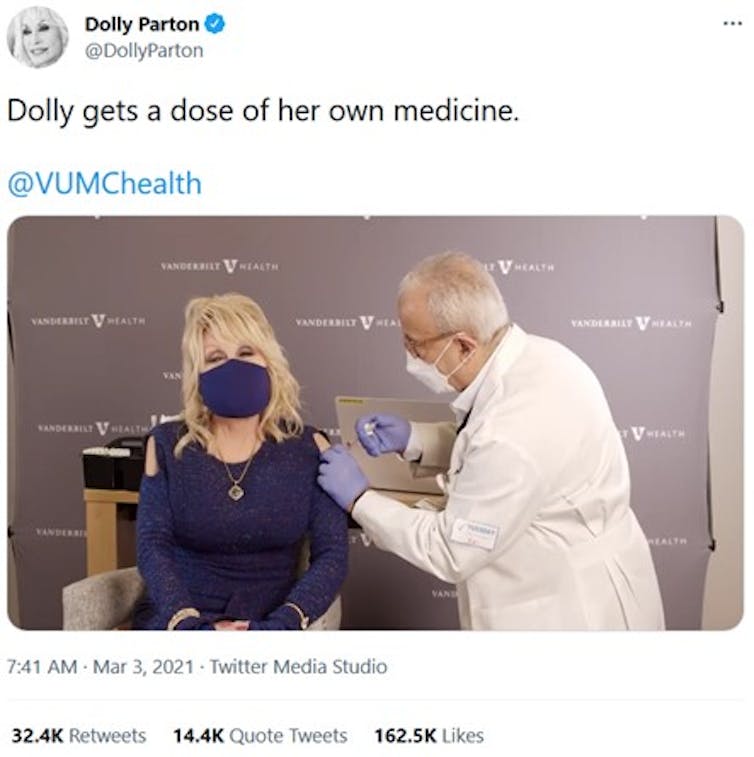 Dolly Parton posted her own vaxxie.
Risks of virtue signalling
One of the main risks in posting a vaxxie is it could alienate others through virtue signalling, which is when a person behaves in a way that highlights their own “good” moral values. People on Facebook will often loudly proclaim their support for a certain cause because they want to seem caring or “woke”.
But most of us aren’t impressed by those who overtly express their own moral correctness. There’s a fine line between encouraging others to engage in a certain behaviour and coming across as self-righteous.
There may also be an element of mob mentality at play with vaxxies. Due to excessive pressure from peers, some may find themselves getting vaccinated for emotional (versus rational) reasons. While the pressure to get vaccinated is arguably positive, some individuals may have legitimate concerns which they will suppress in order to conform.
That said, this is not the same as crowd behaviour which is often shrouded in anonymity and involves blindly following others. Vaxxies are personal, identifiable messages and are not anti-social.
Another risk with vaxxies is they may encourage “brand” competition. Vaxxie posters regularly include the hashtag of their vaccine: #pfizer or #astrazeneca.
Given the mixed messaging around AstraZeneca, could a proliferation of Pfizer vaxxies discourage people from seeking out AstraZeneca, at a time when we’re encouraged to take whichever option we can?
Despite the risks, however, it’s clear we will need a variety of tools to encourage people to get vaccinated during this crucial phase of the pandemic. Vaxxies likely have an important role to play on this front.
And as long as they don’t seek to overtly shame or alienate others, they could help engender a strong sense of solidarity as more and more people get the jab.
Read more: 'Virtue signalling', a slur meant to imply moral grandstanding that might not be all bad
Authors: Louise Grimmer, Senior Lecturer in Marketing, University of Tasmania


















