

Food sharing with a 21st-century twist – and Melbourne's a world leader
- Written by: Ferne Edwards, Honorary Associate, RMIT University
Food sharing is experiencing a renaissance in cities around the world. By food sharing, we mean the collaborative growing, cooking, eating and distributing of food as well as sharing food-related skills, spaces and tools.
This is nothing new, of course, but new socio-technologies are being used to reshape food-sharing opportunities. These range from apps for sharing home-cooked meals to online maps showing surplus harvests in the city.
SHARECITY100, a database covering 100 cities, ranks Melbourne as the third most active food-sharing city, after London and New York. Melbourne is home to more than 100 diverse food-sharing initiatives mediated by information and communication technology.
Our research into food sharing in Melbourne found these initiatives are highly productive. The benefits include revaluing food from waste, supporting social inclusion, and reclaiming underused spaces in the city.
Participation in food sharing produces new knowledge, relationships, identities and understandings as people work together. They dig holes, cart dirt, chop vegetables, smell produce for ripeness, swap recipes, eat together, and do the washing up! Such embodied, emotional and visceral practices linger within us, be it the ache in the muscles, the memory of a shared experience, or the afterglow of a healthy meal.
Understanding food sharing as an ecosystem
As a global study of food sharing, SHARECITY has shown that these initiatives are not isolated experiments. They intersect with other sharing, food and social movements to form “food-sharing ecosystems”.
The SHARECITY100 database provides a rich picture of the many individual food-sharing initiatives. Yet it doesn’t tell us how these fit into the wider urban system. This knowledge gap prompted our research tracing the interactions of four different food-sharing initiatives:
- 3000 Acres links community groups to accessible land for community gardens
- Open Table rescues food from waste to serve feasts uniting local communities
- Food Justice Truck redistributed affordable produce to people seeking asylum
- RipeNear.Me provides an online map to connect people interested in gifting, buying or swapping local food.
Take 3000 Acres as an example of the web of relationships. It draws inspiration from international initiatives 596 Acres and Farming Concrete. Closer to home, 3000 Acres works with public services such as VicTrack and Melbourne Water, developers, councils and community groups to identify spaces for growing food. It also works with the Victorian Eco-Innovation Lab (VEIL) to evaluate the impacts.
What about those vacant lots? Kate Dundas of 3000 Acres explains how unused land is transformed into community gardens.Food-sharing initiatives are diverse, but remain rooted in local communities. They are typically held together by a small core team. This can make them vulnerable to fluctuations in what resources are available.
While independent, these initiatives often share funding sources, volunteers, supplies or spaces. This, in turn, can lead to bottlenecks of both competition and opportunity.
For example, Open Table is one of many community groups that share the kitchen at Fitzroy Community Food Centre. Cultivating Community, the Lord Mayor’s Charitable Foundation and the Fitzroy Office of Housing support this kitchen. Its location, in addition to the services it provides, unites participants from two public housing complexes, three community gardens (one run by 3000 Acres) and a public space.
Our study found that, in addition to being productive, food sharing is generative – it’s a basis for more unexpected sharing to occur. For example, RipeNear.Me hosts would often gift more than their initial online offerings when connecting with people face to face.
Engaging with RipeNear.Me’s digital interface motivated some participants to get involved in offline activities such as food swaps. One participant was inspired to develop their own community food project.
Policy and the law need to catch up
Our research explored the scope, diversity and overlapping territories of food-sharing initiatives. We also identified disconnections between these emerging practices and current policy.
For example, new forms of food-sharing are arising along with emerging technologies, socio-economic pressures and growing workforce precarity. However, councils at times impede their development by placing unreasonable requirements on small-scale and distributed business models.
Similarly, planning legislation has been slow to recognise the value of underused, in-between spaces and land-in-waiting. If rezoned, this could increase opportunities for shared gardens.
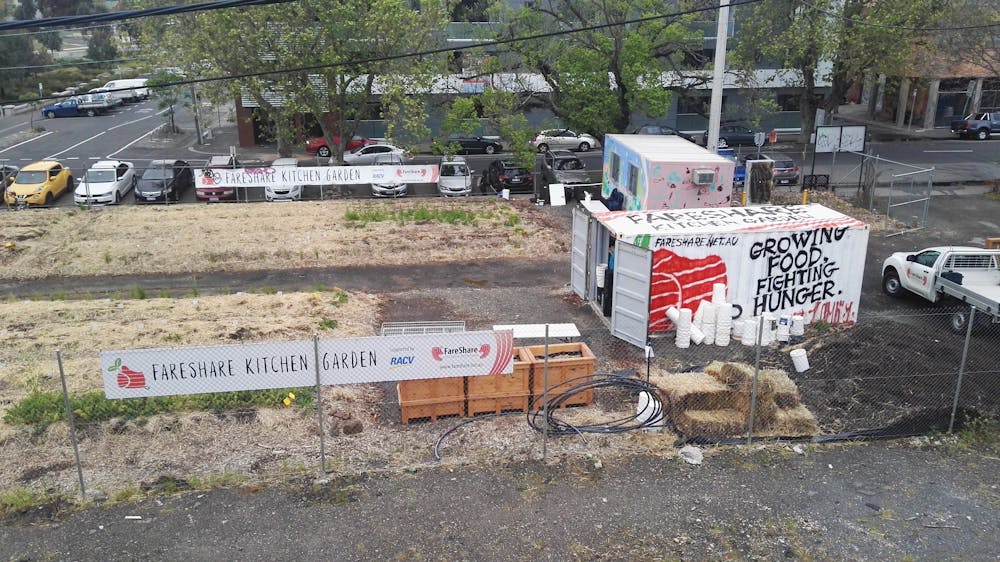 FareShare transforms vacant sites into community kitchen gardens like this one created in Abbotsford, Melbourne, with 3000 Acres’ help.
Ferne Edwards, Author provided
FareShare transforms vacant sites into community kitchen gardens like this one created in Abbotsford, Melbourne, with 3000 Acres’ help.
Ferne Edwards, Author provided
Part of a bigger picture
Melbourne’s food-sharing ecosystem shows that these activities do not happen in a vacuum. The Sustainable Development 2030 Agenda includes as its goals zero hunger, good health and well-being, sustainable cities and communities, and responsible consumption and production. This places cities and food at the centre of governance concerns.
Food-sharing initiatives are part of the food landscape and need to be included in any reformulation of policy and planning in cities. When conceptualised as an ecosystem, the impacts and possibilities of food sharing become more visible. We can build connections both horizontally with other initiatives to form integrated and more robust support networks and vertically to influence different levels of government to develop appropriate legislation.
Food sharing can contribute to a broader food movement towards making Melbourne and cities around the world more resilient, fair and healthy.
Authors: Ferne Edwards, Honorary Associate, RMIT University


















