

India's Varanasi — a sacred site on a river of rituals and altered states
- Written by: Cherine Fahd, Associate Professor, School of Design, University of Technology Sydney
In this series we pay tribute to the art we wish could visit — and hope to see once travel restrictions are lifted.
Varanasi, or Banaras as the locals call it, is one of India’s most sacred cities. Located in the province of Uttar Pradesh in northern India, it is an important place of pilgrimage for Hindus.
Buddhists and spiritual seekers from around the globe are also drawn to its waters. For yogis there is a transformative promise of gurus and ashrams. For Buddhists there is Sarnath, the town where Buddha is believed to have given his first teaching after receiving enlightenment.
There is also bhang lassi, a yogurt drink laced with cannabis for psychedelic effect.
Author Geoff Dyer hilariously rendered Varanasi in his semi-autobiographical novel — Jeff in Venice, Death in Varanasi — as the place to go to lose and find yourself.
To be lost in Varanasi is dangerously exciting.
Everyday death and renewal
In 2018 I was awarded a two-month artist residency by Asialink to Varanasi’s Kriti Gallery. I had never been to India, and what I did know of Varanasi I had learned from television trips featuring actors Miriam Margolyes and Judith Lucy as guides. I remembered Margolyes’ visit to a hostel where people from all over India could reserve a room to wait out their death.
Varanasi is where Hindus want to die to escape the cycles of birth, death and rebirth.
The Ghats of Varanasi, along the banks of Ganges River, from Sunrise until the night time ceremony.Dying in Varanasi is everyday. That’s not to say dying is ordinary. On the contrary, it is a sacred art form, a spiritual passage that is part of the daily practice of living.
Art is everywhere, especially in the rituals and ceremonies performed in celebration of the Hindu gods.
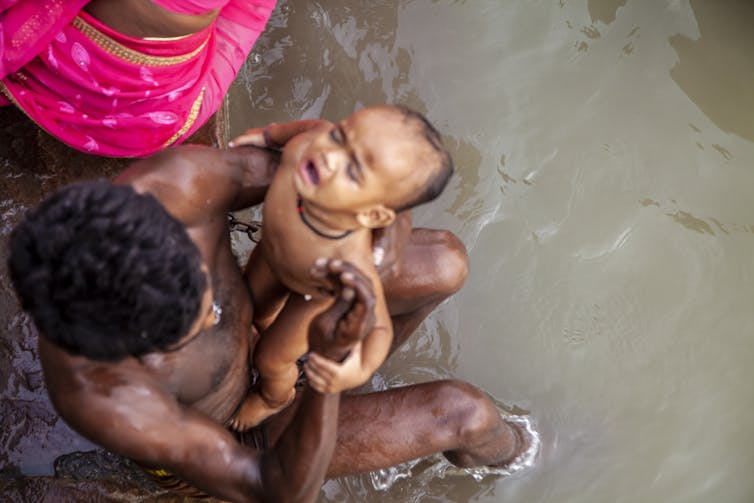 A father blesses his child in the waters of the Ganga.
Cherine Fahd
A father blesses his child in the waters of the Ganga.
Cherine Fahd
I want to return to hear the chanting performed by the hustle of pallbearers as they commemorate the dead on their way to the rising flames. I wish to follow them to Manikarnika, one of the cremation ghats (broad steps to the riverbank).
To see a body in the street — veiled and wrapped in the most beautiful coloured silks, ribbons, pigments and flowers, and carried upon a bamboo stretcher for all to see — changed my view of death.
To be close to the everydayness of death reminds me I am alive. This is why Varanasi is addictive. Its effect is to make me hyper-aware of my living status, especially when I’m pinned by the horns of a bull to the wall of an alleyway as he tries to pass me.
Read more: Friday essay: images of mourning and the power of acknowledging grief
Life without seatbelts
I long to be lost in the commotion of Varanasi street life, among the street dogs, buffaloes, cows, horses, and monkeys. A family on a motorbike, bodies piled onto and into every sort of automobile. No seatbelts, just flowing fabrics of the most beautiful patterns, colours and textures.
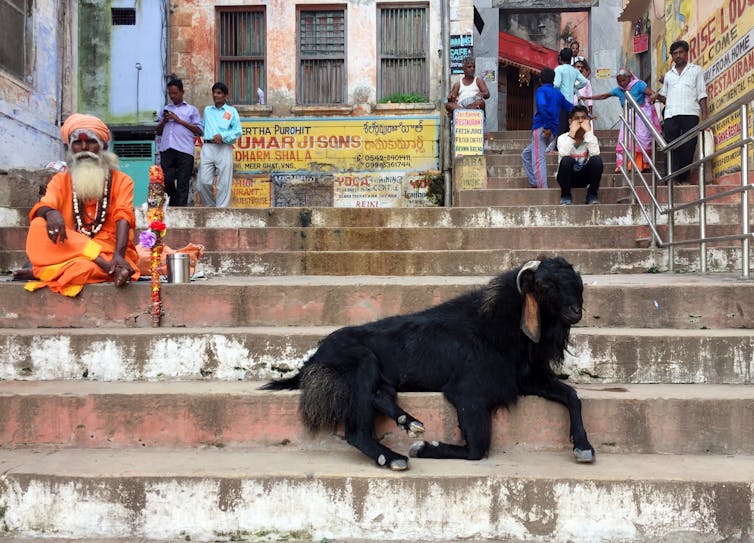 An ordinary day in Varanasi just hanging out at one of the ghats.
Cherine Fahd
An ordinary day in Varanasi just hanging out at one of the ghats.
Cherine Fahd
I want to cross the treacherous roads, to walk in front of cars, buses, trucks and tuk-tuks that are continuously beeping their horns in a cacophony of blasts and blares, knowing they won’t run me over.
Not even the smell of rotting rubbish mixed with the sweet aroma of cow dung, chai and warm milk deters this dream.
Varanasi is beautiful and filthy, vibrant and muddy, and home to stunning silks with intricate gold and silver thread work. You take the good with the bad in Varanasi: the abject poverty, friendly people, dust bowl cricket, endless paradoxes and the Harmony Bookshop.
When I return I will be customarily dressed in my all-black uniform from home. I will gaze upon the beautiful women in their brightly coloured sarees, the bits of flesh poking out teasingly at the waist. And I’ll wonder, “Why don’t I wear colour?”
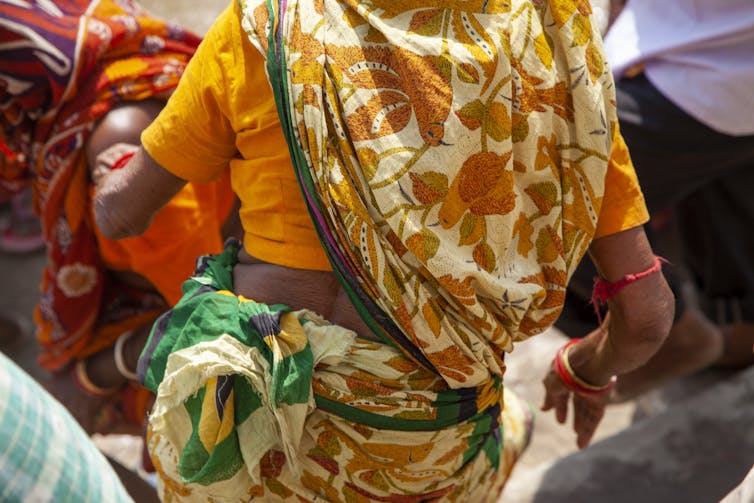 Women wear brightly coloured fabrics.
Cherine Fahd
Women wear brightly coloured fabrics.
Cherine Fahd
In India, art is wearable. Art is on the streets and in the temples. And the front door of every house.
Read more: Friday essay: the uncanny melancholy of empty photographs in the time of coronavirus
Bathing and prayer
Varanasi has 88 ghats. In two months, I only visited a quarter of them, including my favourite, Lassi Ghat.
The ghats are used chiefly for bathing rituals, for puja, and somersaulting.
It is oppressively hot, 38℃ at 8am. The locals bathe and pray and touch. Touch is everywhere. Bodies feeling, pushing, pressing, caressing, splashing each other. The texture of bodies. Hair and wrinkles.
No one is flexing, or spray-tanned or botoxed. Life is dirty and sacred and real. There is no airbrushing and no denying death. The water is magical but muddy. Highly polluted. No one seems to notice.
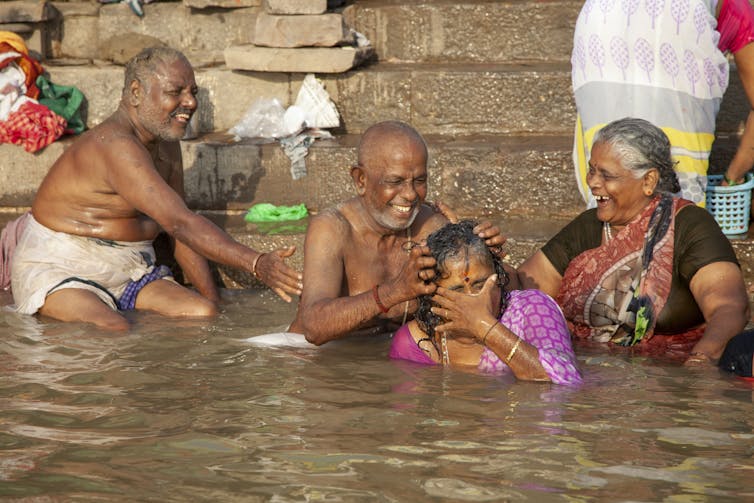 A group of bathers are playful in the morning.
Cherine Fahd
A group of bathers are playful in the morning.
Cherine Fahd
The performance of private rituals in public has long been my thing. In Paris, during the heatwave of 2003, I photographed bathers along the Seine.
Read more: Yearning for touch — a photo essay
Women with cameras
Unlike Bondi Beach, I don’t need a permit to take photographs at the Ganga. The locals and pilgrims are unperturbed by a woman with a camera.
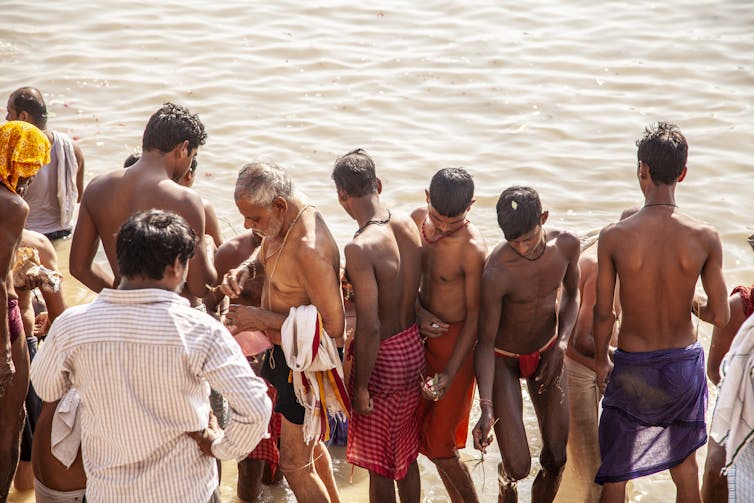 The ghats are always crowded in the mornings.
Cherine Fahd
The ghats are always crowded in the mornings.
Cherine Fahd
I learn that I am following in the footsteps of other female photographers. The late Australian photographer Robyn Beeche had been a regular visitor, as was the late great US photographer Mary Ellen Mark.
Studying their works reminds me that art is chiefly an expression of our humanity. An expression that is everywhere in Varanasi.
For now, from lockdown, I’ll travel through my photographs and as I do, I will perform a prayer for India, a country devastated by the pandemic.
Authors: Cherine Fahd, Associate Professor, School of Design, University of Technology Sydney


















