Mungo ancestral remains reburial proposal disrespects the Elders' original vision
- Written by: Michael Westaway, Australian Research Council Future Fellow, Archaeology, School of Social Science, The University of Queensland
Plans are underway to rebury the remains of more than 100 Aboriginal people, including the remains of Mungo Man and Mungo Lady, arguably the two most important people who ever lived in Australia".
The ancestral remains from Willandra occupy a crucial place in understanding the dispersal of modern humanity across the globe and the story of our species’ adaptation to climate change. Mungo Man and Mungo Lady have been dated to 42,000 years old, making them Australia’s oldest human remains. Mungo Lady is the oldest known cremation in the world.
Human remains were first identified at the dry Lake Mungo in 1968. During the 1980s, a small number of the ancestral remains were excavated. The vast majority, however, were exposed through erosion and collected by archaeologists from the Australian National University and NSW National Parks. Ancient DNA has been recovered from one individual, but the majority of the ancient people have not been researched.
The age of the remains are instrumental touchstones in the battle for Indigenous rights. This research led directly to the 1981 inscription of the area on the World Heritage List as one of Australia’s first two World Heritage properties.
Read more: Fifty years ago, at Lake Mungo, the true scale of Aboriginal Australians' epic story was revealed
Returning the remains home
Aboriginal people have consistently fought for their ancestors to be returned to Country. During the 1980s and 1990s the remains became national symbols for repatriation. There has been agreement among traditional owners, pastoralists and scientists for more than two decades that the ancestral remains should be repatriated to the Willandra.
The remains of Mungo Lady were returned to the area in 1992, and the remainder of the ancient people returned in 2017–18. A National Congress of Australia’s First Peoples said in 2018 a permanent “keeping place”, rather than reburial, should be provided with a monument to mark their importance.
The traditional owner groups have been seeking a keeping place since the 1990s, and in 2000 passed a resolution seeking support from government for its establishment.
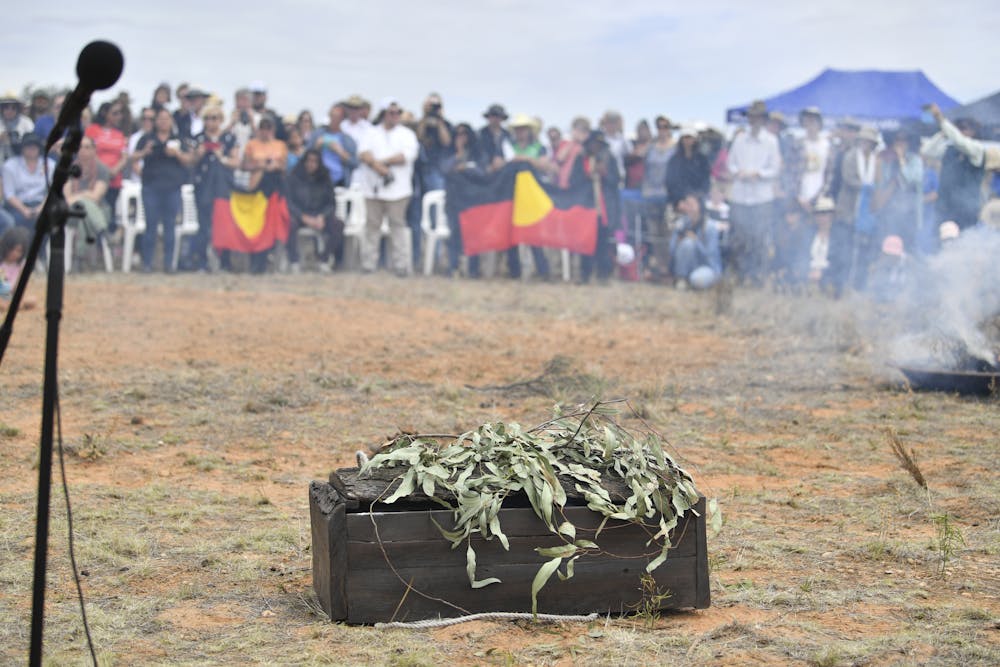 In 2017, the remains of Mungo Man were repatriated at a ceremony at Lake Mungo, New South Wales.
AAP Image/Perry Duffin
In 2017, the remains of Mungo Man were repatriated at a ceremony at Lake Mungo, New South Wales.
AAP Image/Perry Duffin
Read more: Mungo Man moves to National Museum, but he's still not home
But following a series of workshops a plan for reburial (rather than a keeping place) was approved in 2018 by a group representing Barkindji/Paakantji, Mutthi Mutthi and Ngiyampaa peoples. These workshops didn’t include experts in palaeoanthropology or biological anthropology.
The current proposal is for the remains to be taken into the World Heritage Area and buried in deep, unmarked graves. A recent NSW government review concluded this would not negatively impact World Heritage values.
We disagree with the NSW government report and believe burying the remains would negatively impact World Heritage values. Mutthi Mutthi Aboriginal Advisory Group (AAG) members Jason and Daniel Kelly responded to the NSW government review arguing the government did not adhere to UNESCO policy for engaging with Indigenous peoples and had denied traditional owner communities the rights to free, informed and prior consent.
The NSW review ignored a 1997 report by leading palaeoanthropologists Chris Stringer and Clive Gamble listing the fossil remains and their surrounding archaeological and palaeoenvironmental context as a site of outstanding value to the human evolutionary story.
The NSW government review also omitted reference to international standards such as the Vermillion Accord. It states the perspectives of both traditional owners and scientists should be given respect when considering the disposition of ancestral remains of great significance.
The NSW Department of Environment has now referred the proposed plan to rebury the remains for consideration of the federal environment minister, Sussan Ley.
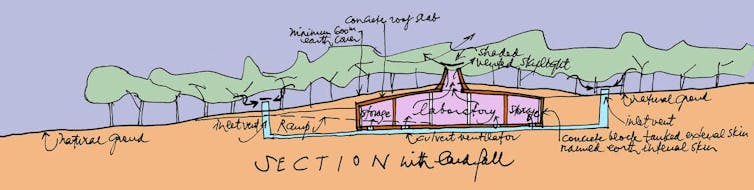 An early design for the Mungo keeping place by leading Australian environmental architect Gregory Burgess.
What would be lost?
The age of most of the key burial sites is still unknown. If these remains were reburied in secret locations, we may lose the opportunity to re-date a large number of them using new methods. Research on Garnpung Man demonstrated this possibility.
We know Mungo Man and Lady coexisted with megafauna.
Mungo Man is buried with ochre from many hundreds of kilometres away. It may prove possible to reconstruct migration of people across the landscape by looking at the geochemical (isotopic) signatures in their teeth. Importantly, we could trace how this mobility changed between 40,000 and 20,000 years with the coming of peak glacial mobility, a period that saw the Willandra transform from a wetland into a desert.
Recovering DNA or employing a new method known as proteomics could provide insights into the complexity of Aboriginal origins: early humans on their journey to ancient Australia mixed with other species of humans such as Neanderthals and the enigmatic Denisovans.
Around 16 individuals whose remains were uncovered had been heavily burnt or cremated. Studying this could challenge our understanding of the origins of complex mortuary practices.
Further research could also help us understand how our species adapted to past climate change.
A learning place
Many Barkandji and Mutthi Mutthi Elders and community members have expressed their wish to share the stories of these ancient people with all humanity.
Earlier this year, a letter with Barkandji Native Title holders in Nature called for a delay of the reburial process, highlighting an absence of adequate consultation.
 Students on the Arumpo lunette during an early Lake Mungo Youth Festival. The Mungo Youth Conference brings together Elders, researchers and pastoralists to discuss the values of the Willandra World Heritage Area.
Read more: Mungo Man returns home: there is still much he can teach us about ancient Australia
The issue is complex, but common ground exists.
Every party involved has supported the repatriation of the ancestral remains to Country and all refer to Willandra as a learning place.
A recent online forum, facilitated by Mutthi Mutthi members of the government’s AAG, discussed how a keeping place could enable future learning.
Supporting the development of a keeping place and cultural centre for the traditional owners of the Willandra, rather than reburial in unmarked graves will be an action in keeping with the principles of World Heritage.
Some Mutthi Muthi AAG representatives believe the current proposal dismisses the voice of elders of the three tribal groups past and present, who have fought for a keeping place. They say it inflicts soul sickness and cultural harm to traditional owners who have been excluded from consultations.
Authors: Michael Westaway, Australian Research Council Future Fellow, Archaeology, School of Social Science, The University of Queensland