

What's behind the spate of super-fast sprints at the Tokyo Olympics? Technology plays a role, but the real answer is training
- Written by: Phil Bellinger, Lecturer in exercise science, Griffith University
The Tokyo Olympic Games have seen incredible performances in the short-distance track events. We have seen two major world records fall: the men’s and women’s 400-metre hurdles - and numerous personal best times.
In the women’s 400-metre hurdles, five of the eight competitors in the final ran personal bests. Jamaica’s Elaine Thompson-Herah set an Olympic record to win the women’s 100-metre event. A European record was set in the men’s 100-metre event, and all medallists in the race were slightly faster than the respective medal-winning times at the 2016 Rio Olympics.
What’s behind these super-fast times? Some have suggested the composition of the track, new “super spike” running shoes, or hot weather are responsible. While these almost certainly contributed to the results, another reason is likely to be more uninterrupted training through reduced international travel and competition in the months leading into the Tokyo Olympic Games.
This better preparation in turn is due to two things: first, the COVID-19 pandemic has meant less competition and more time for training; and second, steady improvements in sports science and applied research are maximising the extremes of human performance. `
Bouncy tracks, super spikes and heat
The track surface at the Tokyo Olympic stadium, installed by an Italian company called Mondo, is designed to allow runners to better grip the surface while also providing better shock absorption. The surface contains hexagonal air chambers that can compress and bounce back with each step.
Many athletes are also wearing relatively new spikes containing a stiff and lightweight plate made from carbon fibre. The Nike version of these so-called “super spikes” also features a foam layer under the carbon fibre to provide additional spring.
Read more: Super shoes: Explaining athletics’ new technological arms race
These Nike shoes in particular have been criticised as providing an unreasonable advantage, including by 400m hurdles champion Karsten Warholm. Warholm wore Puma carbon-fibre spikes without the additional foam in his world record-setting win, while silver medallist Rai Benjamin wore Nike’s version.
The weather in Tokyo, with temperatures in the 30s and humidity sometimes over 80%, may have also contributed to the fast times in sprint events. Hot conditions means warmer muscles, which can produce force more quickly, making for faster sprinting.
Heat and humidity also put greater strain on athletes over longer distances, which is the main reason we have seen fewer records fall in the track endurance events.
Uninterrupted training and competition
However, suggesting these personal best performances and record times in sprint events can be fully attributed to environmental conditions, new shoe technology and the track surface is a little disrespectful to the athletes. Both Warholm and Sydney McLaughlin, who respectively set the new men’s and women’s records for 400m hurdles, broke previous records they had recently set themselves.
On Tuesday Warholm smashed the record he had claimed in July, and on Wednesday McLaughlin beat the time she set in June. Both athletes were in career-best form heading into Tokyo.
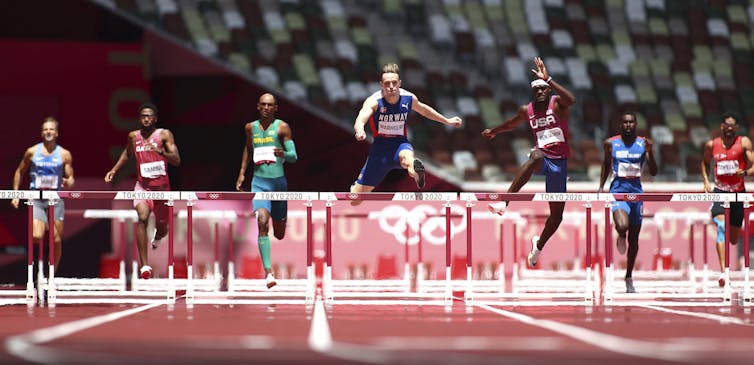 Norway’s Karsten Warholm (centre) set a new world record in the 400m hurdles.
Hiroto Sekiguchi / AP
Norway’s Karsten Warholm (centre) set a new world record in the 400m hurdles.
Hiroto Sekiguchi / AP
All the athletes were aiming to achieve peak performance at Tokyo by precisely timing their training and recovery cycles. This gives them the best chance of maximal performance: personal best times, and for some Olympic or world records.
In addition to manipulating their training programs to peak at Tokyo, at the Olympics the best are racing against the best. This high level of competition raises the standard of each round compared with other international races, and this too contributes to the number of world-class performances in Tokyo.
For example, McLaughlin and her US teammate Dalilah Muhammad have both previously set the 400m hurdles world record when competing against each other. There is no doubt competition with other world-class athletes creates a favourable scenario for achieving more fast times.
COVID and research
Perhaps surprisingly, COVID-19 may have also played a role in these intense track performances. The pandemic has meant a reduced racing schedule over the past 18 months, with far less international travel and few races.
This may have allowed for more consistent training with fewer interruptions and peaks and declines organised around races. It is conceivable that this has contributed to some of the world-class performances we have seen.
Read more: Record-setting performances at the Tokyo Olympics come after months of pandemic-induced stress
In addition to all of these factors, sports science research and support plays an important role in improving performance. Continued applied sports science research in athletes and the ongoing effort to push human limits to performance means we are likely to see world records being broken at the next Olympic Games in Paris in 2024 and beyond.
Authors: Phil Bellinger, Lecturer in exercise science, Griffith University


















