

The global water cycle has become more intense, and that makes New Zealand's wet regions wetter, and dry ones drier
- Written by James Renwick, Professor, Physical Geography (climate science), Te Herenga Waka — Victoria University of Wellington
The Intergovernmental Panel on Climate Change (IPCC) has delivered a sobering update on how much the Earth has warmed and how the climate system is responding.
The IPCC’s Sixth Assessment Report (AR6) is the most comprehensive yet. It shows Earth is now 1.09℃ warmer than it was in the 1850s, and that each incremental increase in warming will bring more extreme weather events.
For the first time, the assessment also includes a regional breakdown of observed and projected changes.
It shows that while the Australian continent has warmed faster than the global average, at 1.4℃ since 1850, New Zealand’s climate has been changing in line with global trends over the last century.
The average temperature has gone up by 1.1℃ and sea levels have risen about 20cm. The wetter western parts of the country have become even wetter, with more heavy rainfall events, while the drier regions in the east and in Northland have become drier.
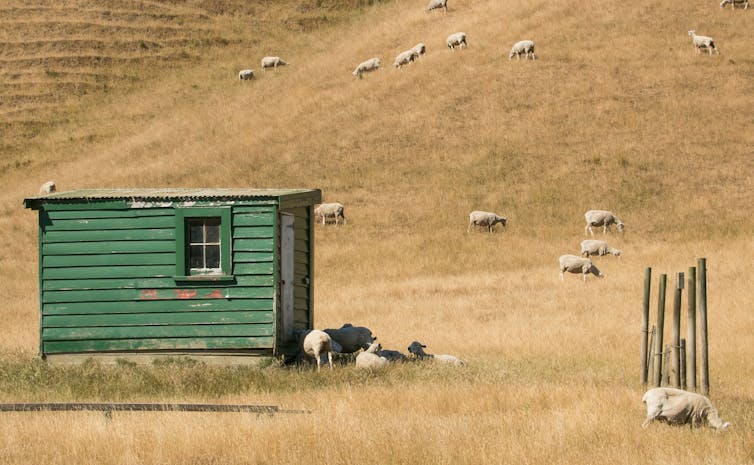 New Zealand’s east and far north regions can expect longer and more intense droughts.
Shutterstock/S Curtis
New Zealand’s east and far north regions can expect longer and more intense droughts.
Shutterstock/S Curtis
Projections for the future continue this theme, becoming wetter in the west, while the eastern regions and the far north continue to dry, especially in winter and spring.
Irreversible changes
The change in rainfall is associated with an overall increase in the strength of the westerly winds across the country, along with an increase in high pressures and settled weather over the far north as the atmospheric band known as the “subtropical high pressure region” is moving south, closer towards the pole.
The overall average warming brings an increase in hot days around the country and more frequent marine heatwaves, with warmer sea surface temperatures over the Tasman Sea and around New Zealand.
The AR6 shows that some of the changes have now become irreversible, at least on time scales of hundreds or even thousands of years.
Across the globe, glaciers will keep retreating as the climate warms. New Zealand’s glaciers will also continue to melt and recede and could disappear right up their valleys if warming reaches 2℃ or more.
The seas will also continue to rise, but how much and how quickly also depends on the amount of warming the world experiences. Even if we manage to cap warming at around 1.5°C, New Zealand will experience up to half a metre of sea level rise by the end of this century.
A changing water cycle
The latest assessment report takes a storyline approach and dedicates each chapter to a specific element of Earth’s climate system. I was an author for a chapter on the water cycle.
Water is vital for life, and changes in water availability have serious implications worldwide. Overall, we see that the water cycle is becoming more intense, that is, a warming atmosphere leads to both more precipitation over land and higher evaporation.
The magnitude and frequency of floods and droughts are increasing in many parts of the world. There is not enough published literature on such trends in New Zealand specifically, but we do know that climate change has made individual floods and droughts more intense in this country.
It is clear that all aspects of the water cycle are affected by warming, including rain and snowfall, glacier mass, groundwater storage, river flows and the oceans.
One clear signal is that variability and extremes in precipitation are increasing, above the rate of the global average. Unless we can reduce greenhouse gas emissions rapidly, we will see even more substantial changes in the water cycle worldwide, including the loss of glaciers and the river flows they feed, more intense precipitation, more extreme rainfall events and associated river floods, but also more intense droughts and an increased risk of wildfires.
As the climate warms, storm tracks are moving towards the poles in many regions, notably across the southern hemisphere. At the same time, the high-pressure regions in the subtropics are expanding poleward. The net effects for New Zealand are that the west and south will see increased precipitation in winter and spring, while the north and east will see reductions.
Abrupt changes
We now have a much better understanding of how aerosols (air pollution) affect the water cycle, especially for tropical monsoons and tropical rainfall generally. An increase in aerosols has generally offset the effect of warming in recent decades.
One proposed technique for managing climate change is known as solar radiation modification. It involves blocking out sunlight by spraying aerosols into the stratosphere.
But recent research shows this could drive abrupt changes in the water cycle and affect different regions in potentially disruptive ways. For example, continued Amazon deforestation, combined with a warming climate, could tip the Amazon ecosystem into a dry state during the 21st century.
Climate change has never been more obvious or better understood. Nor has the urgency of action been clearer, if we are to avoid the really catastrophic consequences. Reduction of carbon dioxide and other greenhouse gas emissions must by a priority, from now.
Click here to read more of The Conversation’s coverage of the IPCC report
Authors: James Renwick, Professor, Physical Geography (climate science), Te Herenga Waka — Victoria University of Wellington

















