

Why delaying legislation on a Voice to parliament is welcome — it allows more time to get things right
- Written by: Eddie Synot, Lecturer, Griffith Law School, Griffith University
Minister for Indigenous Australians Ken Wyatt said last week plans to introduce legislation to establish an Indigenous Voice would be delayed beyond the next federal election.
Wyatt said he was unsure he would have time to introduce legislation, as he has yet to consider the final report of the Voice co-design process led by professors Marcia Langton and Tom Calma.
The shadow minister for Indigenous Australians, Linda Burney, was quick to criticise the government’s failure to introduce legislation, saying it
clearly walked away from any semblance of a Voice to the parliament. This is despite the fact that you know, at the beginning of the term, it was the big thing, the big ticket item.
While government failure to introduce legislation may be a favourable political target, it is an unhelpful and confusing criticism to make considering Labor’s own commitment to the Uluru Statement from the Heart.
This would also mean pausing on Voice legislation — and its announcement to pursue a Makarrata Commission (for agreement-making and truth-telling) — until a referendum on constitutional protection for the Voice can be held
Read more: Most Australians support First Nations Voice to parliament: survey
Why the sequence of reforms matters
Supporting the Uluru Statement in full means accepting a sequence of reforms, the first of which is a change to the constitution to ensure the authority and protection of the reforms going forward.
This sequence is deliberate and key to its success. We have had representative bodies and truth-telling processes before — all introduced by legislation — which have then been taken away or ignored by government. This cannot continue to happen if we want lasting change.
The simple truth is that a legislation-first approach to establishing a Voice (or the Makarrata Commission) without constitutional protection is bad policy.
It is not true to the Uluru Statement’s deliberate sequencing, it is contrary to expert advice that legislation first would be ineffective and kill constitutional reform, and it is not supported by the Australian people.
The Uluru Statement, informed by the rightful place of Indigenous people, is fundamentally about changing the way things are done for the better by establishing a permanent institutional mechanism to negotiate and inform the relationship between Indigenous and non-Indigenous Australians and governments.
The only way to change the constitution is by referendum. By legislating the Voice without constitutional protection, nothing substantive will change. It would remain susceptible to the whim of government and be kicked down the road for generations to come.
So, the failure to pursue this legislate-first path should be welcomed. This is especially so considering consecutive polling and the government’s own co-design process indicate overwhelming public support for a constitutionally enshrined Voice to parliament.
Read more: What did the public say about the government’s Indigenous Voice co-design process?
Process and trust are important
The Voice co-design process was established following recommendations of the Joint Select Committee on Constitutional Recognition, co-chaired by Senator Pat Dodson and MP Julian Leeser.
Despite varying statements, the government has remained committed to a two-stage process recommended by the committee. That approach included the Voice co-design process and a second stage addressing what legal form the Voice would take.
This commitment included A$7.3 million for the co-design process and $160 million for a future referendum.
Read more: The Voice to Parliament isn't a new idea - Indigenous activists called for it nearly a century ago
The fact that Wyatt and senior members of the co-design process have been considering a legislated model should be concerning to all Australians. It is contrary to government policy and the Uluru Statement, and is also indicative of government decision-making that continues to be out of touch with public sentiment and rightfully expected standards of transparency, trust and accountability.
This concern is highlighted by the fact that providing advice on the legal form of the Voice (for example, constitutionally protected or legislated) was not part of the terms of reference for the co-design process established under the Joint Select Committee.
That a legislate-first approach has remained a commitment of the minister shows just how important the structural reforms in the Uluru Statement are.
With the government now stepping back from introducing legislation before the federal election, this gives parliament the opportunity to focus on delivering a referendum so the Australian people can have their say.
Structural reform remains the burning issue
Prime Minister Scott Morrison’s comments last week during his announcement of the Closing the Gap implementation plan indicated a considered approach to the staged recommendations of the Joint Select Committee, now that the first step is complete.
The first step was to define the detail of an Indigenous Voice […] Once a model for the Indigenous Voice has been developed, all governments will need to explore how they can work with the Voice to ensure that these views are considered.
Yet, there is cause for concern when considering Morrison’s purported commitment to learning from the past and doing things differently with First Nations peoples.
Reiterating these steps again last week while detailing the $1 billion in funding to accompany the Closing the Gap plan, he noted “we are making good on our commitment to do things differently”.
Read more: How can the new Closing the Gap dashboard highlight what indicators and targets are on track?
It’s not that the funding isn’t welcome. It is beyond time, for example, that members of the Stolen Generations in the Northern Territory, the Australian Capital Territory and Jervis Bay (Commonwealth jurisdictions) are recognised and compensated for the harm they suffered. Other jurisdictions should follow.
The problem is that despite the rhetoric, much remains the same. The poorly conducted Voice co-design process is one example of this.
Perhaps more importantly, the government’s own vaunted new agreement on Closing the Gap shows, yet again, that it is not taking into account the views of the recently formed Coalition of Peaks on key policy decisions.
We only need look to the example of the heavily criticised cashless debit card to see this.
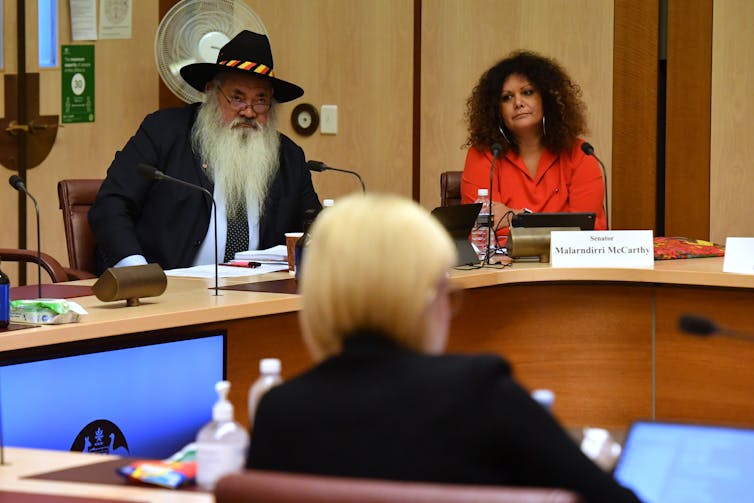 Senators Pat Dodson and Malarndirri McCarthy in Senate Estimates this year.
Mick Tsikas/AAP
Senators Pat Dodson and Malarndirri McCarthy in Senate Estimates this year.
Mick Tsikas/AAP
As was highlighted by Northern Territory Senator Malarndirri McCarthy during Senate Estimates last November, the government pushed ahead with its expanded rollout of the card, despite the vehement opposition of the Coalition of Peaks and extensive expert advice.
How can trust, accountability and change in decision-making be established if this is how the government continues to operate under its new approach to Indigenous affairs?
These questions aren’t just political. They matter for all Australians when it comes to the behaviour and practice of our government and parliament. They also highlight, once again, why the reforms called for by the Uluru Statement are more important than ever if we are to achieve real change.
Authors: Eddie Synot, Lecturer, Griffith Law School, Griffith University


















