

We can't compare Australia’s intake of Afghan refugees with the post-Vietnam War era. Here's why
- Written by: Rachel Stevens, Research fellow, Australian Catholic University
With the fall of Kabul this week, many commentators have noted the parallels with the fall of Saigon 46 years ago.
The rapid advance of the Taliban insurgents and seizing of the capital left the US humiliated once again. Dramatic images of frantic evacuations by helicopters from the US embassy triggered memories of similar scenes in Saigon in April 1975.
Like then, civilians fearing enemy retribution were desperate to escape, risking – and in some cases losing – their lives in the process.
Historical analogies help us make sense of a rapidly changing world. In connecting a current crisis with one past, they offer comfort in the implicit promise that we have been through this before. Despite these psychic benefits, historical analogies are more often than not inaccurate and simplistic.
I have written elsewhere that the Fraser government was no golden era for refugees. Far from welcoming Vietnamese refugees with open arms, the Whitlam and Fraser governments were ambivalent about these new arrivals.
Despite this indifference, Australian politicians in the 1970s were open to policy reform and, as good global citizens, were committed to international cooperation to address mass displacement. Between 1975 and 1991, Australia resettled over 130,000 Indochinese refugees.
We should not expect the Australian government to accept a similar number of Afghan refugees. Since the 1970s, the Australian policy landscape has changed irrevocably, meaning Kabul can never be “another Saigon” from a refugee standpoint.
There are four main differences between then and now that help explain this.
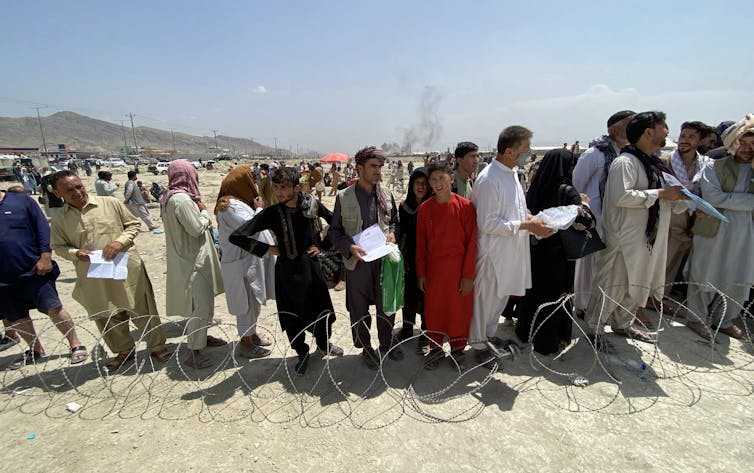 Afghans wait outside the Kabul airport to flee the country last week.
Stringer/EPA
Afghans wait outside the Kabul airport to flee the country last week.
Stringer/EPA
1. Australia had no refugee policy
First, when Saigon fell to the communists in 1975, the Australian government had no formal refugee policy. Australian immigration officials benefited from a blank slate. They were able to craft a refugee policy that responded directly to the Vietnamese refugee crisis.
Today, both major political parties have invested political capital in refusing to resettle asylum seekers who arrive by boat. Our politicians have been cornered into finding a solution for the emerging Afghan crisis within a preexisting, politically motivated refugee policy.
For instance, last week immigration minister Alex Hawke reasserted
while the Australian government operates a generous humanitarian program, our approach to combating people smuggling remains unchanged.
2. Politics were fundamentally different
In April 1975, the Whitlam Labor government was in its last seven months of power. Initially, Prime Minister Gough Whitlam was reluctant to admit anticommunist Vietnamese refugees, fearing that once they naturalised, they would vote for conservatives.
After the Whitlam dismissal in November 1975, the incoming Fraser government was dominated by the “wet”, small “l” liberals who were socially progressive and reform-minded.
Back then, immigration ministers Michael MacKellar (1975-9) and Ian MacPhee (1979-82) were attuned to conversations about migrant rights and emerging multiculturalism. They adopted recommendations from the 1978 Galbally Report, which called for expanding services to help newly arrived refugees settle in Australia.
Although polls in the late 1970s showed two-thirds of respondents opposed the resettlement of Vietnamese asylum seekers, what mattered was politicians did not succumb to public anxieties. The government implemented policies — such as the telephone interpreter service and SBS television — that made resettlement in a foreign land a little easier than before.
The “dry” revolution of the Liberal Party in the 1980s and ‘90s resulted in a focus on the economic utility of migrants at the expense of humanitarian considerations.
Of course, a humanitarian stream still exists in our immigration program. But, as a proportion of the population, the numbers of refugee admissions have fallen.
For the most part, refugee admissions have remained around 13,000 visas per year since 1979. This is despite the Australian population increasing by 11 million people during that time.
Read more: Afghan refugees can no longer wait — Australia must offer permanent protection now
3. Family visas were much more common
Not only have politics changed since the 1970s, the composition of the migration intake bares little similarity to today. It’s important to note that when Vietnamese refugees sought Australian visas, they had two viable channels: the humanitarian visa and family reunification visa.
These family visas became particularly important in the late 1980s and early '90s when refugee camps in Southeast Asia and Hong Kong were cleared and unsuccessful refugee applicants faced repatriation to Vietnam.
The importance of the family reunification channel cannot be overstated, as it gave Vietnamese refugees a second chance at resettlement in Australia.
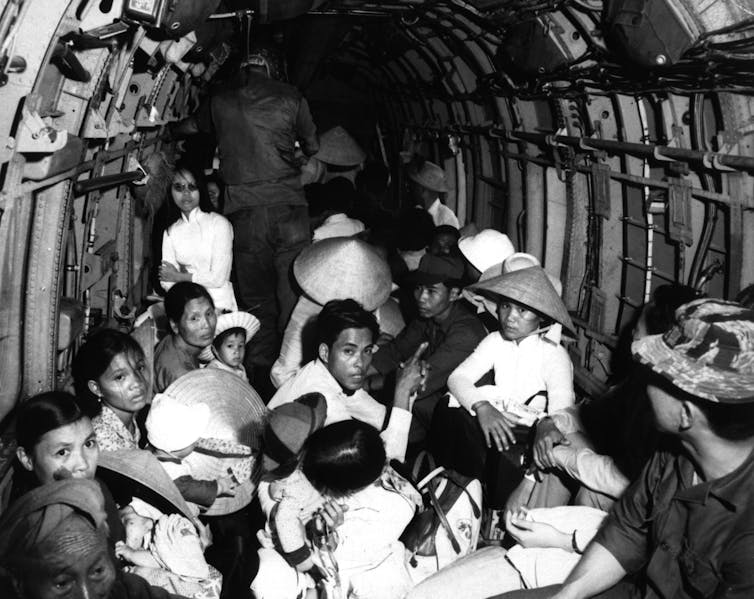 Vietnamese refugees on an Air Force helicopter to safety near Saigon in 1966.
Wikimedia Commons
Vietnamese refugees on an Air Force helicopter to safety near Saigon in 1966.
Wikimedia Commons
In 1985-6, 65% of Vietnamese arrivals came on refugee visas, while just 35% came under the family migration program. By 1991-2, more than 80% of Vietnamese migrants came on family reunification visas, while just one in seven received refugee visas.
These historical data tell us two things. First, they show how refugee movements evolve over years, if not decades, after the dust of the revolution settles.
The current proposal announced by immigration minister Alex Hawke to evacuate 3,000 Afghans is shortsighted and will unlikely satisfy refugee demand for resettlement in the years ahead.
Read more: Grattan on Friday: The compassion quotient in Morrison's Afghan response needs a boost
And second, since the Howard government, successive governments have reduced the size of the family migration program relative to the skilled migration program.
At its peak in 1984-5, 81% of visas were allocated to family migration, 18% to skilled migration. In 2019-20, the figures were 31% family migration and 68% skilled migration.
The government’s definition of a family member has also narrowed over the past 40 years. An expansive definition that once included adult siblings and elderly parents has made way for one restricted to a western-centric nuclear family.
Without a sizeable family migration program, one wonders what will happen to Afghan asylum seekers who don’t meet the strict eligibility for refugee status.
4. Third countries allowed for a more orderly departure
In the 1970s and '80s, many countries united to share the responsibility of resettling refugees from Vietnam, Cambodia and Laos. This included the countries where they were coming from, as well as the countries they transited through and their final destinations.
Most notably, the “orderly departure program” signed by the UN High Commissioner for Refugees and Vietnam in 1979 provided a comprehensive response to the mass displacement of people.
Read more: The photographer’s war: Vietnam through a lens
This included “in-country processing” of their applications for resettlement overseas. Though thousands still took to boats over the years, this “orderly departure program” saved many others from making the risky and clandestine journeys. In Australia’s case, no asylum seekers arrived by boat from 1981–89.
But this program required cooperation and goodwill between nations, particularly among neighbouring countries in southeast Asia that agreed to keep their borders open to asylum seekers, and for resettlement nations to accept large numbers of refugees.
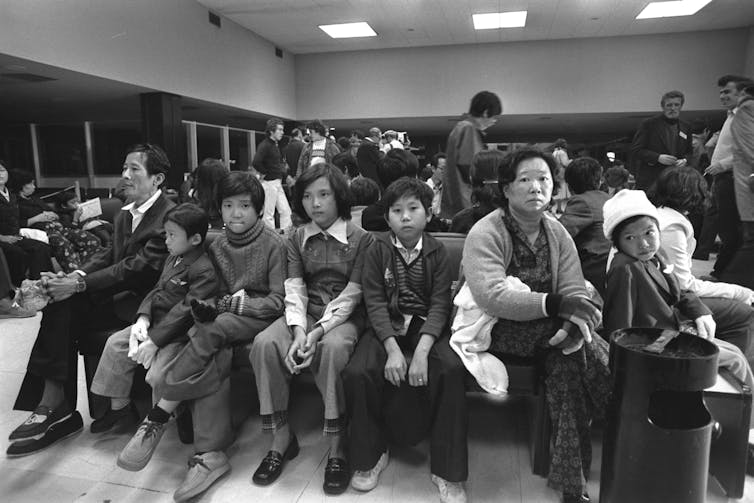 Vietnamese family en route from the Philippines for resettlement in Israel in 1979.
Wikimedia Commons
Vietnamese family en route from the Philippines for resettlement in Israel in 1979.
Wikimedia Commons
The Taliban takeover in Afghanistan, by contrast, may divide the international community. The Taliban has steadfast support from Pakistan and Iran; it is also likely to be recognised by Russia and China. Meanwhile, western states have recoiled at the Taliban’s human rights record and religious extremism.
When Afghan refugees cross into neighbouring Pakistan, Iran and other central Asian countries, it remains unclear what support they will receive or whether the UNHCR or another third party would be welcome to set up “in-country” processing for resettlement elsewhere.
The fall of Kabul is a seismic event that cannot be reduced to an ill-considered historical analogy. When it comes to the emerging refugee crisis, we should see this event in its full complexity. Only then can we hope to rise to the policy challenges ahead.
Authors: Rachel Stevens, Research fellow, Australian Catholic University


















