

Cockatoos and rainbow lorikeets battle for nest space as the best old trees disappear
- Written by: Gregory Moore, Doctor of Botany, The University of Melbourne
The housing market in most parts of Australia is notoriously competitive. You might be surprised to learn we humans are not the only ones facing such difficulties.
With spring rapidly approaching, and perhaps a little earlier due to climate change, many birds are currently on the hunt for the best nesting sites.
This can be hard enough for birds that construct nests from leaves and twigs in the canopies of shrubs and trees, but imagine how hard it must be for species that nest in tree hollows.
They are looking for hollows of just the right size, in just the right place. Competition for these prime locations is cut-throat.
Sulphur-crested cockatoos battling for spots
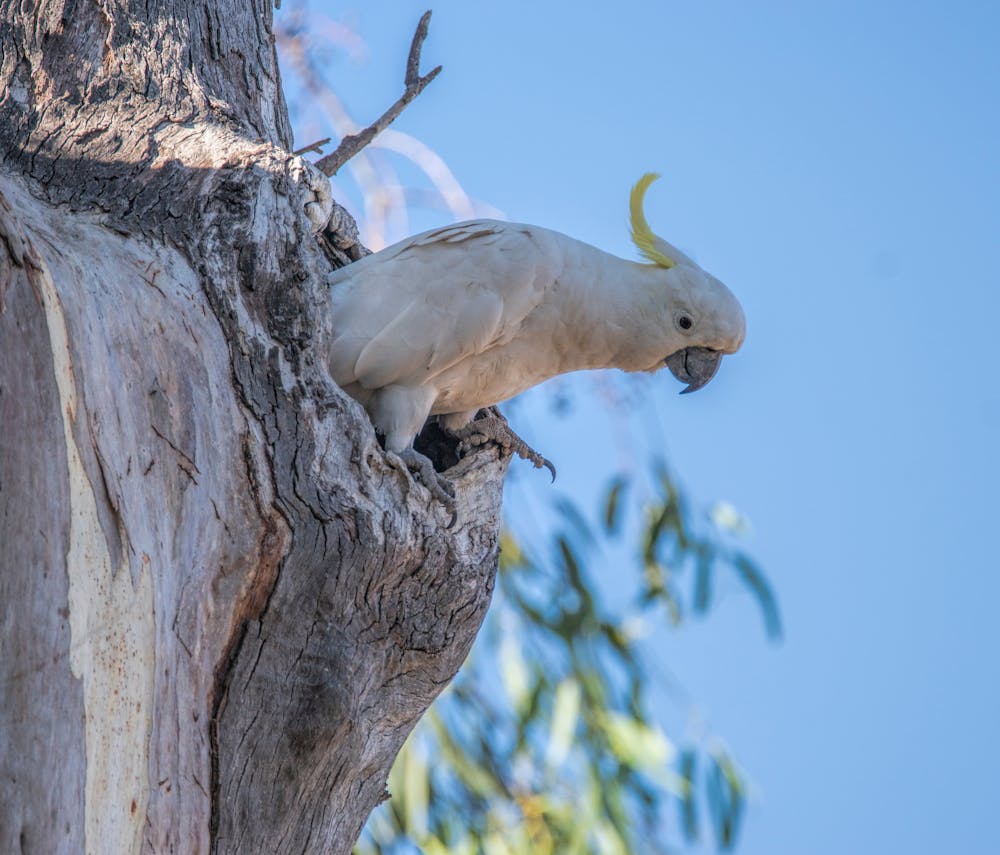
Sulphur-crested cockatoos, Cacatua galerita, are relatively large birds, so naturally the hollows they nest in need to be quite large.
Unfortunately, large hollows are only found in old trees.
It can take 150 years or more before the hollows in the eucalypts that many native parrot species nest in are large enough to accommodate nesting sulphur-crested cockatoos. Such old trees are becoming rarer as old trees on farms die and old trees in cities are cleared for urban growth.
In late winter, early spring you quite often find sulphur crested-cockatoos squabbling among themselves over hollows in trees.
 It can take 150 years or more before the hollows in the eucalypts that many native parrot species nest in are large enough to accommodate nesting sulphur-crested cockatoos.
Shutterstock
It can take 150 years or more before the hollows in the eucalypts that many native parrot species nest in are large enough to accommodate nesting sulphur-crested cockatoos.
Shutterstock
These squabbles can be very loud and raucous. They can last from a few minutes to over an hour, if the site is good one. Once a pair of birds takes possession and begins nesting, they defend their spot and things tend to quieten down.
The stakes are high, because sulphur-crested cockatoos cannot breed if they don’t have a nesting hollow.
Read more: Don't disturb the cockatoos on your lawn, they're probably doing all your weeding for free
Enter the rainbow lorikeets
In parts of southeastern Australia, rainbow lorikeets, Trichoglossus moluccanus (and/or Trichoglossus haematodus), have expanded their range over the past couple of decades. It is not uncommon to see sulphur-crested cockatoos in dispute with them over a hollow.
The din can be deafening and if you watch you will see both comedy and drama unfold. The sulphur-crested cockatoos usually win and drive the lorikeets away, but all is not lost for the lorikeets.
Sometimes the hollows prove unsuitable — usually if they are too small for the cockatoos — and a few days later the lorikeets have taken up residence. Larger hollows are rarer and so more highly prized.
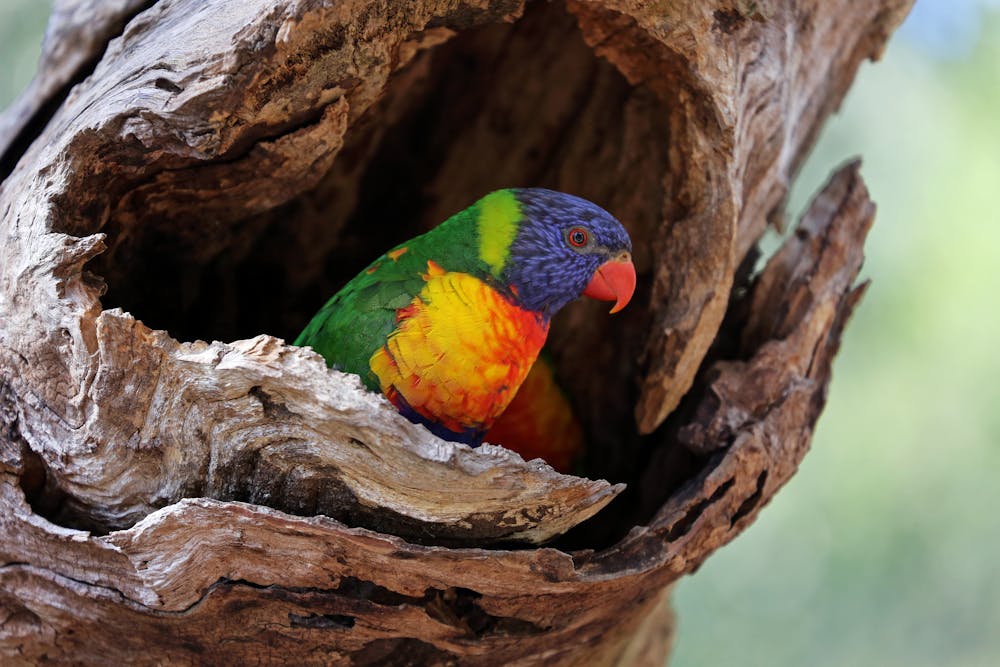 It is not uncommon to see sulphur-crested cockatoos in dispute with rainbow lorikeets over a hollow.
Shutterstock
It is not uncommon to see sulphur-crested cockatoos in dispute with rainbow lorikeets over a hollow.
Shutterstock
How hollows form
Many hollows begin at the stubs of branches that have been shed either as part of the tree’s growth cycle or after storm damage. The wood at the centre of the branch often lacks protective defences and so begins to decay while the healthy tree continues to grow over and around the hollow.
Other hollows develop after damage to the trunk or on a large branch, following lightning damage or insect attack. Parrots will often peck at the hollow to expand it or stop it growing over completely. Just a bit of regular home maintenance.
Sulphur-crested cockatoos can often be seen pecking at the top of large branches on old trees, where the branch meets the trunk. They can do considerable damage. When this area begins to decay, it can provide an ideal hollow for future nesting.
Sadly, for the cockatoo, it may take another century or so and the tree might shed the limb in the interim. Cockatoos apparently play a long game and take a very long term perspective on future nesting sites.
 Every effort must be made to ensure old, hollow-forming trees are preserved.
Shutterstock
Every effort must be made to ensure old, hollow-forming trees are preserved.
Shutterstock
Which trees are best for hollows?
In watching the local battles for parrot nesting sites, some tree species are the scenes of many a conflict.
Sugar gums, Eucalyptus cladocalyx, were widely planted as wind breaks in southern Australia and they were often lopped to encourage a bushier habit that provided greater shade.
Poor pruning often leads to hollows and cavities, which are now proving ideal for nesting — but it also resulted in poor tree structure. Sugar gums are being removed and nesting sites lost in many country towns and peri-urban areas (usually the areas around the edges of suburbs with some remaining natural vegetation, or the areas around waterways).
 Many species need hollows for nests.
Shutterstock
Many species need hollows for nests.
Shutterstock
Old river red gums, (Eucalyptus camaldulensis) growing along our creeks and rivers are also great nesting sites. They are so big they provide ideal sites for even the largest of birds.
These, too, are ageing and in many places are declining as riverine ecosystems suffer in general. Even the old elms, Ulmus, and London plane trees, Platanus x acerifolia — which were once lopped back to major branch stubs each year, leading hollows to develop — are disappearing as they age and old blocks are cleared for townhouses.
Read more: The river red gum is an icon of the driest continent
Protecting tree hollows
Cavities in trees are not that common. Large cavities are especially valuable assets. They are essential to maintaining biodiversity because it is not just birds, but mammals, reptiles, insects and arachnids that rely on them for nesting and refuge.
If you have a tree with a hollow, look after it. And while some trees with hollows might be hazardous, most are not. Every effort must be made to ensure old, hollow-forming trees are preserved. Just as importantly, we must allow hollow-forming trees to persist for long enough to from hollows.
We consider our homes to be our castles. Other species value their homes just as highly, so let’s make sure there are plenty of tree hollows in future.
Authors: Gregory Moore, Doctor of Botany, The University of Melbourne


















