

The government has again rescued the childcare sector from collapse. But short-term fixes still leave it at risk
- Written by: Peter Hurley, Policy Fellow, Mitchell Institute, Victoria University
The federal government yesterday announced a relief package for childcare providers affected by extended lockdowns.
Childcare services in Commonwealth-declared hotspots will be eligible for payments of 25% of their pre-lockdown revenue. Outside-school-hours-care services will be eligible for payments of 40%.
Childcare centres must be experiencing a 50% drop in attendance, and agree to a fee freeze for the duration of support.
About 60% of childcare centres in Sydney reportedly had less than half their usual number of children. In Melbourne, the reported expectation is attendance would settle at about 40-50%.
Prime Minister Scott Morrison said the payments would immediately help around 3,600 childcare services in Greater Sydney. In Greater Melbourne, the package will assist about 2,300 services and nearly 300 in the ACT.
This is the second time in two years the pandemic has brought parts of Australia’s childcare system to the verge of collapse. Last year, the government put in place several rescue packages for childcare and out-of-school-hours-care services.
Read more: Not much relief for parents, but new childcare measures will rescue providers (again)
But unlike in 2020, the recently announced package falls short of meeting the full costs of closure.
The most recent announcement means the federal government will meet most, but not all, the fee revenue childcare services collect. Parents whose children are still attending childcare may be asked to pay gap fees.
What does this package mean for providers?
Around 160 childcare centres have reportedly closed nationally due to the immediate risk of COVID transmission.
In Victoria, childcare and preschools are open to children who have at least one parent or guardian with a valid authorised worker permit, working either at home or on site, and who can’t make alternative supervision arrangements.
In NSW, parents and families are strongly encouraged to keep their children at home.
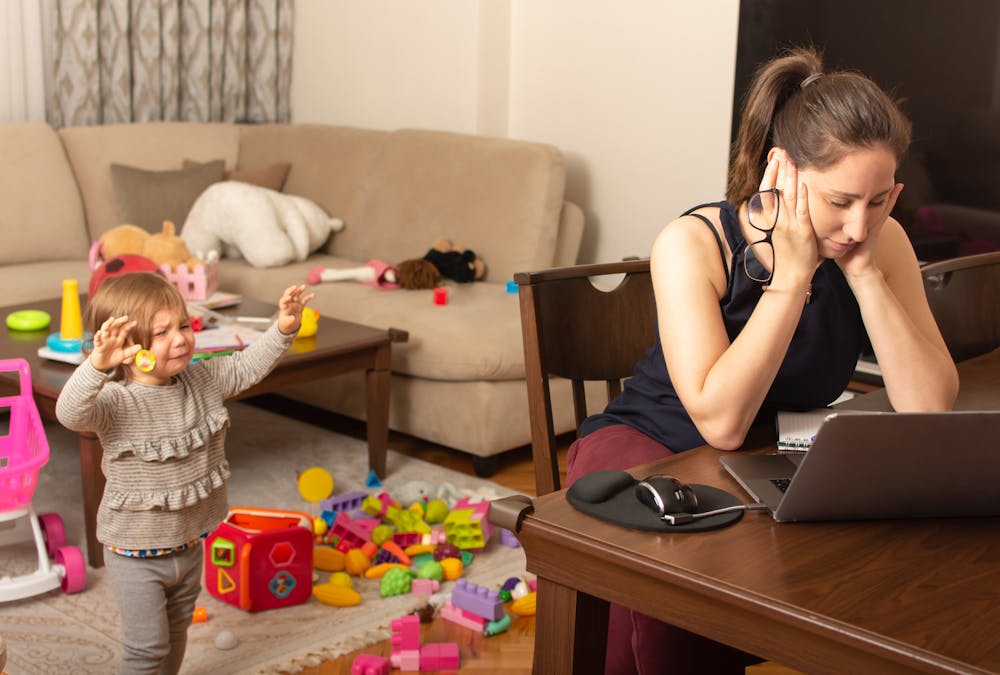 Childcare isn’t open to all parents who need it.
Shutterstock
Childcare isn’t open to all parents who need it.
Shutterstock
Australia’s childcare is provided by a mixture of for-profit and not-for-profit services who usually charge on a per hour or daily basis.
The federal government provides a subsidy, paid directly to early childhood services, who then pass it on to families as a fee reduction.
The amount of the subsidy, and the amount parents pay out-of-pocket, depends on family income and the fee childcare providers charge.
Normally, childcare providers must charge a gap fee to receive the federal government subsidy.
In 2020, during the first wave of the pandemic, the federal government implemented a “free childcare” package.
Effectively, this meant the federal government continued to pay childcare providers the subsidies they normally received, as well as cover parents’ out-of-pocket costs.
Before the announcement yesterday, the federal government had already agreed to waive gap fees for services in certain coronavirus “hot-spots”. Childcare providers can still receive the federal childcare subsidy, regardless of whether the child attends the service or whether they charge a gap fee to the child’s family.
Read more: It takes a village: why sending your kid to childcare isn't 'outsourcing parenting'
However, the federal government was not covering the out-of-pocket costs of parents. Without fees collected from families, childcare providers were suffering.
The table below shows government subsidies account for about 62% of all income received by childcare providers. Out-of-pocket expenses are estimated to be on average about 38% of total revenue for early childhood service providers.
Without the fees collected from families, it was difficult for providers to pay and retain their staff during the crisis. There were other difficult choices, too.
Childcare providers needed to make the decision whether to continue charging out-of-pocket expenses or waive the gap fee. While some providers may be eligible for state based support, many do not meet eligibility requirements.
For parents and carers, whether they were required to pay out-of-pocket costs depends on the childcare provider. Many were faced with the tough decision of whether to pay for a service they are not using to keep their child enrolled.
The current announcement has helped ease these issues, but the sector remains vulnerable, especially when the rescue measures end.
Let’s fix the funding model
In the short term, advocates in the sector are also calling for two further measures. The first is clarification about which children are able to access childcare, particularly in NSW. This is so childcare providers and parents can more clearly understand their obligations.
The second is a vaccination program that enables childcare workers to access vaccines as essential workers.
In the long term, Australia may need to review how it approaches childcare to ensure a more resilient system less susceptible to external shocks.
Australia’s childcare system is a market-based subsidy model. This is different from other education or health services, which are often directly run or funded by governments.
Mostly non-government providers operate in the sector. Providers choose where to operate and set their own fees.
Australia applies similar types of economic principles to childcare that it does industries such as aviation. Like an airline seat, payment is based entirely on use. Competition between providers on services and fees is encouraged.
Like the airline industry, the system is also prone to periodic collapse. In 2008, Australia’s largest provider of childcare services, ABC Learning, folded leaving the childcare arrangements for more than 110,000 children in the balance.
There is a huge amount of research showing the benefits of high quality early childhood education and care.
According to the OECD:
The evidence suggests that direct public funding of services brings more effective governmental steering of early childhood services, advantages of scale, better national quality, more effective training for educators and a higher degree of equity in access compared with parent subsidy models.
The experience of the pandemic shows a fundamentally different approach might be needed for Australia to take full advantage of the benefits childcare can offer.
Authors: Peter Hurley, Policy Fellow, Mitchell Institute, Victoria University


















