

What we know about why Chinese students come to Australia to study
- Written by: Hannah Soong, Lecturer in Teacher Education Practice, School of Education, University of South Australia
In 2016-17 Australia’s third largest export, international education, leapt from A$23.6 billion to a record high of A$28 billion. Within the higher education sector, the highest intake of international students is of Chinese origin.
Behind these statistics are the individual stories and aspirations of Chinese students’ parents who provide them the financial resources and emotional support. Yet, we know so little about why it matters so much to their parents, and what long-term impacts overseas study has on them and their families when they return home.
Read more: International student report emphasises their value, but not the means
Knowing what aspirations Chinese parents have for their children will help us understand what keeps our international education export industry vibrant today. And more importantly, sustainable tomorrow.
The shifting educational landscape in Shanghai-China
Focusing on a shifting landscape of education in Shanghai, I undertook a longitudinal pilot case-study of four bilingual kindergarten-secondary schools to investigate the aspirations Chinese middle-class parents have for their children’s education.
These schools are run privately. Their aim is to promote a dual stream model with a mission of implementing a bilingual “East-meets-West” education. Global competitiveness is driving the innovative change and quality of education in Shanghai.
In these schools, Chinese students are taught by local Chinese teachers in subjects like maths, Chinese language and values education. At the same time, they study a range of Western curriculum such as International Baccalaureate or General Certificate of Education at Advanced-Levels (the higher school certificate in the UK). These are co-taught by Western expatriate teachers and Chinese bilingual teachers, in subjects like English, arts, music, physical education, science and philosophy.
This emerging privatised education industry is a testament to how Shanghai-Chinese society is changing. By studying in such schools, their children can essentially opt out of the most stressful examination – the National University Entrance Examination (Gao Kao- 高考). In the eyes of Chinese middle-class parents, international education credentials open doors to the top jobs.
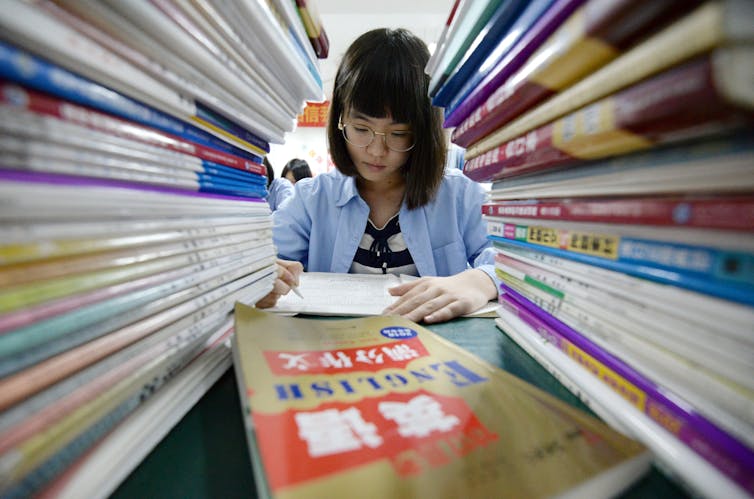 The Gao Kao lasts about nine hours over a period of two days, depending on the province.
Hao Qunying/AAP
The Gao Kao lasts about nine hours over a period of two days, depending on the province.
Hao Qunying/AAP
Under these circumstances, the provision of “international-local” school education has become the preferred choice for many Chinese middle-class families when it’s available and affordable to the local population.
In May this year, I went to Shanghai for a month to interview 46 Chinese middle-class parents whose children are attending such schools. Although they are from diverse educational and career backgrounds, a portion of these parents have overseas education credentials and are now doing well in Shanghai. There are also some whose close relatives or friends have either migrated or studied overseas.
A study from the UK of 652 Chinese international students after they returned home found the majority have experienced profound identity-transforming experiences with a renewed sense of self at home.
Today, Australia is an attractive destination for many Chinese students because of the ways the Australian international education system interacts with immigration policy. Not only will their children’s education at an Australian university be perceived as cultural capital for the family, they also want their children to gain post-study migration and employment opportunities.
‘Tiger’ or ‘chicken blood’ parents or neither
Students of Chinese ethnicity who are migrants in countries such as the UK and Australia are the highest performing ethnic group. Because of this, we are often led to believe it’s the high expectations Chinese parents have of their children that push them to perform well in schools.
But for some of these middle class Chinese parents I interviewed, who are successful in their educational experiences in China, they don’t want their children to have the same Chinese education they had. They want to avoid being parents of “chicken blood” (鸡血) – the Shanghai-Chinese term for demanding “tiger” mums or dads.
In their case, unlike what most research indicates about Chinese parenting styles, they want their children to have a broader worldview, to be fluent in English and Chinese, and still have a competitive edge over other local Chinese students without the stress of performing well academically.
Most of them have planned to send their children to study overseas because they did. Such attitudes and aspirations middle-class Chinese parents instil in their children make an important contribution to the continual influx of Chinese students to study in Western countries like Australia.
What next?
For Chinese international students who have returned home, they still aspire to provide a Western overseas education for their children. This is still significant in creating flexible citizenship for their child’s future.
For Australian international education, this means their children can potentially be second-generation international students. This is also why, for some of these middle class Chinese parents, the “East-meets-West” schooling system in Shanghai is a good option.
If Australia is to remain a destination for world-class education, we need to be far more self-reflective and long-sighted about what Australian international education offers: global citizenship and transnational mobility. We need to listen to the voices of an increasing middle-class in China.
Authors: Hannah Soong, Lecturer in Teacher Education Practice, School of Education, University of South Australia
Read more http://theconversation.com/what-we-know-about-why-chinese-students-come-to-australia-to-study-97257


















