

Communication is changing — and most universities haven't kept up
- Written by T.J. Thomson, Senior Lecturer in Visual Communication & Media, Queensland University of Technology
Almost everyone can agree communication is important. There is much less agreement about what, exactly, communication is or how best to develop skills in it.
Communication today is more multi-modal than ever, but we still tend to give and receive the most training in writing. Our national survey of introductory communications courses in 2020, just published in the journal Communication Research and Practice, found more than 70% of assignments in the sample evaluated only a single communication mode. Perhaps unsurprisingly, 85.7% of these were in written form.
Read more: 5 tips on writing better university assignments
Less than a third of the assessment pieces were multi-modal. And only 11% enabled students to practise their spoken, written and visual communication skills in an integrated way.
While writing is certainly a critical communication skill, it’s not the only one. We make and receive messages in spoken or visual form every day. We sometimes seem to believe just by using these modes we’ll naturally get better at them over time.
Sadly, anyone who’s sat through a typical PowerPoint presentation or unending Zoom meetings knows even senior professionals and heads of government often are unaware of or ignore best practices for crafting an effective message in written, spoken or visual form.
And with these three modes being increasingly bundled together, it’s time to stop studying them in isolation. We need to start learning how to thoughtfully integrate them.
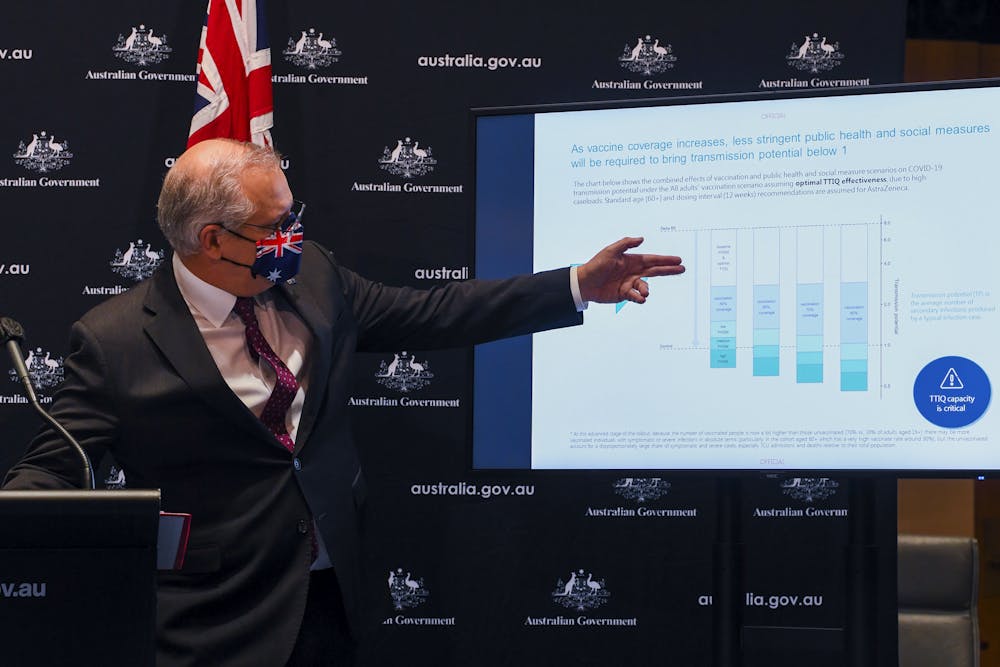 Many people struggled to read the PowerPoint used by Prime Minister Scott Morrison in his August 3 press conference.
Lukas Coch/AAP
Many people struggled to read the PowerPoint used by Prime Minister Scott Morrison in his August 3 press conference.
Lukas Coch/AAP
Read more: In a world of digital bystanders the challenge is for all of us to design engaging online education
A growing field but writing dominates
Universities are a prime training ground for students to learn what communication is. It’s here they should be able to hone communication skills in all its forms before entering the workforce. Despite this, universities have a long history of privileging the written word over other communication types.
English departments, for example, have existed for more than 250 years but not until 1974 did Australia’s first communication degree enter the scene. Interest in communication has grown since then – 86% of Australian universities now offer a degree in this field.
However, the ways communication is defined and taught vary widely across the country. In part, this reflects the diversity of where communication degrees are housed. They can be found everywhere from faculties of arts to education, social science, law, business and even health.
Our survey of first-year undergraduate courses found class sizes ranged from as few as 16 students to as many as 1,000 or more. The average was 343.
Such large classes make it hard to achieve consistency across the large teaching teams required to staff these units.
The COVID-19 pandemic has introduced new challenges and increased existing ones related to catering to students from potentially many time zones. In our survey, 20% of universities did not provide synchronous tutorials, where students and teaching staff meet in real time.
Asynchronous learning opportunities, where learners and teachers aren’t meeting in real time, can be convenient for students. However, they don’t allow them to hone the dynamics of real-time conversation and communication.
When assessment tasks are pre-recorded or pre-prepared, are we modelling real-world communication to our students?
Read more: Digital learning is real-world learning. That's why blended on-campus and online study is best
The challenges of holistic communications teaching
Another challenge relates to the background and skills of the teaching team. More than half the universities surveyed had only a single lecturer for the unit. Expecting one person to be able to adequately support the very different modes of written, spoken and visual communication is unrealistic.
A co-taught lecturing approach might better position these programs to define and teach communication more holistically. Our survey found the most popular way to support learning was through student group work. This team-based approach mirrors how much of the professional workforce operates and deserves a closer look.
Shrinking university budgets and reduced teaching teams mean much of the work of providing feedback in large units is relegated to group work and peer critique. This can be valuable but shouldn’t substitute for expert feedback.
Encouragingly, unit co-ordinators surveyed are keen to experiment with more innovative assessment types and to consider communication more holistically.
Read more: What is the point of assessment in higher education anyway?
To achieve these goals, significant barriers need to be navigated. These include:
1) the length of the semester or degree program, as only so much can fit into a few months and Australia’s degrees are shorter than those in the United States
2) the disciplinary background of the teaching team
3) workload and marking considerations
4) university bureaucracy, as universities sometimes require a year or more to make changes to how classes are taught, which doesn’t encourage innovation and allow co-ordinators to be nimble.
In this age of lockdowns and remote working, being able to present a message in written, spoken and visual forms is more critical than ever. We need holistic training in all three modes so we can become more effective, empowered and responsible communicators.
Authors: T.J. Thomson, Senior Lecturer in Visual Communication & Media, Queensland University of Technology
Read more https://theconversation.com/communication-is-changing-and-most-universities-havent-kept-up-165754

















