

We studied Afghan refugees for 3 years to find out what life is like for them in Australia
- Written by: Jock Collins, Professor of Social Economics, UTS Business School, University of Technology Sydney
The shocking scenes at Kabul airport — reminiscent of the images of the fall of Saigon in 1975 — highlight the desperate situation many Afghans face following the unexpectedly quick Taliban victory.
In the 1970s, the Fraser government responded generously to the plight of the Vietnamese people seeking refuge in Australia, taking 15,000 refugees a year. In contrast, last week, Prime Minister Scott Morrison announced Australia will take in 3,000 Afghan refugees.
Read more: No permanent settlement for Afghans who did not come 'the right way': Morrison
This comes from our existing annual intake of 13,750 humanitarian visas a year.
Our new research shows the government’s reluctance to take a more generous approach to Afghan refugees is not rooted in evidence about how they settle once they get to Australia.
Our research on Afghan refugee families
We have been doing a three-year study of recent refugees, examining what happens to them once they come to Australia. We followed Afghan, Syrian, and Iraqi refugee families who settled in metropolitan and regional NSW, Queensland and Victoria between 2018 and 2020. Most arrived in 2016 or 2017.
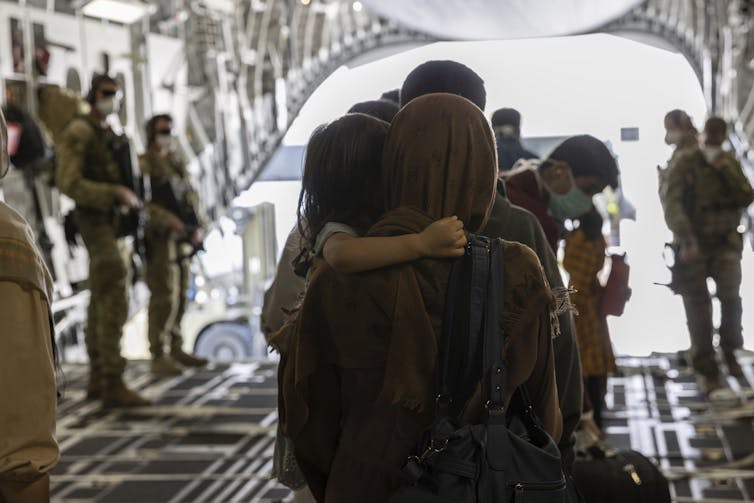 Since the fall of Kabul last week, Australia has been conducting rescue flights out of Afghanisatn.
Department of Defence/AAP
Since the fall of Kabul last week, Australia has been conducting rescue flights out of Afghanisatn.
Department of Defence/AAP
In this article, we present the results for the Afghan group, which involves 33 families. Many were Hazaras who fled persecution by the Taliban and many were in large, single female parent families who had arrived on women-at-risk visas.
Adults and young people aged five to 18 were interviewed and surveyed three times over three years.
They were asked a range of questions about their experience and life in Australia. This included how difficult it was to find accommodation, work, make friends, speak and read English, access good schools, and how they felt about their lives.
Feeling happy and safe
Overall, the adults we surveyed were optimistic and positive about their lives in Australia and felt welcome in their communities.
Just over half had no difficulty finding accommodation, while more than 70% said they found it “easy” to make friends. By 2020, 100% of respondents agreed they had access to good schools and felt safe in their neighbourhoods.
Some still struggled with English language ability, though this improved year on year. By 2020, more than half (55%) said they understood English “well to very well”.
At least 86% of respondents were “mostly to very happy” with their lives, over the three years of questioning. As a 20-year-old female respondent exlained:
Australia has given us safety, security, education, so we have to work for Australia’s improvement […] The Aussie people, they are very good […]Though our cultures are really different, but they respect us.
In addition to feeling safe, there was a recognition of equality:
Everybody is having the equal life. The biggest thing I can find here is equality. Here we cannot find any difference between girls and guys.
At least 96% were “mostly to very confident” about their children’s future. Meanwhile, 100% agreed Australia was a good place to raise children.
Finding a job
A significant improvement was seen in employment, although there is still room for more growth.
One of the biggest concerns Afghan adults mentioned in the first year of the study was getting a job and just 8% had paid work. By year two, this was up to 35% and then back to 26% in year three, when COVID hit.
Read more: Afghan refugees can no longer wait — Australia must offer permanent protection now
A number of factors created barriers to employment, including a protracted work history due to war and moving from country to country seeking safety. Once in Australia, the immediate need to focus on learning English and the need to understand a new job market also delayed getting a job.
Opportunities to volunteer or take up internships helped break the catch-22 of “no job if you don’t have Australian employment experience”. While English language fluency created barriers to employment, employment was also key to learning English:
Yes, my English is getting better. Yes, working is good because I’m using English — people talk and I listen. Yes, that’s how I get better.“
‘Real Aussies’
As part of our research, we also spoke to young Afghan refugees. They were markedly positive about their lives in Australia. By 2020, 100% replied "very good to excellent” when asked how they were finding school or TAFE. One 13-year-old told us:
I have made lots of friends at school. I don’t go one day, I miss all of them.
They were also very confident about their English ability — 100% rated their speaking and listening at “very good to excellent”. More than 80% rated their reading and writing as “very good to excellent”.
More than 92% said they felt safe in their neighbourhoods and as though they belonged. As one 17 year-old boy said:
I do play soccer. Yes, I do play for the school team […] Do I do swimming? I do. Yes, I’ve become a real Aussie boy.
One 15 year-old respondent also described her work and study program, illustrating the ambition and work ethic of this young cohort.
There was a scholarship — it was from UQ [Queensland University]. Finally, I got accepted and it pays for four years of uni. Yes [I got a part-time job] […] Twelve hours a week. I’m also [a] Toowoomba regional youth leader.
Compelling practical reasons
Beyond the humanitarian and moral arguments for accepting more Afghan refugees in Australia, our research shows there are compelling practical reasons to increase our intake.
It demonstrates how Afghan refugees can overcome settlement challenges and achieve strong outcomes in terms of education and employment and belonging. This confirms findings of earlier research with Hazara boat people who set up successful businesses in Adelaide, many in partnership with those they met in detention centres.
This also ties with our current research with Syrian and Iraqi refugee families, which demonstrates their resilience and determination to create a better future in Australia for their children.
Authors: Jock Collins, Professor of Social Economics, UTS Business School, University of Technology Sydney


















