

Qantas has grounds to mandate vaccination, but most blanket policies won't fly
- Written by: Giuseppe Carabetta, Senior Lecturer, Sydney University Business School, University of Sydney
Last week Qantas became the first major Australian public company to declare it would require all its staff to be vaccinated against COVID-19.
“Having a fully vaccinated workforce will safeguard our people against the virus but also protect our customers and the communities we fly to,” said Qantas chief executive Alan Joyce.
All the airline’s “frontline” workers — meaning its cabin crew, pilots and airport employees — must be fully vaccinated by November 15, and the rest by March 31 2022. There will be exemptions for those unable to be vaccinated for documented medical reasons. They will be accommodated with measures including social distancing, masks and testing.
Qantas’ announcement follows similar policies declared by Queensland regional air operator Alliance Airlines and Victorian fruit-canning company SPC Australia, which has said it will mandate vaccines (with medical exemptions) for all employees, contractors and visitors.
SPC’s chairman, Hussein Rifai, has said he is “obliged under Australian law to provide the safest workplace I can for my employees”. But his plan may be stymied by legal action by the Australian Manufacturers Workers Union, which has criticised the lack of consultation.
Qantas is on firmer ground, having determined the majority of employees support its move. But it might still face a legal storm if its policy is tested before a tribunal or court. Here’s why.
Read more: Can Australian employers make you get a COVID-19 vaccine? Mostly not — but here's when they can
The legal framework
Legally the clearest way for employers to insist on vaccinations is where this is provided for by law, normally via state-based public health orders.
Four states — Queensland, Western Australia, New South Wales and South Australia — have introduced such orders for quarantine, transport, airport workers and certain health care professionals. States and territories have also agreed to similar orders for residential aged-care workers.
Without a public health order, the validity of any employer mandating vaccination depends on assessing their right to issue “lawful and reasonable directions”.
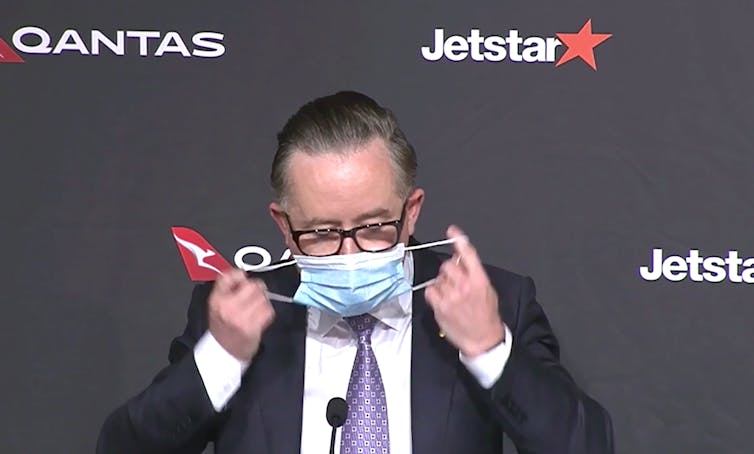 Qantas chief executive Alan Joyce.
Mick Tsikas/AAP
Qantas chief executive Alan Joyce.
Mick Tsikas/AAP
Is is reasonable?
The Fair Work Ombudsman’s latest advice says the following circumstances ought to be considered to determine if a mandatory vaccination policy is reasonable:
the nature of the workplace — for example, the extent to which employees interact with the public, whether social distancing is possible and whether the business provides an essential service
the extent of community transmission of COVID-19 in the location where the direction is given
the effectiveness of vaccines in reducing the risk of transmission
work health and safety obligations
each employee’s duties and the risks associated with their work
whether employees have a legitimate reason for refusing vaccination (for example, a medical reason)
vaccine availability.
These considerations essentially align with three Fair Work Commission rulings in unfair dismissal cases involving employees refusing influenza vaccinations.
Four tiers of work
The Ombudsman’s advice also refers to four “tiers” of work for applying the reasonableness test:
Tier 1 work, where employees are required to interact with people with an increased risk of being infected with coronavirus (for example, hotel quarantine employees).
Tier 2 work, where employees are required to have close contact with people who are particularly vulnerable to the impacts of coronavirus (for example, health or aged-care employees).
Tier 3 work, where there is likely interaction between employees and customers, co-employees or the public.
Tier 4 work, where employees have minimal face-to-face interaction with others.
The advice notes an employer’s direction to Tier 1 or Tier 2 employees is “more likely to be reasonable”. Conversely, a direction to employees in Tier 4 is “unlikely to be reasonable”.
For employees in Tier 3, where no community transmission has occurred for some time in the relevant location, a direction to vaccinate is less likely to be reasonable.
Where do Qantas and SPC fit
If Qantas’ policy is challenged before a court or tribunal, it may well be found to be reasonable for front-line workers, including flight crew and pilots.
This is because they are likely to interact with travellers and fellow employees in environments with a higher risk of COVID-19 transmission and where social distancing is impossible.
But looking to apply a “blanket” policy to all its employees, rather than specific subsets of workers in high-risk settings, is problematic. The Qantas workforce is likely to have a significant “mix”, with some performing “Tier 4” work in low-exposure settings.
So too SPC. Like Qantas, SPC’s management has argued the vaccination policy is necessary to discharge its statutory duty of care to the health and safety of its employees, most of whom work in close proximity of each other.
But an employee may argue there are other ways, short of vaccinations, to do this. This may include using personal protective equipment, testing and varying work patterns and procedures.
Read more: Grattan on Friday: Vaccine passports are a better tool than mandating jabs for all jobs
Another important consideration will be vaccine access, noting that, in some states, certain employees may not yet have access to an ATAGI-approved vaccine for their age group.
A court or tribunal may also consider if the employer has provided adequate support, imposed reasonable deadlines, met consultation requirements or allowed alternative work arrangements for unvaccinated employees.
While the risk of transmission of COVID-19 remains high there is a good argument vaccination is an inherent requirement of all jobs involving face-to-face interactions. But regardless of the tier of work performed by employees, whether a vaccine mandate is reasonable needs to be assessed case by case.
Authors: Giuseppe Carabetta, Senior Lecturer, Sydney University Business School, University of Sydney


















