

Why it will soon be too late to find out where the COVID-19 virus originated
- Written by: Dominic Dwyer, Director of Public Health Pathology, NSW Health Pathology, Westmead Hospital and University of Sydney, University of Sydney
SARS-CoV-2 has caused the greatest pandemic of the past 100 years. Understanding its origins is crucial for knowing what happened in late 2019 and for preparing for the next pandemic virus.
These studies take time, planning and cooperation. They must be driven by science — not politics or posturing. The investigation into the origins of SARS-CoV-2 has already taken too long. It has been more than 20 months since the first cases were recognised in Wuhan, China, in December 2019.
This week US President Joe Biden was briefed by United States intelligence agencies on their investigation into the origins of the virus responsible for COVID-19, according to media. Parts of the investigation’s report are expected to be publicly released within the next few days.
An early report from the New York Times suggests the investigation does not conclude whether the spread of the virus resulted from a lab leak, or if it emerged naturally in a spillover from animals to humans.
Read more: How do viruses mutate and jump species? And why are 'spillovers' becoming more common?
While a possible lab leak is a line of inquiry (should scientific evidence emerge), it musn’t distract from where the current evidence tells us we should be directing most of our energy. The more time that passes, the less feasible it will become for experts to determine the biological origins of the virus.
Six recommendations
I was one of the experts who visited Wuhan earlier this year as part of the World Health Organisation’s investigation into SARS-CoV-2 origins. We found the evidence pointed to the pandemic starting as a result of zoonotic transmission of the virus, meaning a spillover from an animal to humans.
Our inquiry culminated in a report published in March which made a series of recommendations for further work. There is an urgent need to get on with designing studies to support these recommendations.
Today, myself and other independent authors of the WHO report have written to plead for this work to be accelerated. Crucial time is disappearing to work through the six priority areas, which include:
further trace-back studies based on early disease reports
SARS-CoV-2-specific antibody surveys in regions with early COVID-19 cases. This is important given a number of countries including Italy, France, Spain and the United Kingdom have often reported inconclusive evidence of early COVID-19 detection
trace-back and community surveys of the people involved with the wildlife farms that supplied animals to Wuhan markets
risk-targeted surveys of possible animal hosts. This could be either the primary host (such as bats), or secondary hosts or amplifiers
detailed risk-factor analyses of pockets of early cases, wherever these have occurred
and follow up of any credible new leads.
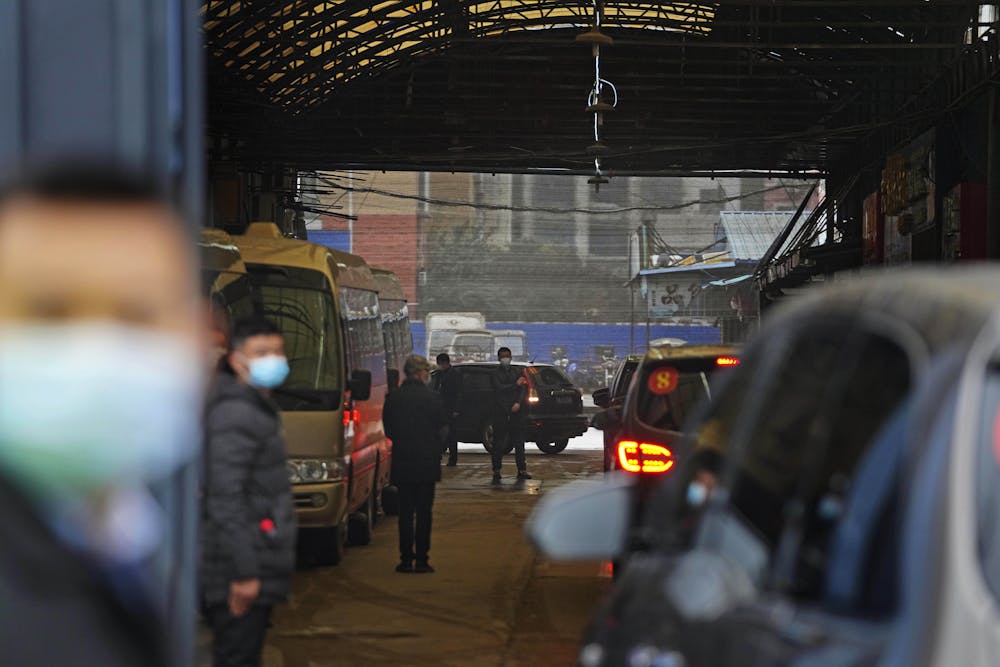 In May US President Joe Biden told US intelligence agencies to double their efforts to investigate the origins of the COVID-19 pandemic, including the possibility it emerged from a lab. The ‘lab-leak hypothesis’ had dominated headlines for months.
Ng Han Guan/AP
In May US President Joe Biden told US intelligence agencies to double their efforts to investigate the origins of the COVID-19 pandemic, including the possibility it emerged from a lab. The ‘lab-leak hypothesis’ had dominated headlines for months.
Ng Han Guan/AP
Race against the clock
The biological feasibility of some of these studies is time dependent. SARS-CoV-2 antibodies emerge a week or so after someone has become infected and recovered from the virus, or after being vaccinated.
But we know antibodies decrease over time — so samples collected now from people infected before or around December 2019 may be harder to examine accurately.
Using antibody studies to differentiate between vaccination, natural infection, or even second infection (especially if the initial infection occurred in 2019) in the general population is also problematic.
For example, after natural infection a range of SARS-CoV-2-specific antibodies, such as to the spike protein or nucleoprotein, can be detected for varying lengths of time and in varying concentrations and ability to neutralise the virus.
But depending on the vaccine used, antibodies to the SARS-CoV-2 spike protein may be all that is detected. These, too, drop with time.
There is also a need to have international consensus in the laboratory methods used to detect SARS-CoV-2-specific antibodies. Inconsistency in testing methods has led to arguments about data quality from many locations.
It takes time to come to agreement on laboratory techniques for serological and viral genomic studies, sample access and sharing (including addressing consent and privacy concerns). Securing funding also takes time — so time is not a resource we can waste.
Read more: Coronavirus is evolving but so are our antibodies
Distance from potential sources
Moreover, many wildlife farms in Wuhan have closed down following the initial outbreak, generally in an unverified manner. And finding human or animal evidence of early coronavirus spillover is increasingly difficult as animals and humans disperse.
Fortunately, some studies can be done now. This includes reviews of early case studies, and blood donor studies in Wuhan and other cities in China (and anywhere else where there was early detection of viral genomes).
It is important to examine the progress or results of such studies by local and international experts, yet the mechanisms for such scientific cross-examination have not yet been put in place.
New evidence has come forward since our March report. These papers and the WHO report data have been reviewed by scientists independent of the WHO group. They have came to similar conclusions to the WHO report, identifying:
- the host reservoir for SARS-CoV-2 has not been found
- the key species in China (or elsewhere) may not have been tested
- and there is substantial scientific evidence supporting a zoonotic origin.
Teetering back and forth
While the possibility of a laboratory accident can’t be entirely dismissed, it is highly unlikely, given the repeated human-animal contact that occurs routinely in the wildlife trade.
Still, the “lab-leak” hypotheses continue to generate media interest over and above the available evidence. These more political discussions further slow the cooperation and agreement needed to progress with the WHO report’s phase two studies.
The World Health Organisation has called for a new committee to oversee future origins studies. This is laudable, but there is the risk of further delaying the necessary planning for the already outlined SARS-CoV-2 origins studies.
Authors: Dominic Dwyer, Director of Public Health Pathology, NSW Health Pathology, Westmead Hospital and University of Sydney, University of Sydney


















