

Research reveals humans ventured out of Africa repeatedly as early as 400,000 years ago, to visit the rolling grasslands of Arabia
- Written by: Julien Louys, Deputy Director, Australian Research Centre for Human Evolution, Griffith University
If you stood in the middle of the Nefud Desert in central Arabia today, you’d be confronted on all sides by enormous sand dunes, some rising more than 100 meters from the desert floor.
The few scraggly bushes make poor browse for the herds of goats and camels that eke out a living in this harsh environment. But this wasn’t always the case.
Our research published today in Nature shows that in repeated pulses over the past 400,000 years, the Nefud Desert landscape received monsoon rains that resulted in rolling grasslands, flowing rivers and large lakes home to thousands of wild donkeys, antelopes and hippos.
Humans also inhabited these green corridors as they made their way out of Africa, only to disappear when conditions deteriorated again.
Among other findings, we present the oldest dated evidence for hominins in Arabia, in the form of stone tools dated to about 400,000 years ago. The Homininae subfamily is the group of humans of which Homo sapiens is the sole survivor.
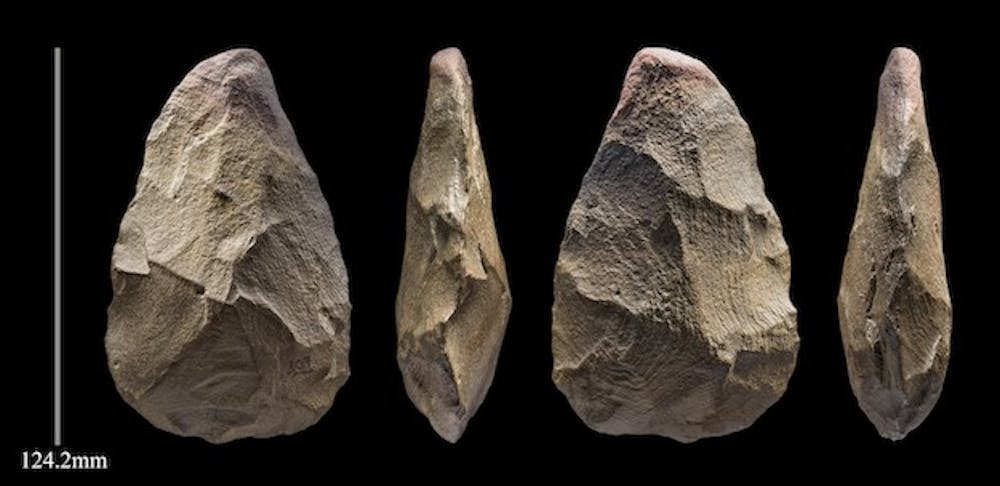 A 400,000 year ‘handaxe’ stone tool from Khall Amayshan 4.
Palaeodeserts Project (photo by Ian Cartwright)
A 400,000 year ‘handaxe’ stone tool from Khall Amayshan 4.
Palaeodeserts Project (photo by Ian Cartwright)
Early movements out of Africa
Today Arabia is one of the world’s driest places, and was long thought to have played little role in human prehistory.
While the rich and long-studied Levant and the Mediterranean regions were considered critical for the dispersal of people out of Africa, it was thought most humans would have avoided places like the Arabian “Empty Quarter” — due to the harshness of its environmental conditions.
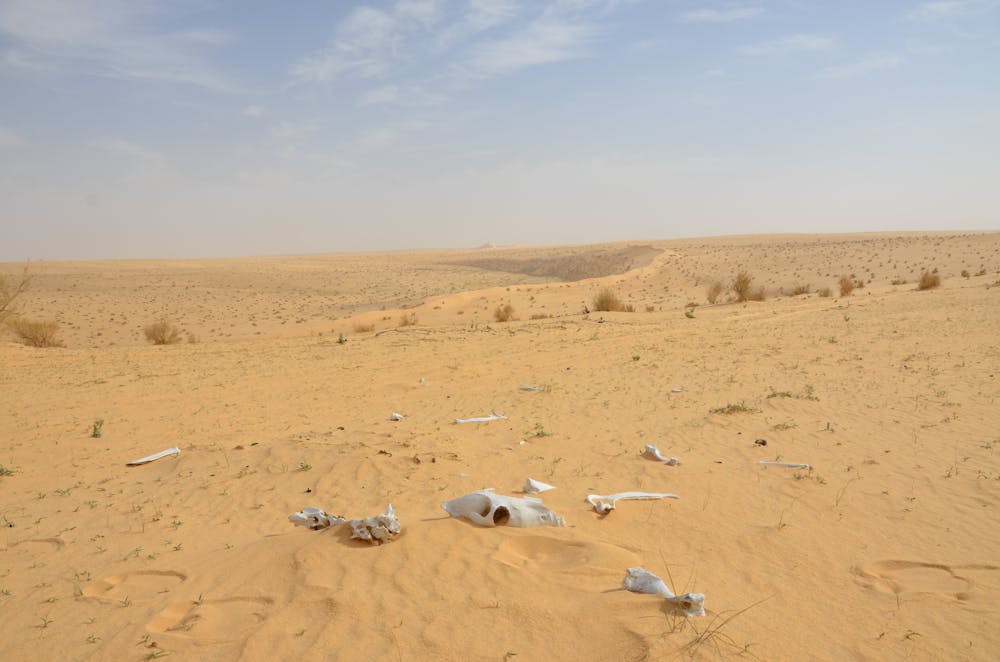 The Nefud Desert today.
Julien Louys
The Nefud Desert today.
Julien Louys
But detailed scientific investigations over the past few decades have been slowly changing these ideas. A rich stone tool culture has now been recovered from the surfaces of many ancient and dried out lakebeds in Southwest Asia.
However, because these were from isolated beds — often hundreds of kilometres apart — and restricted to surface scatters, it was difficult to determine who had left these tools, when, and where they came from.
In collaboration with the Heritage Commission of the Saudi Ministry of Culture and other Saudi colleagues, our international team of researchers has been working in Saudi Arabia, Southwest Asia’s largest country, for the past decade.
We have recorded and studied a wealth of stone tools and animal fossils emerging from the sands and ancient lakebeds. And we’ve made some startling discoveries.
We recovered a Homo sapiens finger bone, among other fossils, from an ancient Saudi Arabian lakebed known as Al Wusta. These remains were dated to 85,000 years ago. This finding shows modern humans had made it out of Africa at least 20,000 years before the genetic evidence indicates we left.
It has been thought (and many still believe) Homo sapiens only left Africa about 50-65,000 years ago. Our finger bone finding challenges this view, as do other discoveries - including from Madjedbebe in Australia.
Read more: Buried tools and pigments tell a new history of humans in Australia for 65,000 years
What happened to the group of people from Al Wusta remains unknown. They may have moved further into Asia, or retreated back to Africa. Or they may have become locally extinct.
A green Arabia
We also report a series of archaeological sites associated with multiple lakes across two locations which tell the story of human prehistory going back 400,000 years. The first of these locations, Khall Amayshan 4, is a depression located between large sand dunes covering 60,000 square metres.
In this single depression we found individual lakebeds dated back to 55,000, 100,000, 200,000, 300,000 and 400,000 thousand years ago. And each of the five lake phases is represented by its own unique archaeological signature.
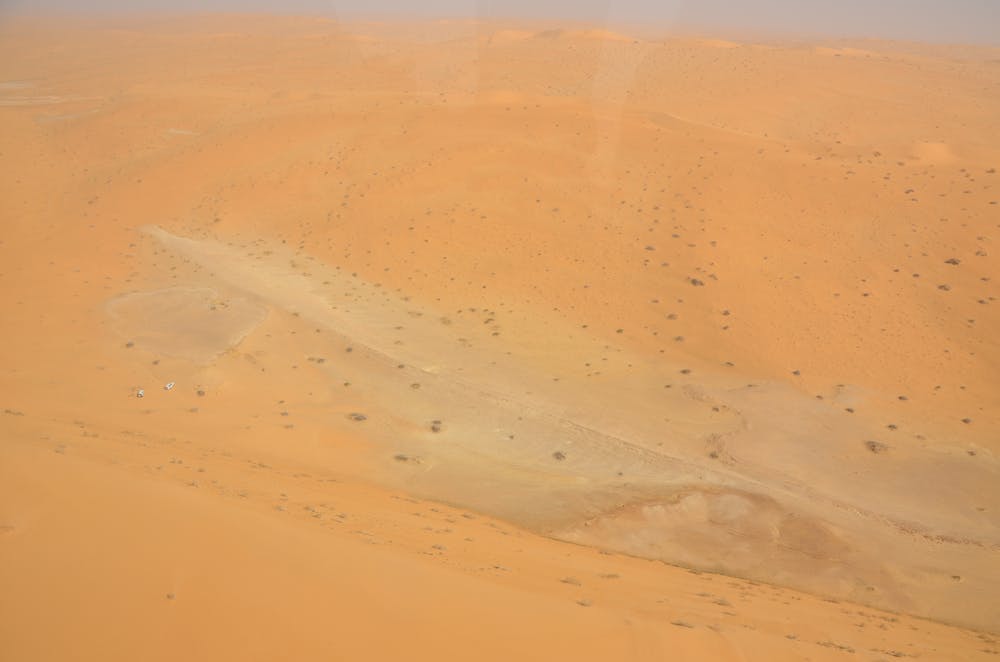 Aerial view of Khall Amayshan 4 showing the series of ancient lakebeds. See the two small, white 4WDs on the left for scale.
Julien Louys
Aerial view of Khall Amayshan 4 showing the series of ancient lakebeds. See the two small, white 4WDs on the left for scale.
Julien Louys
Today different populations around the world can be identified by their cultures, which include the tools they use, how they’re made and how they use them. Think chopsticks across Asia and forks in Europe, for example.
These tools are passed on to successive generations, even if those generations move from their point of origin. The way people made and used stone tools in the past also reflected patterns of cultural inheritance.
So by studying and comparing the stone tools from Arabia with those from surrounding regions, we can find out not just when people were living and moving through the region, but also where their ancestors had moved from and how they changed as they moved.
The most striking thing we found was that each assemblage of stone tools recovered from each ancient lakebed was very different from the others.
Our detailed examination of the lakebeds and the mammal fossils they preserved, including from hippos, clearly pointed to how much wetter, greener and more productive each of those phases were compared to the region today.
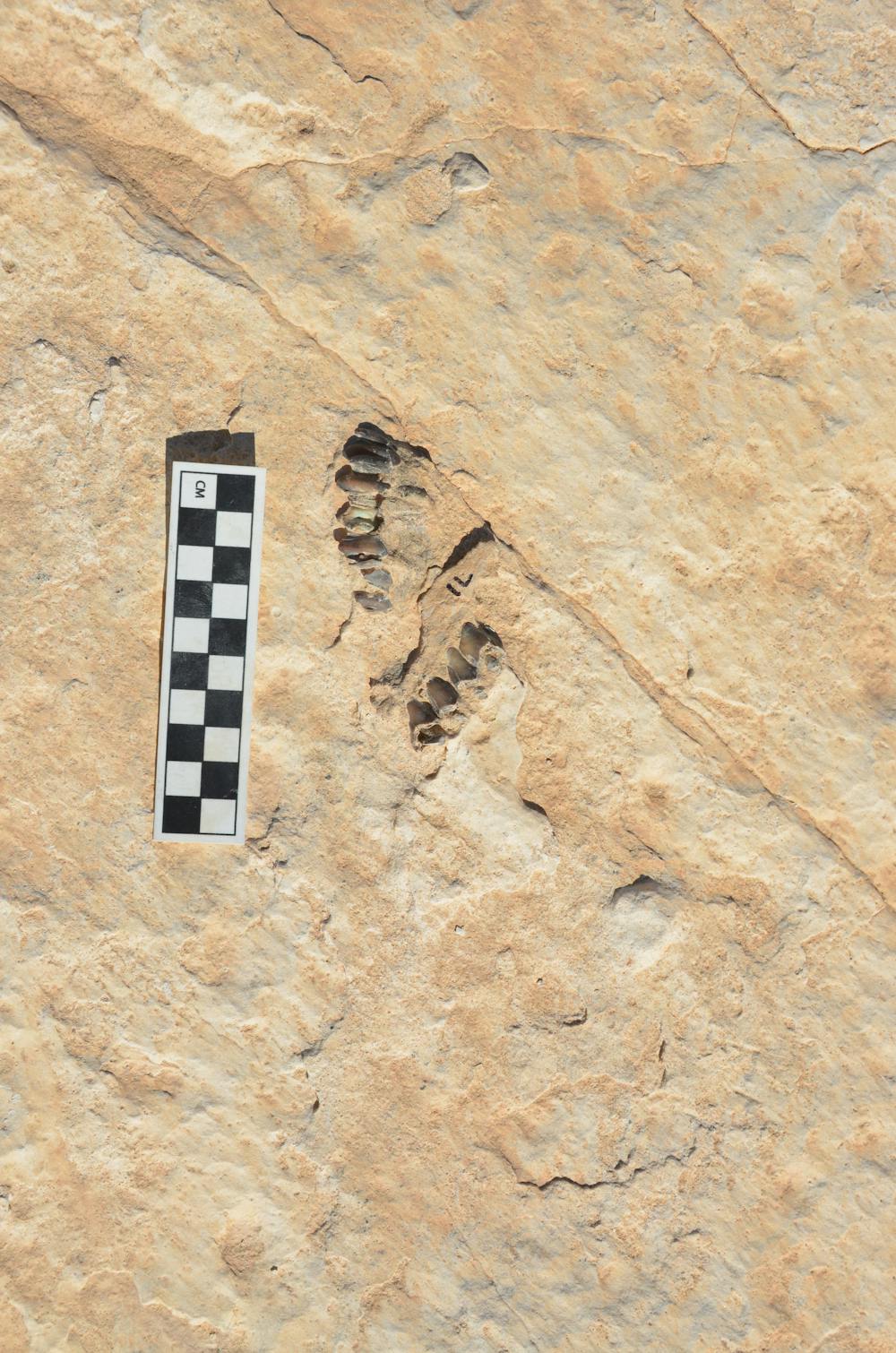 Antelope teeth eroding from an ancient lakebed in the Nefud Desert.
Julien Louys
Antelope teeth eroding from an ancient lakebed in the Nefud Desert.
Julien Louys
The different technologies associated with each green phase indicate there was no long-term continuity in the populations in the area. Instead, different populations, perhaps even different species of hominin, were moving in and out with each phase.
At the Jubbah Oasis around 150 km east of Khall Amayshan 4, two further sites – Jebel Qattar 1 and Jebel Umm Sanman 1 – filled in the last of the gaps in the timeline. These sites presented different stone tools dating to around 200,000 and 75,000 years ago, also associated with green phases.
Each of these phases occurs during wetter climatic periods, which are wetter due to the northern movements of the monsoon, bringing increased rainfall to the desert. Once the climate shifted back, however, conditions became arid again and humans and other fauna disappeared from Arabia.
Read more: Prehistoric desert footprints are earliest evidence for Homo sapiens on Arabian Peninsula
Our findings reveal the intimate association between early human migrations and patterns of climate change — wherein different groups of humans repeatedly made it out of Africa when conditions became favourable.
And this happened long before the dispersal event of 50-65,000 years ago, which finally saw their descendents permanently colonise other regions.
Yet dozens of questions remain. Were some of these migrations from northern Neanderthals? What became of these different populations? Where did they go? Could some have made it to Southeast Asia and hence to Australia?
The human story won’t be told completely until we explore more long-neglected areas, much like our ancestors once did.
Authors: Julien Louys, Deputy Director, Australian Research Centre for Human Evolution, Griffith University


















