

10 photography exhibitions that defined Australia
- Written by: Daniel Palmer, Professor, School of Art, RMIT University
Australians have always loved photography exhibitions. They are consistently among the most well attended at our museums and galleries, and have formed an important part of our cultural landscape since the middle of the 19th century.
Our research reveals a fascinating history of encounters, spaces, and techniques of display — hidden in more conventional accounts that focus on famous photographers and iconic images.
Here are ten exhibitions that represent some key chapters in this history.
Read more: Ten photos that changed how we see human rights
1. J. W. Newland’s ‘Daguerrean Gallery’, Sydney, 1848
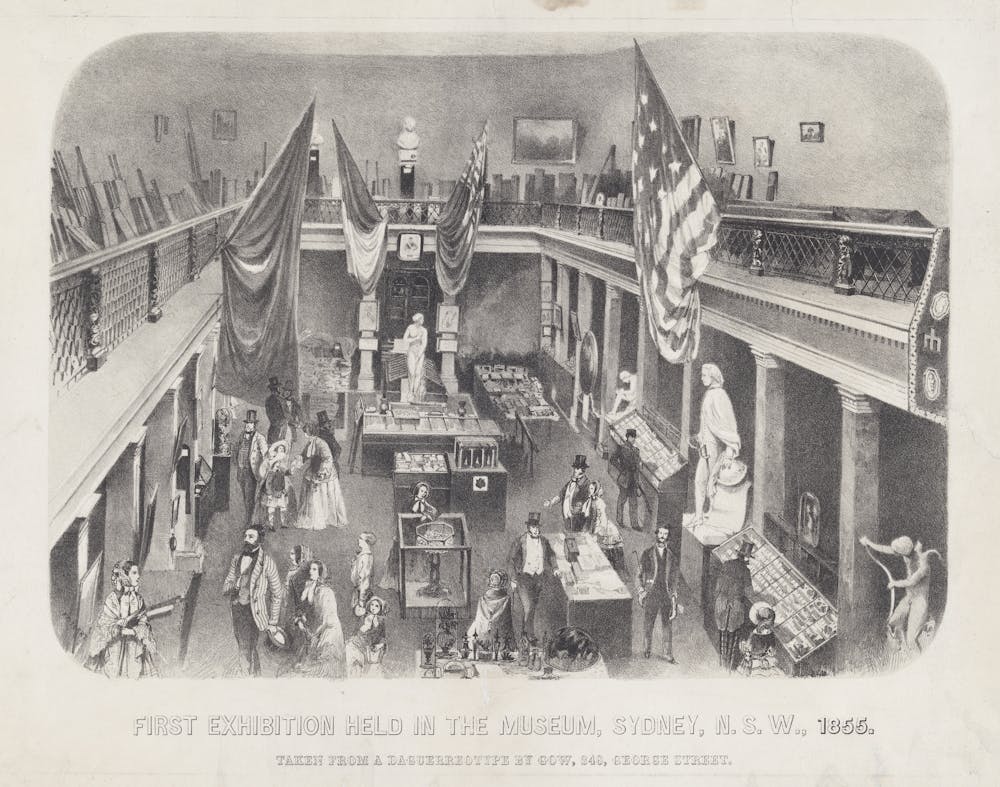 First exhibition held in the Museum, Sydney, NSW, 1855. Lithograph by F. C. Terry and John Degotardi after an 1854 daguerreotype by James Gow.
Courtesy National Gallery of Australia, Canberra
First exhibition held in the Museum, Sydney, NSW, 1855. Lithograph by F. C. Terry and John Degotardi after an 1854 daguerreotype by James Gow.
Courtesy National Gallery of Australia, Canberra
Visitors to Australia’s first photography exhibition in 1848 climbed the steps above a wine and spirits store in the centre of Sydney to the studio of J. W. Newland. He had just arrived with 200 daguerreotypes made during an almost three-year journey from New Orleans, thorough Central and South America, across the Pacific to New Zealand, and finally to Sydney.
In delicate images formed on polished silver plates ranging from the size of an iPad to an iPhone, visitors saw “views” of other great Pacific ports such as Peru’s Callao, “specimens” of various Indigenous people, and “likenesses” of celebrities they had only read about in newspapers. These included Queen Pomare IV of Tahiti who had famously become caught up in French and British colonial rivalry.
Visitors could also have their own portrait taken for the gallery, joining the other daguerreotypes Newland advertised as covering “two thirds of the globe”.
2. The Australian Intercolonial Exhibition, Melbourne, 1866
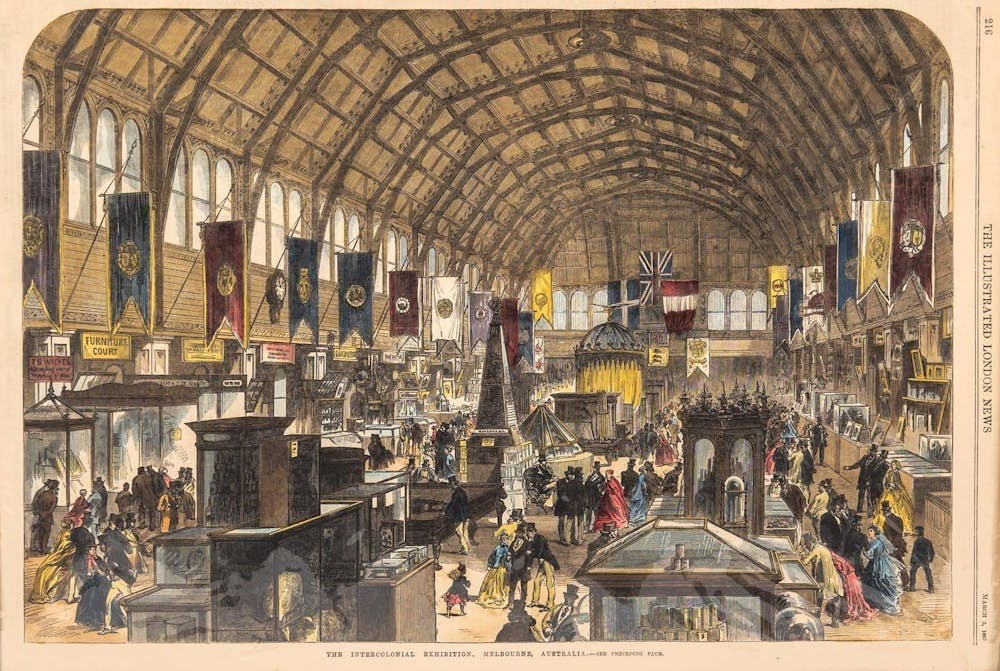 The Intercolonial Exhibition, Melbourne, Australia. Originally printed in The Illustrated London News March.
Author provided
The Intercolonial Exhibition, Melbourne, Australia. Originally printed in The Illustrated London News March.
Author provided
In 1866, where Victoria’s State Library now stands, two purpose-built, timber exhibition halls were filled with commodities from ten Australasian colonies for the first Intercolonial Exhibition. The hundreds of photographs crammed between the profusion of the displays were such an important component they attracted their own review from the now defunct Australian Monthly Magazine.
This “wanderer amongst the photographic views” thought they exhibited “the high standard of taste to which we, as inhabitants of new colonies, have arrived”. Like the pyramidal “trophies” of canned foods and confectionery placed throughout the exhibition spaces, the photographs visualised and quantified colonial prosperity.
Scale and spectacle were everything. Many views of the new colonial buildings were contact printed from glass plate negatives 25 x 30 cm in size, and one multi-panelled panorama of Sydney stretched over a metre in length. Viewers could peer into the binocular lenses of a stereoscope, which enabled them to see a number of paired images taken from slightly different angles as a sequence of 3D views of Hobart.
3. Harold Cazneaux’s ‘One Man Show’, Photographic Society of New South Wales, Sydney, 1909
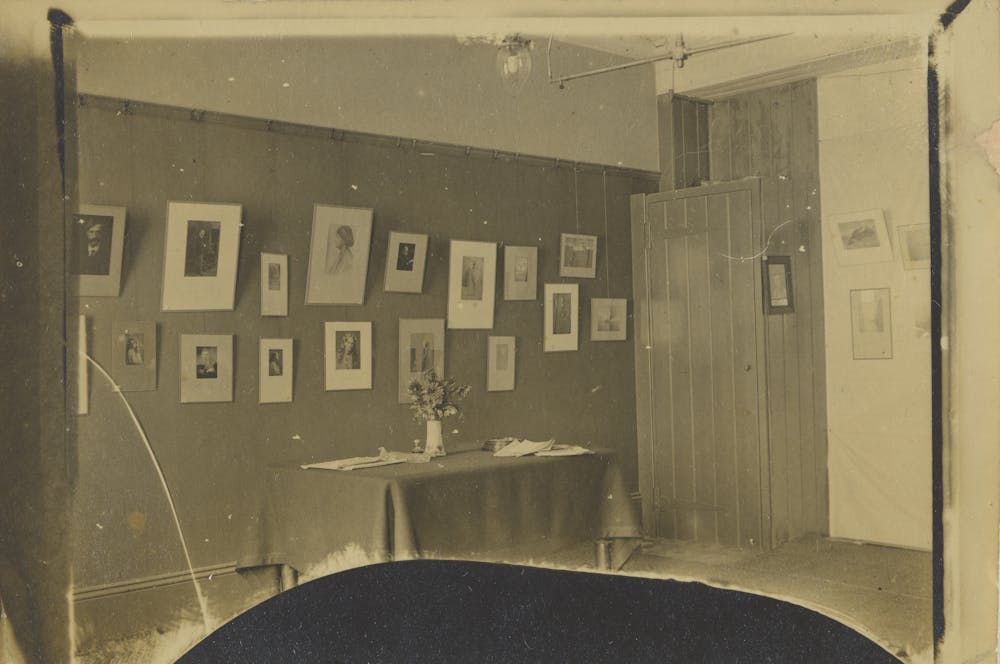 Harold Cazneaux’s One Man Show, Photographic Society of New South Wales, Sydney, 1909.
Courtesy National Gallery of Australia, Canberra
Harold Cazneaux’s One Man Show, Photographic Society of New South Wales, Sydney, 1909.
Courtesy National Gallery of Australia, Canberra
At the turn of the 19th century, Australian photography was transformed by the self-consciously artistic style of Pictorialism. In 1909, one of its emergent figures, Harold Cazneaux, held the first solo show by an individual Australian photographer.
Its 26 portraits, landscapes, seascapes, harbour scenes and “picturesque city corners” showed what “any energetic cameraist can secure in his lunch hour, if he is gifted with the ‘seeing eye’.”
Cazneaux proudly documented the tasteful installation of his show in the Sydney rooms of the Photographic Society of New South Wales. Each print was individually mounted behind a wide cardboard mat in an elegant frame and numbered, referring to a catalogue on a table beneath a vase of flowers. Cazneaux had set the template for thousands of photographers’ shows to come.
4. Wolfgang Sievers and Helmut Newton’s New Visions in Photography, Federal Hotel, Melbourne, 1953
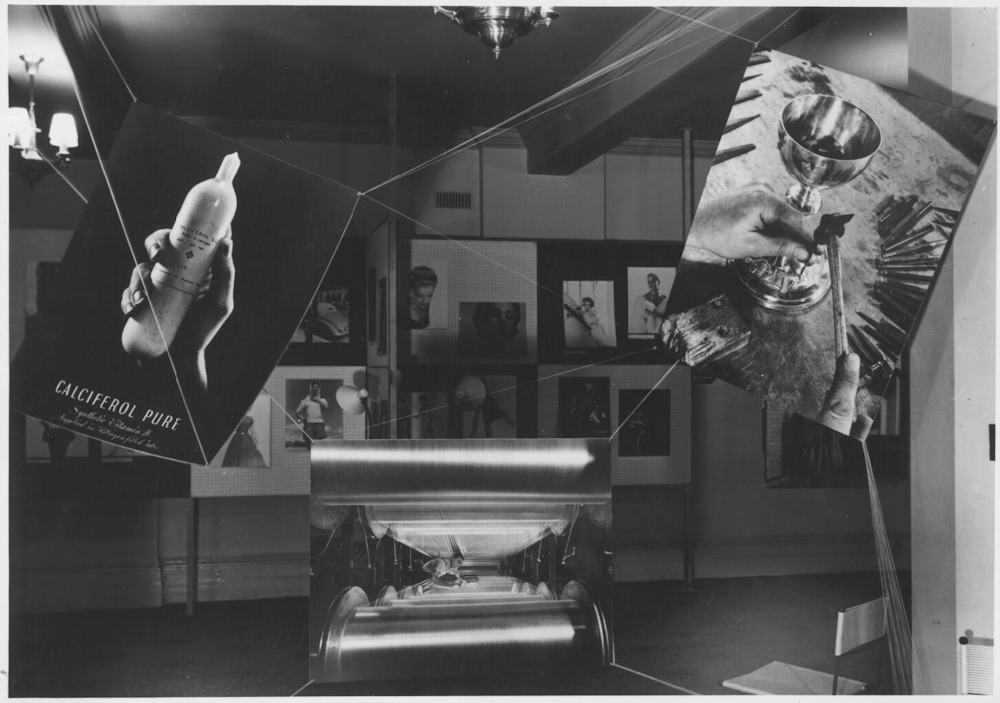 Wolfgang Sievers and Helmut Newton’s exhibition New Visions in Photography, Federal Hotel, Collins Street, Melbourne, 1953.
Photograph by Wolfgang Sievers. Courtesy National Library of Australia, Canberra
Wolfgang Sievers and Helmut Newton’s exhibition New Visions in Photography, Federal Hotel, Collins Street, Melbourne, 1953.
Photograph by Wolfgang Sievers. Courtesy National Library of Australia, Canberra
Staged over five days at the Federal Hotel on Melbourne’s Collins Street in 1953, Wolfgang Sievers and Helmut Newton declared the bold aim of New Visions in Photography in an introductory wall panel. It was “to demonstrate … the potential of industrial and fashion photography as a means of better promotion and bigger sales”.
The two German émigrés embodied a dramatically new approach to the photograph. Sievers’ industrial and architectural studies and Newton’s fashion images both exploited radical vantage points and close-ups to produce bold, graphic compositions in sharp, high contrast black and white — reflecting Australia’s emergence as a modern nation.
The magazine-like display matched the formal qualities of the photographs. Instead of framed images in a row, enlarged unframed photographs were presented on white pegboard and suspended in the air by fine thread, sometimes at radical angles.
This dramatic sculpting of space in the old hotel underscored Sievers and Newton’s belief in photography’s potential to make the world anew.
5. Urban Woman, Melbourne Town Hall, 1963
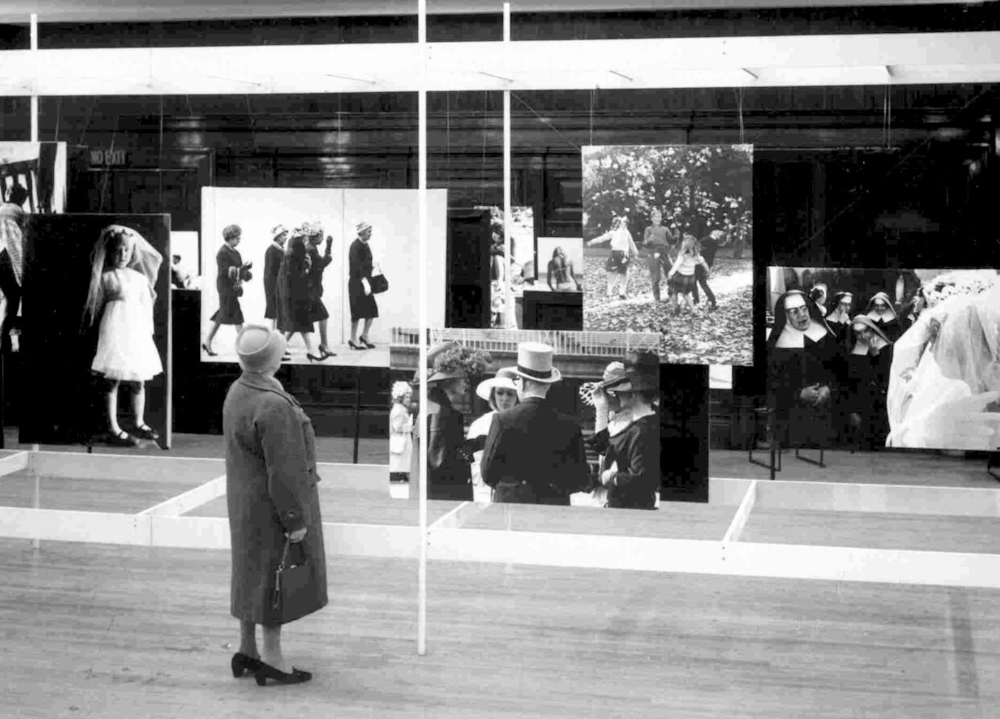 Group M’s exhibition Urban Woman, Lower Melbourne Town Hall, 1963.
Courtesy National Library of Australia, Canberra
Group M’s exhibition Urban Woman, Lower Melbourne Town Hall, 1963.
Courtesy National Library of Australia, Canberra
Urban Woman was the most ambitious and accessible exhibition by a collective of Melbourne-based amateur photographers including Albert Brown, George Bell, Roy McDonald and John Crook who called themselves Group M. Earnest teachers and chemists, they were inspired by the tradition of social documentary.
Urban Woman comprised over 200 mostly candid, long, focal length images by 13 photographers (all male), selected by designer Max Forbes. Inspired by the photographers’ observation of the “loneliness” of young suburban mothers, they aimed “to confront reality with an unprejudiced eye”.
The fact that an exhibition about women was made exclusively by men went unnoticed in the significant press coverage it attracted.
Conceived as a direct response to the international blockbuster The Family of Man, which toured to Australia in 1959, Urban Woman appealed to similar humanist sentiment. Its design featured purpose-built wooden structures to display huge, unframed prints, with subjects arranged from youth to old age.
6. Frontiers, National Gallery of Victoria, 1971
 Frontiers, National Gallery of Victoria, Melbourne, 1971.
Courtesy National Gallery of Victoria, Melbourne
Frontiers, National Gallery of Victoria, Melbourne, 1971.
Courtesy National Gallery of Victoria, Melbourne
The National Gallery of Victoria became the first Australian gallery to establish a department of photography in 1967, despite opposition from some trustees (one of whom referred to photography as a “cheat’s way of doing a painting”). At the time, it was one of only a handful of such departments in the world.
Frontiers featured the experimental and abstract photography of John Cato, Peter Medlen, Stanislaus Ostoja-Kotkowski, Mark Strizic and John Wilkins. All-male photography exhibitions remained common until the pioneering exhibitions of feminist photographers such as Sue Ford and Carol Jerrems in the mid-1970s.
The work in Frontiers was self-consciously contemporary, even psychedelic. Cato’s environmental protest work comprised 52 prints installed on crimson screens with strobe lighting. Ostoja-Kotkowski’s light transparencies, formed by laser beams and infra-red, were backlit from spotlights mounted on the ceiling. Strizic presented a 10-metre colour mural (later destroyed due to chronic fading).
7. William Yang, Sydneyphiles, Australian Centre for Photography, 1977
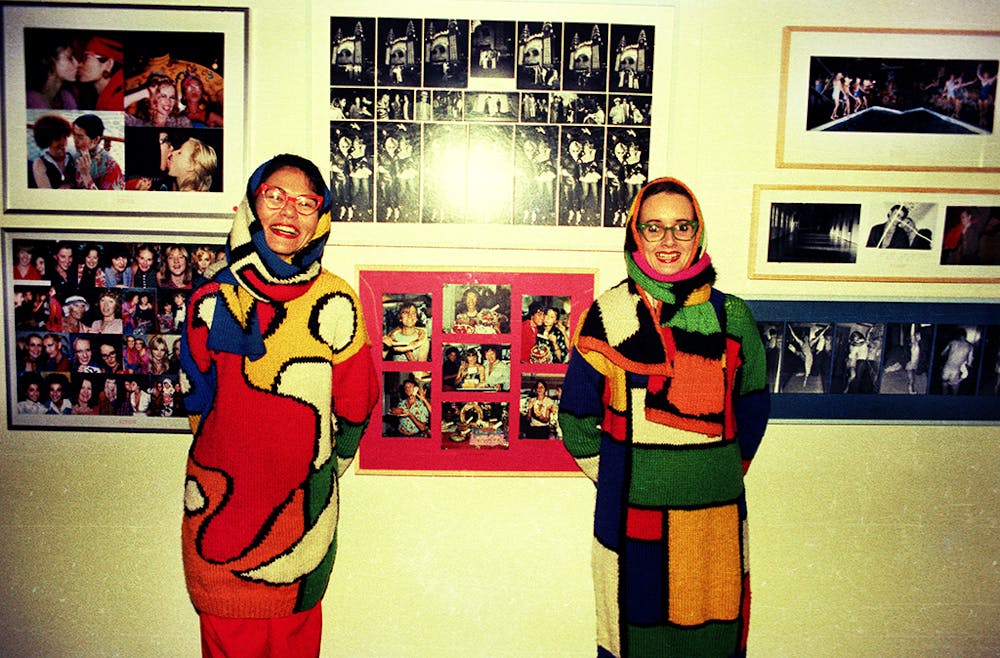 William Yang, Sydneyphiles, Australian Centre for Photography, Sydney, 1977.
Courtesy the artist
William Yang, Sydneyphiles, Australian Centre for Photography, Sydney, 1977.
Courtesy the artist
In 1977, William Yang used the walls of the new Australian Centre for Photography for a diaristic exhibition, Sydneyphiles. This was Yang’s first exhibition, in which his small scale colour and black and white photographs of Sydney’s gay community and its art, fashion and socialite scenes were hung closely alongside and above each other to cover the walls like a giant personal scrapbook.
Sydneyphiles is significant for reasons beyond its controversial sexual content. It was an early example of the Centre moving beyond a more conventional framed black and white modernist tradition.
It is likely the first exhibition by an Asian-Australian photographer, and it included its community as part of the event (the press release notes Yang “invited many of the subjects of his photography” to his exhibition). Yang later said the exhibition “launched me as a photographer”.
8. National Aboriginal and Islander Photographers Exhibition, Aboriginal Artists Gallery, Sydney, 1986
 NADOC 86 Exhibition of Aboriginal and Islander Photographers, Aboriginal Artists Gallery, Sydney, 1986. Back row: Darren Kemp, Michael Riley, Tracey Moffatt, Brenda L. Croft, Mervyn Bishop; front row: Tony Davis, Chris Robinson.
Photograph by William Yang. Courtesy William Yang
NADOC 86 Exhibition of Aboriginal and Islander Photographers, Aboriginal Artists Gallery, Sydney, 1986. Back row: Darren Kemp, Michael Riley, Tracey Moffatt, Brenda L. Croft, Mervyn Bishop; front row: Tony Davis, Chris Robinson.
Photograph by William Yang. Courtesy William Yang
The first exhibition in which Aboriginal people had control over their own photographs took place in 1986 during what is now known as NAIDOC week. On the raw brick walls of Sydney’s Aboriginal Artists Gallery, ten Indigenous photographers hung their exhibition.
They included Mervyn Bishop, Australia’s first Aboriginal press photographer, and others such as Brenda L. Croft, Michael Riley and Tracey Moffatt, who went on to become important figures in Australian art.
The show featured photographs that later became touchstones, such as Moffatt’s portrait of actor David Gulpilil relaxing at Bondi beach in board shorts and face paint.
It was an immediate success, as Moffatt ruefully commented: “To be honest, we got the kind of publicity which makes me want to vomit; e.g. ‘they’re Aborigines, they’re articulate, and gee whizz, they take good pictures’ sort of stuff. I guess I shouldn’t complain because we got a lot of people coming through looking at the show and buying work, which is what we do like!”
9. Photography Is Dead! Long Live Photography!, Museum of Contemporary Art, Sydney, 1996
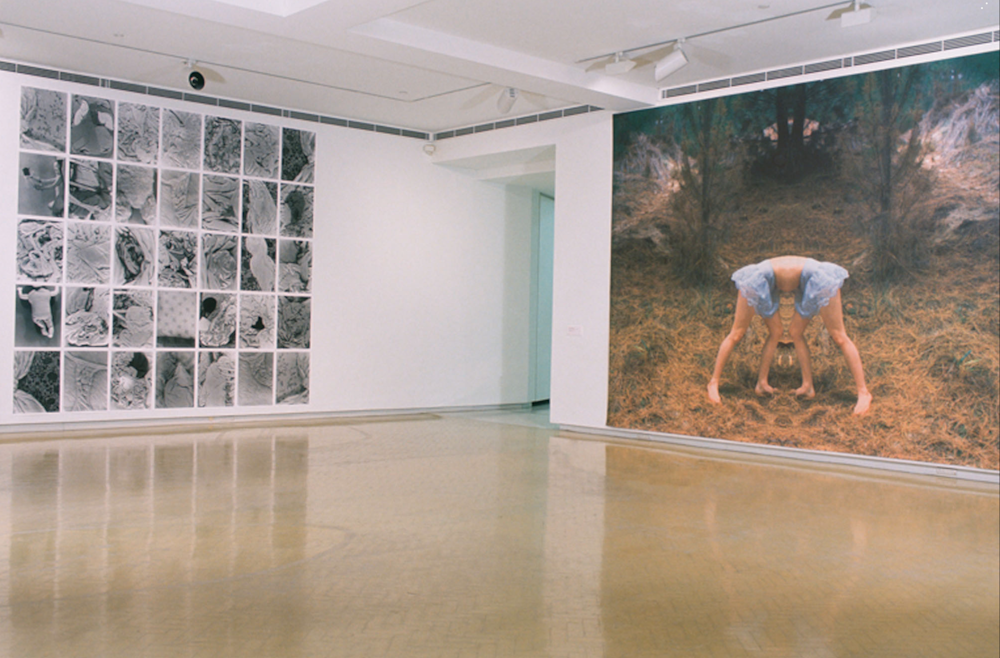 Photography is Dead! Long Live Photography!, 1996, curated by Linda Michael, showing work by Pat Brassington and Jane Eisemann, Museum of Contemporary Art, Sydney.
Courtesy the artist, Tolarno Galleries, Melbourne and Museum of Contemporary Art, Sydney
Photography is Dead! Long Live Photography!, 1996, curated by Linda Michael, showing work by Pat Brassington and Jane Eisemann, Museum of Contemporary Art, Sydney.
Courtesy the artist, Tolarno Galleries, Melbourne and Museum of Contemporary Art, Sydney
In 1996, as the medium was being transformed by the impact of digital photography, the Museum of Contemporary Art mounted Photography Is Dead! Long Live Photography! For curator Linda Michael its 32 exhibitors were “artists using photography”, not photographers per se. They saw photographs not as transparent windows onto the world, but as a material within themselves.
Some large unframed prints were suspended to curl delicately out from the wall, others were bonded onto aluminium for an industrial look; some were expressionistically cut up, others were physically sculpted.
Some — such as Jane Eisemann’s surrealist imagery and Patricia Piccinini’s glossy advertising style portraits of a celebrity starlet holding a genetically modified pet — were digitally produced, with computer manipulation an intrinsic part of their meaning.
10. Hoda Afshar’s Remain, The Substation, Melbourne, 2019
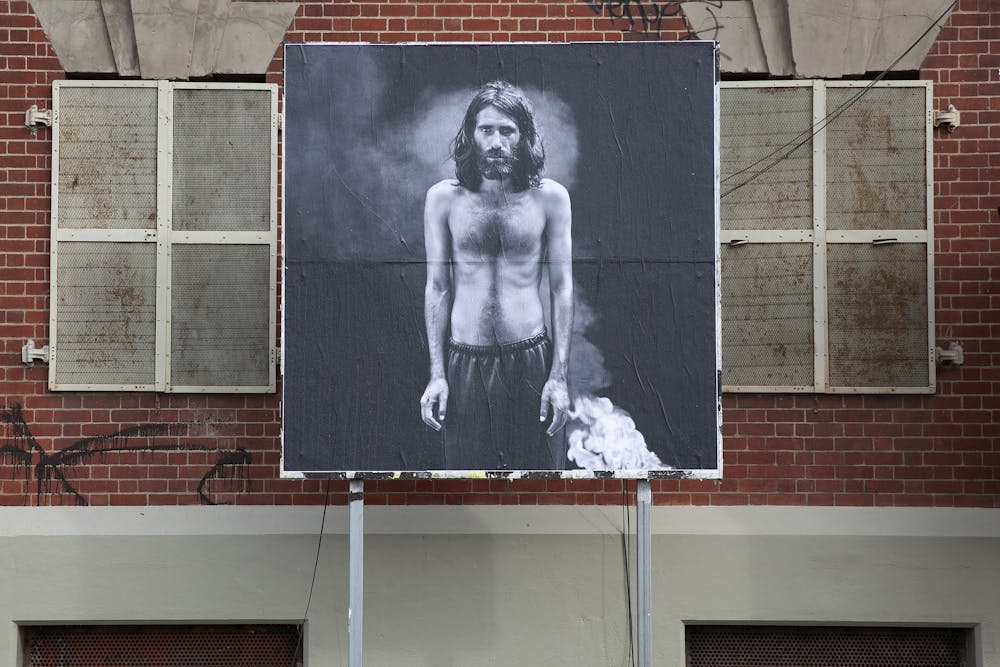 Hoda Afshar’s exhibition Remain, The Substation, Melbourne, 2019.
Photograph by Leela Schauble. Courtesy the artist and The Substation, Melbourne
Hoda Afshar’s exhibition Remain, The Substation, Melbourne, 2019.
Photograph by Leela Schauble. Courtesy the artist and The Substation, Melbourne
Photographs have long appeared in public space in the form of corporate messaging. They can be projections or billboards. To offer different messages, Tehran-born, Melbourne-based artist Hoda Afshar is one of many who have taken advantage of inexpensive, large-scale printing to give voice to the experiences of marginalised people.
In 2019 Afshar presented her striking, collaboratively-produced portraits of asylum seekers incarcerated by the Australian Government on Manus Island on 2.4-metre-high billboards along the train line that skirts The Substation in the western Melbourne suburb of Newport.
The Christ-like image of the Iranian journalist Behrouz Boochani was already becoming iconic, having won a major photography prize and circulated in newspapers and Afshar’s Instagram account (arguably the most important site for photography today).
But the public display amplified the political potency of her ghostly black-and-white portraits to new audiences. As she has said, “When you make a socially and politically engaged work, the intention is to communicate with the people”.
These moments are drawn from our book Installation View: Photography Exhibitions in Australia (1848-2020) published by Perimeter Editions in 2021.
Authors: Daniel Palmer, Professor, School of Art, RMIT University
Read more https://theconversation.com/friday-essay-10-photography-exhibitions-that-defined-australia-166755


















