

how The Age got entangled in competing pandemic storylines
- Written by: Denis Muller, Senior Research Fellow, Centre for Advancing Journalism, The University of Melbourne
Two distinct narratives have emerged in the public debate about COVID-19, a narrative of hope and a narrative of threat.
In the polarised atmosphere of our times, each has become politically branded.
This is partly because of deliberate exploitation by politicians and partly because of a genuine conflict in public attitudes about the management of the pandemic.
It is a conflict vividly demonstrated by the visceral reaction to an editorial published by The Age on September 1 headed “Victoria can’t go on like this”.
The fallout was such that the editor, Gay Alcorn, felt the need to write an open letter explaining how and why the editorial was written, and describing the response. She said in part:
The reaction to this editorial was extraordinary. Behind our live news blog, this was the most-read article on The Age online, almost unheard of for an editorial.
Some readers were furious, saying we had undermined public-health messages, had politicised the pandemic and that Peter Costello (chairman of The Age’s parent company, Nine Entertainment) must have written it. Then there were comments that it was a relief, the best editorial The Age had published for years and that it had articulated what many people were thinking and feeling at this moment.
Alcorn summarised the editorial’s argument in these terms:
It suggested that we had reached a point in Victoria where the harm strict lockdowns are causing should be factored in a little more when decisions about restrictions are made.
When the editorial is read as a whole, it is a lot stronger than that. The relevant paragraph says:
But there comes a point, and The Age believes that point has been reached, where the damage caused by the harshest and longest lockdowns in the country needs to be more seriously factored in. Wednesday’s announced “easing” was a harsh and cruel blow. Playgrounds can open on Friday (although, in true Victorian style, only one carer can attend and they cannot remove their mask even to eat or drink). Few experts ever endorsed the playground ban in the first place.
Among the furious responses was an article submitted to the paper by historian Emeritus Professor Jenny Hocking, author of The Palace Papers, the celebrated unearthing of correspondence between Sir John Kerr and Buckingham Palace concerning the dismissal of the Whitlam Government in 1975.
Hocking’s characterisation of the editorial was quite different from Alcorn’s. By way of illustration, she quoted this passage:
No more lectures about compliance. No more measures that have limited if any evidence to back them just in case they might assist around the edges.
This, Hocking wrote,
would have to be the most irresponsible and divisive editorialising imaginable in the midst of a pandemic. The work of the Victorian public health team over the past 18 months has been exceptional, it demeans The Age as much as it does that team to suggest that they might introduce measures without evidence, “just in case”.
It’s barely a month ago that the prime minister and Treasurer Josh Frydenberg (a Victorian, remember!) were applauding NSW Premier Gladys Berejiklian for refusing to lockdown early, even as numbers of infections were rising exponentially.
Hocking’s piece appeared in John Menadue’s blog, Pearls and Irritations, with a footnote saying The Age had declined to publish it.
Read more: Right-wing shock jock stoush reveals the awful truth about COVID, politics and media ratings
There is enough in these brief extracts to illustrate the political undercurrents running through the narratives of hope and threat.
It is on the public record that Morrison and Frydenberg repeatedly berated Victoria’s Labor government over its imposition of lockdowns while praising the Liberal-National Coalition government of New South Wales for abjuring lockdowns in favour of reliance on swift contact-tracing: the so-called “gold standard”.
It is looking like fool’s gold now.
With a federal election due inside nine months, Morrison and his ministers have started cranking up the narrative of hope. “There is light at the end of the tunnel” has become a stock phrase.
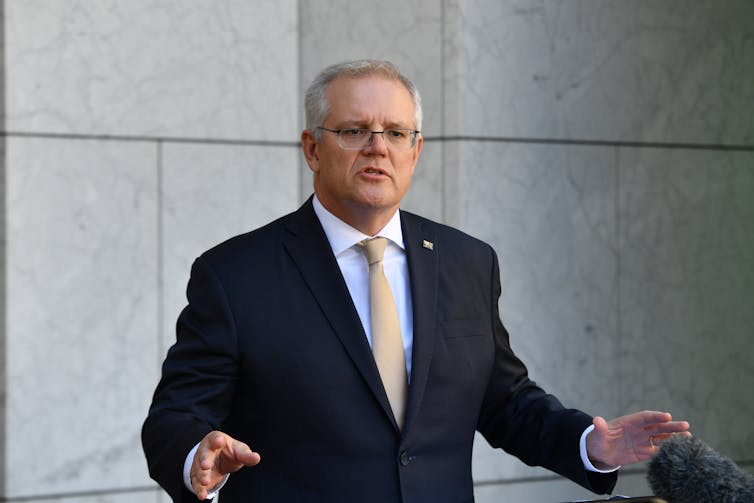 Prime Minister Scott Morrison has gone hard on the ‘narrative of hope’ in recent weeks.
Mick Tsikas/AAP
Prime Minister Scott Morrison has gone hard on the ‘narrative of hope’ in recent weeks.
Mick Tsikas/AAP
Morrison has also wheeled out the popular if fatuous expression that “it is darkest before dawn”. For him, the narrative of hope is all about positioning himself for the election.
Berejiklian, while criticising his government for the shortage of vaccine, has joined him in the chorus of hope, doubtless hoping to save her own skin too.
Meanwhile the Labor governments of Queensland, Victoria and Western Australia – as well as the Liberal government of South Australia – have adhered to the narrative of threat: threat to people’s health and threat to the sustainability of their hospital systems.
The resounding election wins for Labor in Queensland (2020) and Western Australia (2021) were based on the narrative of threat. They showed it to be a potent political weapon, and one that Morrison cannot get his hands on.
This is the background against which The Age published its editorial.
In Australia’s polarised media landscape, News Corporation champions the right while The Age, The Sydney Morning Herald, the ABC and Guardian Australia are seen as providing a counterpoint on the centre-left.
In this atmosphere of polarisation, any concession to the narrative of hope by those of the centre-left is seen as a sell-out. Yet, as anyone living through the sixth Melbourne lockdown knows, there is a need for some hope. Nothing reckless, just something.
Victorian Premier Daniel Andrews has subtly shifted his messaging in that direction.
The Age’s editorial can be seen as a recognition of this shift in sentiment, but its tone – “enough” – was impatient.
It also called for clear evidence that what it calls harsh restrictions are effective. This is not reasonable.
The Victorian Chief Health Officer, Professor Brett Sutton, has said repeatedly it is difficult to know precisely what contribution each measure makes, but taken together, they keep the rate of infection down. That much is demonstrably true, as a comparison with New South Wales makes clear.
However, evidence about the efficacy of specific measures is likely to be obtainable only in retrospect when enough comparative data from enough jurisdictions can be analysed.
The editorial is on stronger ground when it demands more information on what is known about the patterns of spread and on the modelling that shows the effects of various estimated rates of spread on people’s health and the health system.
The sane elements of the media, of which The Age is one, serve the community better when their opinions are measured and do not feed into the political polarisation developing around the pandemic.
Authors: Denis Muller, Senior Research Fellow, Centre for Advancing Journalism, The University of Melbourne


















