

What is hospital in the home and when is it used? An expert explains
- Written by: Martin Hensher, Associate Professor of Health Systems Financing & Organisation, Deakin University
The hospital in the home program has been used to care for COVID patients at home, according to a recent report by The Saturday Paper.
Expert opinion is divided on whether or not such COVID cases should be included in the hospitalisation rate figures released by governments; that question goes beyond my area of expertise, but what I can talk about is how hospital in the home works, and why we have it.
What is hospital in the home?
Many health services in most states in Australia operate hospital in the home services, allowing patients to receive nursing care, allied health care and medical care in their own home.
Being treated at home is better for the patient in many ways. If you don’t need to be in hospital, you shouldn’t be there.
Hospital in the home (sometimes abbreviated to HITH) also allows people to be kept out of hospital, which frees up beds for those who are more severely unwell.
Read more: The 'hospital in the home' revolution has been stalled by COVID-19. But it's still a good idea
What about COVID and hospital in the home?
New South Wales appears to be using hospital in the home for COVID patients as an admission prevention service.
In other words, hospital in the home is being used to give quite intensive monitoring for people who are COVID positive and feeling quite poorly — but who don’t require inpatient care at this time.
NSW premier Gladys Berejiklian said over the weekend that “if you need oxygen you’ll be taken to hospital”, reiterating a point made earlier by that state’s health minister, Brad Hazzard.
Hospital in the home involves very active monitoring.
The idea is that people who don’t need to be in hospital shouldn’t be in hospital — but if the situation worsens, they will be transferred quite quickly via ambulance. (It’s worth noting, however, that recent reporting has described an ambulance system under strain.)
Any nursing, medical or allied health staff visiting a COVID patient in the home would need to be wearing the same personal protective equipment (PPE) as they would be if dealing with COVID patients in hospital.
What other conditions might you be treated for in hospital in the home?
Traditionally, there were two main kinds of hospital in the home services.
One form of this service aims to prevent people from being admitted to hospital in the first place.
That might be, for example, someone with diabetes who has been having trouble controlling their condition and is becoming fairly ill. Hospital in the home allows that person to be managed at home with more intensive inputs to get the diabetes under control without having to go into hospital.
Other conditions that can sometimes be managed via hospital in the home care include pneumonia, deep vein thrombosis, chronic obstructive pulmonary disease (COPD) and urinary tract infections.
The other main type of hospital in the home care is early discharge. Early discharge hospital in the home is for patients who have already been in hospital for something like a fall or major surgery.
Hospital in the home helps get you out of hospital earlier so you can get your recovery and rehabilitation started at home quicker; you might still be receiving quite an intense level of care, but you can receive it at home rather than stay extra days in hospital.
Hospital in the home is often used very successfully with older people after orthopaedic procedures.
What are the benefits for patients?
For patients who are not critically ill, there are many benefits to being treated at home.
As colleagues and I outlined in a previous article on The Conversation, research on the use of hospital in the home services (in the pre-COVID era) is associated with a lower likelihood of readmission within 28 days (2.3% vs 3.6%) and lower rates of patient deaths (0.3% vs 1.4%), compared with being an inpatient.
Home is a less stressful environment and is less disruptive at night (allowing for better quality of sleep).
And in cases where a person needs nursing care for a non-COVID related condition, there is another benefit to home-based care — you don’t have to share a room with a stranger.
Also, your carers and family can be with you in a way that’s much more convenient for them.
And crucially, you are less likely to pick up a hospital-acquired infection.
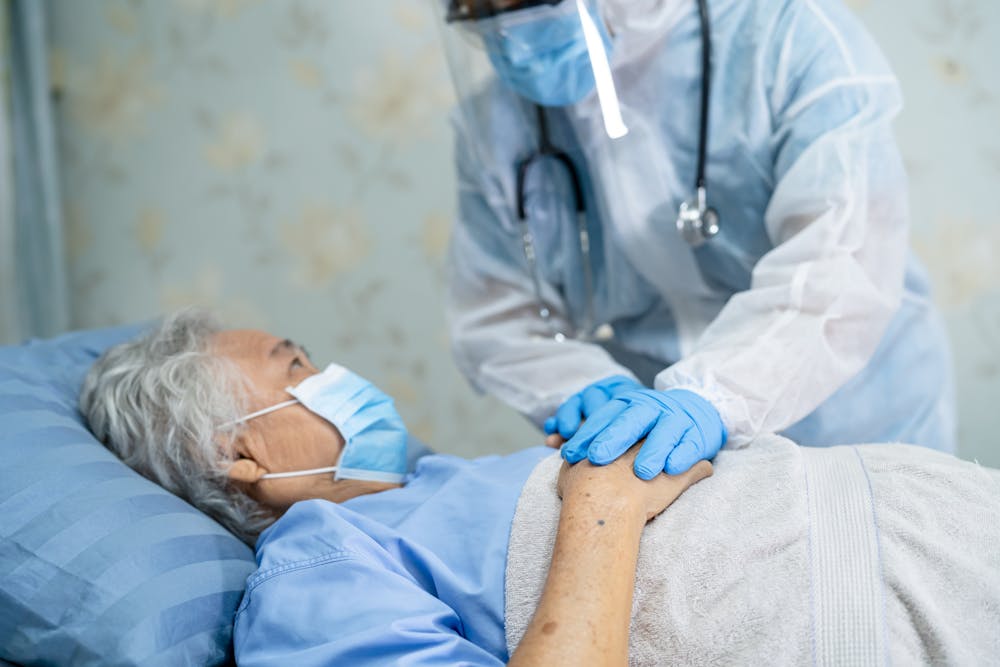 Hospital in the home involves very active monitoring.
Shutterstock
Hospital in the home involves very active monitoring.
Shutterstock
What sort of care do you get in hospital in the home?
Nursing staff might be with you for a couple hours of day, changing dressings, administering drugs, changing intravenous lines.
The backbone of hospital in the home service is nursing and hospital in the home teams use highly qualified nursing staff.
Many hospital in the home programs have their own doctors or are linked to the hospital medical teams, so a patient might have registrars or a medical specialist coming out to see them (although possibly not every day).
Depending on the patient’s condition, the hospital in the home team may also include physiotherapists or occupational therapists.
There are some hospital in the home services that are very specialised. For example, there are paediatric hospital in the home services and a few mental health hospital in the home services, with specialist nurses and psychiatrists as part of the team.
Who is eligible for hospital in the home services?
It depends on your condition.
Clinically, the key characteristic for hospital in the home is that you are someone who is quite ill, or recovering from a fairly major procedure, and you need quite close care and monitoring for a period of days — but you are not so ill that the healthcare professionals are really worried you might decline rapidly.
If your healthcare team thinks you might decline rapidly, you’ll go to hospital.
Hospital in the home is used much more by public hospitals, but a few private hospitals are starting to develop hospital in the home services too. Some private health insurers will now pay for it via private hospitals.
What are the downsides of hospital in the home?
There is always some risk that we may have selected the wrong patient for hospital in the home care, and that they should have been in hospital.
But what hospital in the home teams are trained to do well, and what they spend a lot of time doing, is monitoring that risk incredibly closely. If things start to go wrong, the patient is transferred straight to hospital.
People usually expect hospital in the home will be cheaper for the public health system as a whole than hospital care — but in reality it’s not a lot cheaper for the public health bill.
This reflects the fact that hospital in the home uses very similar resources to an inpatient ward to ensure that appropriate, high quality care is offered — but it provides many other benefits to patients, families, and the health system.
Authors: Martin Hensher, Associate Professor of Health Systems Financing & Organisation, Deakin University


















