

New analysis shows Morrison government funding won't cover any extra uni student places for years
- Written by Mark Warburton, Honorary Senior Fellow, Centre for the Study of Higher Education, The University of Melbourne
The federal government’s promise to deliver more student places through its Job-ready Graduates Package was hollow rhetoric, as research released today demonstrates.
From university funding agreements, we now know the maximum subsidy payable to each university from 2021 to 2023.
My research shows the total amount made available isn’t enough to provide subsidies for any extra student places, let alone the extra 30,000 this year announced by Treasurer Josh Frydenberg in his budget speech in May.
Federal Treasurer Josh Frydenberg delivers the budget in May.One year ago, the government legislated major changes to higher education funding, marketed as Job-ready Graduates. In selling these changes, the then education minister, Dan Tehan, said:
“[…] our government wants more Australians to have the opportunity to benefit from a university education. Because of the surge in demand caused by the COVID-19 recession we need those additional places from next year. Doing nothing for one or two years will not help the year 12s of 2020 and the Australians looking to retrain in 2021. Deferring our economic recovery helps no one and risks scarring a generation.”
The changes meant that, on average, student contributions should increase while government subsidies for student places decrease. An increase in student places was one of the major reasons given for accepting these changes. If we could rely on the government rhetoric about its policy, then every year this decade we should have seen more working-age Australians able to enrol in higher education than ever before.
Read more: The 2021-22 budget has added salt to universities' COVID wounds
What did the government promise?
The Job-ready Graduates promise was to increase the total subsidy for student places over time. This growth was in recognition of the extra demand that would arise in areas of high population growth and from the “Costello baby boom” generation reaching university age.
The government promised 27,000 extra domestic student places in 2021 and nearly 100,000 by 2030. In 2019, there were 627,545 Commonwealth-supported student places.
 The government response to questions on notice about how many new Commonwealth-supported places there will be each year.
Commonwealth Parliament
The government response to questions on notice about how many new Commonwealth-supported places there will be each year.
Commonwealth Parliament
The government doesn’t fund a set number of student places. Under the Job-ready Graduates arrangements, it sets the maximum subsidy it will pay to a university for student places. Each student place attracts a set subsidy, with the amount varying depending on its discipline.
Each university is free to decide the number and mix of student places it provides. But it is paid the subsidy for student places only up to the maximum amount set for it by the government. If it provides places beyond its subsidy cap, it receives only the student contribution. This would usually not be enough to cover costs.
Read more: 3 flaws in Job-Ready Graduates package will add to the turmoil in Australian higher education
I advised the Senate committee inquiry into the changes that it was a mystery how the government had produced its estimate of the number of student places to be created. We now know the maximum subsidy payable to each university from 2021 to 2023 from the publicly available funding agreements of universities. We also know how this maximum amount is proposed to increase each year to 2030.
Unis continue to be short-changed on subsidies
With Job-ready Graduates, the government appeared to radically change its attitude to funding student places from the previous three years. In 2018 and 2019, it froze funding. In 2020, subsidies increased by less than inflation. These decisions effectively reduced the number of government-subsidised student places.
By 2019, there were 27,800 places in the system from which the government was withholding over A$322 million in subsidies.
Universities were bearing that cost when COVID-19 hit in 2020. The government response to the pandemic, notably closing the borders to international students, continues to reduce the revenue universities receive.
Read more: Universities lost 6% of their revenue in 2020 — and the next 2 years are looking worse
Hidden in the detail of the transition to Job-ready Graduates is another source of subsidy shortfall that will further limit universities’ ability to provide student places. “Grandfathered students” are students who started their courses before the changes took effect in 2021. They are protected from having to pay higher student contributions. To ensure funding for their places is not severely cut, the old, higher government subsidy rate continues for them.
In reality, university subsidy limits do not adequately allow for these grandfathered students. The shortfall is likely to be around $300 million over the time they take to complete their courses. Around $200 million relates to the period from 2023 to 2025.
Shortfall exceeds $1 billion by 2024
The total amount of government subsidy over the next decade is shown in the chart below.
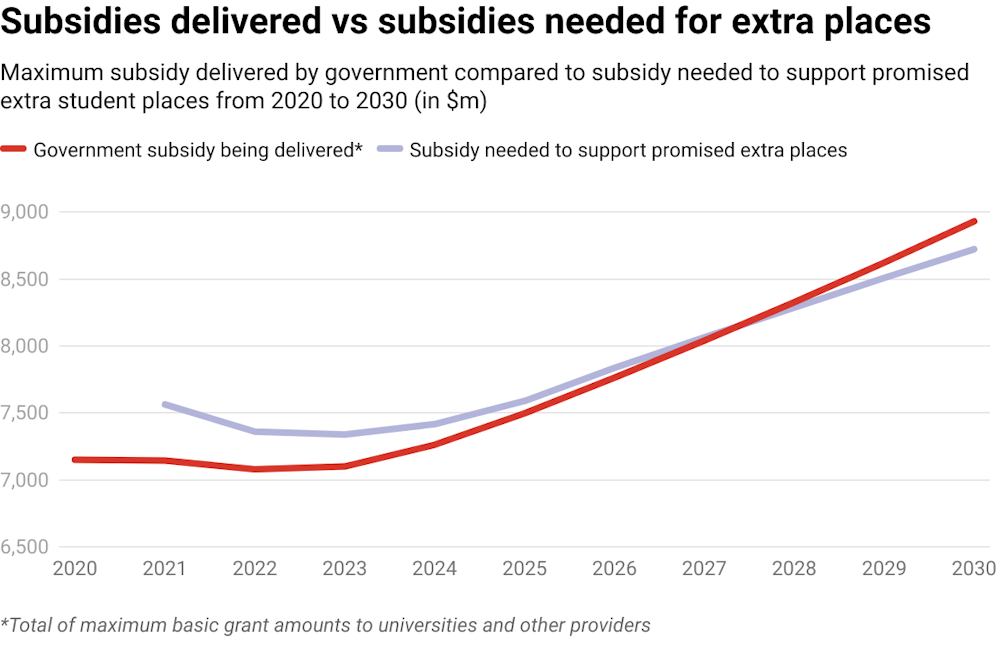 Data: M. Warburton, The rhetoric and reality of Job-ready Graduates (2021), Author provided
The amount made available in 2021 is not enough to provide subsidies for any additional student places. The combined effect of the changes since 2018 is that, in 2021, the government has underdelivered on its promised subsidy level by the equivalent of 39,000 student places – the 27,000 extra places promised under Job-ready Graduates and 12,000 places in the system since 2019 that remain unsubsidised.
While the shortfall reduces over time, by 2024 the government is still subsidising around 14,000 fewer student places than it promised. It would need to provide about $1.1 billion more in subsidy from 2021 to 2024 to honour the claims it made to the public and the parliament.
The government explicitly set student contributions to influence student choices. It was trying to encourage students into disciplines that it considered would make them job-ready. If students respond as desired, they will shift from disciplines with low subsidies into more highly subsidised disciplines.
If successful, however, this policy would increase the average cost of subsidy per place. And that would reduce the number of subsidised places that universities could provide within their maximum subsidy level.
Read more:
The government would save $1 billion a year with proposed university reforms — but that's not what it's telling us
If the government was serious about ensuring universities were able to support Australia’s economic recovery, it could have adopted a policy that was both more effective and simpler. As a first step, it could have provided the subsidies to support the student load already in the system in 2019. It could then have increased subsidy levels so that from 2021 to 2023 working-age Australians have the same opportunities to undertake higher education that they had from 2014 to 2017 before the funding freeze.
In the long term, the rate of growth in subsidies may restore these opportunities, but that time is two elections away. By then, reducing government debt may be the priority. If the government of the day decides to abandon the policy of increasing subsidies each year, it will not require any legislative change.
Read more:
Big-spending 'recovery budget' leaves universities out in the cold
Data: M. Warburton, The rhetoric and reality of Job-ready Graduates (2021), Author provided
The amount made available in 2021 is not enough to provide subsidies for any additional student places. The combined effect of the changes since 2018 is that, in 2021, the government has underdelivered on its promised subsidy level by the equivalent of 39,000 student places – the 27,000 extra places promised under Job-ready Graduates and 12,000 places in the system since 2019 that remain unsubsidised.
While the shortfall reduces over time, by 2024 the government is still subsidising around 14,000 fewer student places than it promised. It would need to provide about $1.1 billion more in subsidy from 2021 to 2024 to honour the claims it made to the public and the parliament.
The government explicitly set student contributions to influence student choices. It was trying to encourage students into disciplines that it considered would make them job-ready. If students respond as desired, they will shift from disciplines with low subsidies into more highly subsidised disciplines.
If successful, however, this policy would increase the average cost of subsidy per place. And that would reduce the number of subsidised places that universities could provide within their maximum subsidy level.
Read more:
The government would save $1 billion a year with proposed university reforms — but that's not what it's telling us
If the government was serious about ensuring universities were able to support Australia’s economic recovery, it could have adopted a policy that was both more effective and simpler. As a first step, it could have provided the subsidies to support the student load already in the system in 2019. It could then have increased subsidy levels so that from 2021 to 2023 working-age Australians have the same opportunities to undertake higher education that they had from 2014 to 2017 before the funding freeze.
In the long term, the rate of growth in subsidies may restore these opportunities, but that time is two elections away. By then, reducing government debt may be the priority. If the government of the day decides to abandon the policy of increasing subsidies each year, it will not require any legislative change.
Read more:
Big-spending 'recovery budget' leaves universities out in the cold
Authors: Mark Warburton, Honorary Senior Fellow, Centre for the Study of Higher Education, The University of Melbourne

















