COVID will likely shift from pandemic to endemic — but what does that mean?
- Written by Lara Herrero, Research Leader in Virology and Infectious Disease, Griffith University
Most people are wondering when and how the COVID pandemic will end and there are still no easy answers.
The word “endemic” is regularly mentioned, especially among public health leaders and experts as they discuss potential future scenarios. So, it’s important to define exactly it would mean for COVID to be endemic.
Scientists predict COVID will become endemic over time but there will still be sporadic outbreaks where it gets out of control. The transition from pandemic to endemic will likely play out differently in different locations around the world.
Read more: Israel was a leader in the COVID vaccination race – so why are cases spiralling there?
‘Outbreak’, ‘Epidemic’, ‘Pandemic’ and ‘Endemic’
First let’s recap the public health terms Australians have been increasingly using in conversation over the last 18 months. These words cover the lifecycle of disease and include “outbreak”, “epidemic”, “pandemic” and “endemic”.
An outbreak is a rise in disease cases over what is normally expected in a small and specific location generally over a short period of time. Foodborne diseases caused by Salmonella contamination provide frequent examples of this.
Epidemics are essentially outbreaks without the tight geographical restrictions. The Ebola virus that spread within three West African countries from 2014–2016 was an epidemic.
A pandemic is an epidemic that spreads across many countries and many continents around the world. Examples include those caused by influenza A(H1N1) or “Spanish Flu” in 1918, HIV/AIDS, SARS-CoV-1 and Zika virus.
Finally, the normal circulation of a virus in a specified location over time describes an endemic virus. The word “endemic” comes from the Greek endēmos, which means “in population”. An endemic virus is relatively constant in a population with largely predictable patterns.
Viruses can circulate endemically in specific geographical regions, or globally. Ross River virus circulates endemically in Australia and the Pacific island countries, but is not found in other regions of the world. Meanwhile, rhinoviruses which cause the common cold circulate endemically around the world. And influenza is an endemic virus we monitor for its epidemic and pandemic potential.
What’s the usual path from pandemic to endemic look like?
Over time and thanks to public health efforts from mask wearing to vaccination, the pandemic could disappear like small pox and polio did — or it might gradually become endemic.
Host, environment and virus factors combine to explain why some viruses are endemic while others are epidemic.
When we look at the SARS-CoV-2 virus that causes COVID, we see it is infecting human hosts with no prior immunity.
In terms of environment, the virus transmits better in cold, dry, crowded, close-contact, confined settings with poor ventilation.
Each virus has its own characteristics, from speed of virus replication to drug resistance. The new COVID strains are transmitted faster and cause different symptoms.
Viruses are more likely to become endemic if they become adapted to a local environment and/or have a continuous supply of susceptible hosts. For COVID these would be hosts with low or zero immunity.

Read more: Four factors that increase the risk of vaccinated people getting COVID
How long will it take for COVID-19 to become an endemic disease?
Scientific mathematical modelling provide some idea of likely COVID epidemic outcomes.
Most public health experts currently agree COVID is here to stay rather than likely to disappear like small pox, at least for a while. They expect the number of infections to become fairly constant across years with possible seasonal trends and occasional smaller outbreaks.
Globally, the road from pandemic to endemic will be a rocky one. In Australia our national and state leaders are announcing future plans to reopen businesses and eventually borders. The process of doing this will result in the second nation-wide epidemic of COVID. People will die and our health systems will be challenged. Vaccination rates will protect many, but there are still those who won’t, or can’t get vaccinated. Herd immunity (from vaccination or infection) will play a key role in ensuring we move towards an endemic COVID.
With time, scientists predict COVID will become more prevalent among unvaccinated youths or those without prior exposure to the virus. This is what happens with common cold coronaviruses. Despite periodical spikes in caseloads each season or immediately after relaxation of economic, social, and travel restrictions, COVID will eventually become more manageable.
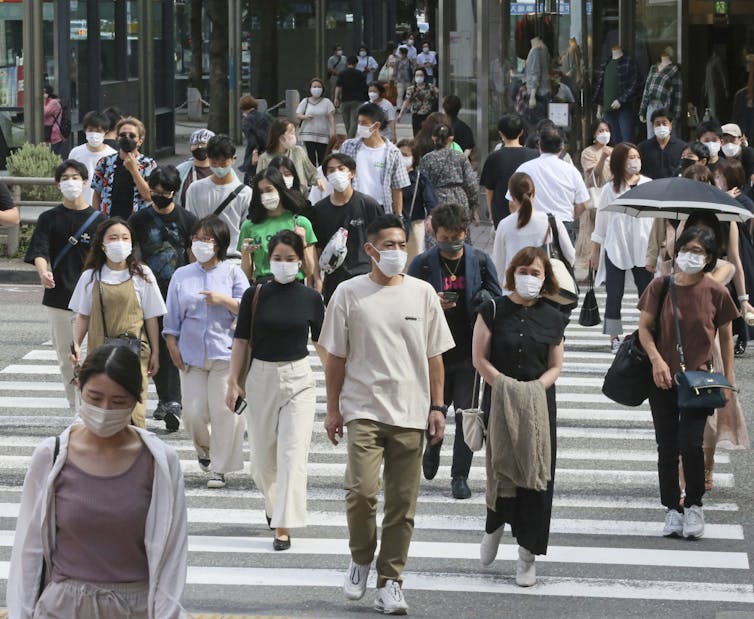
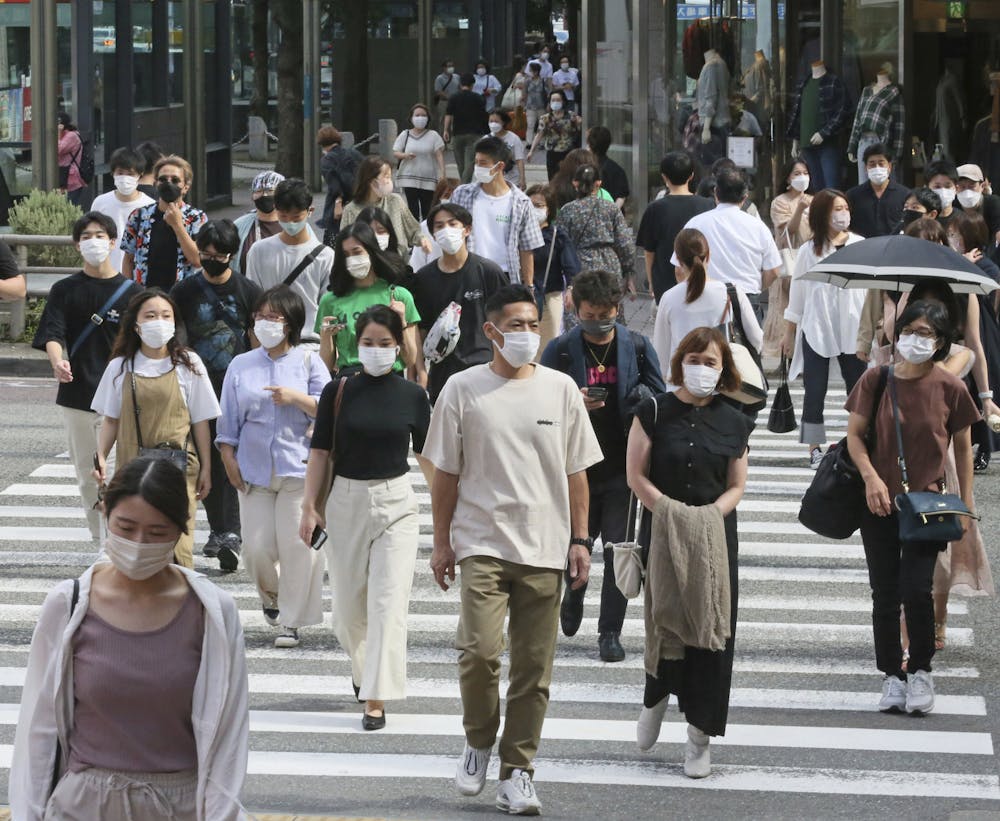 Mask-wearing in Fukuoka City, Japan.
Katsumi Tanaka/AP/Yomiuri Shimbun
Mask-wearing in Fukuoka City, Japan.
Katsumi Tanaka/AP/Yomiuri Shimbun
It won’t be the same everywhere
Countries will not enter an endemic phase at the same time because of variable host, environmental, virus factors including vaccination rates. The availability and rollout of booster vaccine shots each year or season will also shape this path. Poor vaccine coverage could allow the virus to continue at an epidemic level for longer. In a location where immunity wanes quickly and there are no booster shots available, COVID could go from endemic back to epidemic.
Once we see a stable level of SARS-CoV-2 transmission indicating a new “baseline” of COVID, we will know the pandemic has ended and the virus is endemic. This will likely include minor seasonal trends as we see now with flu.
The most important thing we can do to help reach a safe level of endemic COVID is to get vaccinated and continue to adhere to COVID-safe practices. By doing this we protect ourselves, those around us, and move together towards an endemic phase of the virus. If we don’t work together, things could turn for the worse very quickly and prolong the end of the pandemic.
Authors: Lara Herrero, Research Leader in Virology and Infectious Disease, Griffith University