

Many Australian school students feel they 'don't belong' in school: new research
- Written by: Sue Thomson, Director, Educational Monitoring and Research Division; Research Director, Australian Surveys Research Program, Australian Council for Educational Research
A report released today by the Australian Council for Educational Research (ACER), the managers of the Program for International Student Assessment (PISA) in Australia, explores Australian students’ sense of belonging. This has been shown to play a big part in academic success at school.
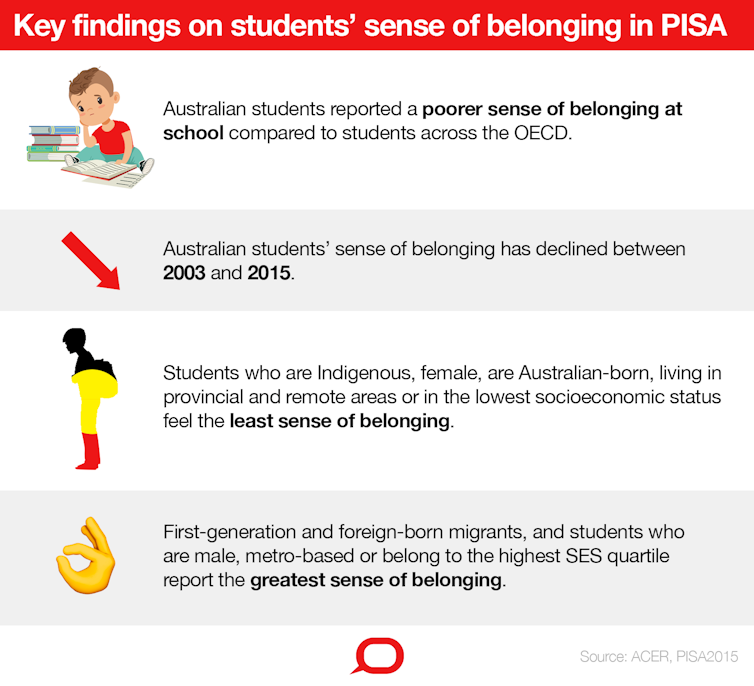
Australian students, on average, reported a poorer sense of belonging at school compared to students across the OECD. A lower proportion of Australian students than the OECD average said they “feel like they belong at school”.
Why does this matter?
For some students, a sense of belonging is indicative of educational success and long-term health and wellbeing. It has also been found to promote positive attitudes towards students’ learning.
What’s more, students who feel part of, and accepted by, their school community are not only more likely to participate in school activities, both academic and non-academic, but will be actively engaged in these activities.
What were students asked?
PISA 2015 asked students to rate their reaction to these six statements on how they feel about school:
- I feel like an outsider (or left out of things) at school
- I make friends easily at school
- I feel like I belong at school
- I feel awkward and out of place in my school
- other students seem to like me
- I feel lonely at school.
Student responses (strongly agree, agree, disagree and strongly disagree) were combined to construct the sense of belonging index. This allowed us to compare Australian students with their OECD counterparts and with their peers in different states and territories, socioeconomic groups, and between genders.
 ACER/The Conversation, CC BY-ND
How does Australia compare?
Across the full spectrum of PISA participants, students in Spain had the highest levels of sense of belonging. This was followed by students in Austria and Albania. Students in Turkey had the lowest sense of belonging, followed by students in Macao (China) and the Dominican Republic.
Ten countries were selected for further comparison with Australia. These included seven high-performing countries – Canada, Estonia, Finland, Hong Kong (China), Japan, Macao (China) and Singapore – who performed significantly higher in scientific, reading and mathematical literacy than Australia, and three culturally similar English-speaking OECD countries – New Zealand, the UK and the US.
Read more:
Ideas for Australia: Why is Australia falling behind in maths, science and literacy – and what can be done about it?
Students in the high-performing countries did not necessarily report a greater sense of belonging than Australian students. Macao (China), Hong Kong (China), Singapore, Canada, Estonia and Japan came in below, and Finland above, the OECD average. Students in the other English-speaking countries also reported a sense of belonging below the OECD average.
Australia performed close to the OECD average on most questions except “other students seem to like me” (88% compared with the OECD average of 82%) and “I feel like an outsider (or left out of things) at school” (77% against the OECD average of 83%).
Fewer Australian students disagreed with the remaining negative statements than the average. This indicates more Australian students feel awkward, out of place, and lonely in school than their OECD peers.
Sense of belonging in different demographic groups
We also examined sense of belonging among a number of different groups within Australia.
Male students in Australia reported a greater sense of belonging than female students. For males, the sense of belonging was similar to the average across OECD countries. But for female students, it was substantially lower.
Boys were more likely to respond positively to all of the statements. The most substantial of these were seen on the negative statements. Some 7% more female than male students reported feeling like an outsider at school, and 7% more female than male students said they felt lonely at school.
Indigenous students reported a much lower sense of belonging than their non-Indigenous peers. The largest difference was on the statement “I feel like I belong in school”, which 8% fewer Indigenous students agreed with.
Students in metropolitan schools responded more positively on all of the statements than students in either provincial or remote schools. In particular, a much lower proportion of students in provincial and remote schools felt they belonged in school (11% difference between students in metropolitan schools and those in remote schools).
There were stark differences in the results for different levels of socioeconomic background. In PISA, the socioeconomic index for students is broken into quarters and compared.
Students in the highest quarter of socioeconomic background scored at the OECD average on sense of belonging. These students’ experience of schooling is very different from that of students in the lowest quarter of socioeconomic background.
The differences are large on every item. The largest, again, was on the statement “I feel like I belong in school”, for which there was a 13% gap between the two groups. Just 65% of students in the lowest socioeconomic quartile agreed with this statement, compared to 78% of students in the highest socioeconomic quartile.
Some 73% of low socioeconomic students said they felt awkward and out of place in their school, compared to 82% of high socioeconomic students. There was a similar difference in the proportion of each group of students who said they felt like an outsider at school.
Finally, foreign-born and first-generation students reported a greater sense of belonging than Australian-born students.
Even when taken individually, some of these differences are disturbing. While the majority of Australian students feel a sense of belonging at school, there is a solid core of students who do not feel this way - roughly one in five, or five students in the average classroom.
But we know the issues in individual schools can be much worse than these figures describe. Other than gender, these characteristics are not randomly distributed across the population.
Read more:
To reduce inequality in Australian schools, make them less socially segregated
For example, there are schools that enrol a large proportion of low socioeconomic background students. The number of students who feel like an outsider, lonely, or awkward will be much higher in these schools than in schools in which there are few such students.
For provincial and remote schools, the proportions could be further inflated, with more students from Indigenous backgrounds and more students at lower levels on the socioeconomic index.
Trends over time
Sense of belonging at school in Australia has declined overall between PISA 2003 and PISA 2015. It has declined across all demographic groups.
The largest decline was on the statement “I feel like I belong at school” - with which 88% of students agreed in 2003 but just 72% agreed in 2015. The difference in the proportion who said they felt like an outsider declined by 15%, while the proportion who said they felt awkward or out of place declined by 13%.
Read the full report here.
ACER/The Conversation, CC BY-ND
How does Australia compare?
Across the full spectrum of PISA participants, students in Spain had the highest levels of sense of belonging. This was followed by students in Austria and Albania. Students in Turkey had the lowest sense of belonging, followed by students in Macao (China) and the Dominican Republic.
Ten countries were selected for further comparison with Australia. These included seven high-performing countries – Canada, Estonia, Finland, Hong Kong (China), Japan, Macao (China) and Singapore – who performed significantly higher in scientific, reading and mathematical literacy than Australia, and three culturally similar English-speaking OECD countries – New Zealand, the UK and the US.
Read more:
Ideas for Australia: Why is Australia falling behind in maths, science and literacy – and what can be done about it?
Students in the high-performing countries did not necessarily report a greater sense of belonging than Australian students. Macao (China), Hong Kong (China), Singapore, Canada, Estonia and Japan came in below, and Finland above, the OECD average. Students in the other English-speaking countries also reported a sense of belonging below the OECD average.
Australia performed close to the OECD average on most questions except “other students seem to like me” (88% compared with the OECD average of 82%) and “I feel like an outsider (or left out of things) at school” (77% against the OECD average of 83%).
Fewer Australian students disagreed with the remaining negative statements than the average. This indicates more Australian students feel awkward, out of place, and lonely in school than their OECD peers.
Sense of belonging in different demographic groups
We also examined sense of belonging among a number of different groups within Australia.
Male students in Australia reported a greater sense of belonging than female students. For males, the sense of belonging was similar to the average across OECD countries. But for female students, it was substantially lower.
Boys were more likely to respond positively to all of the statements. The most substantial of these were seen on the negative statements. Some 7% more female than male students reported feeling like an outsider at school, and 7% more female than male students said they felt lonely at school.
Indigenous students reported a much lower sense of belonging than their non-Indigenous peers. The largest difference was on the statement “I feel like I belong in school”, which 8% fewer Indigenous students agreed with.
Students in metropolitan schools responded more positively on all of the statements than students in either provincial or remote schools. In particular, a much lower proportion of students in provincial and remote schools felt they belonged in school (11% difference between students in metropolitan schools and those in remote schools).
There were stark differences in the results for different levels of socioeconomic background. In PISA, the socioeconomic index for students is broken into quarters and compared.
Students in the highest quarter of socioeconomic background scored at the OECD average on sense of belonging. These students’ experience of schooling is very different from that of students in the lowest quarter of socioeconomic background.
The differences are large on every item. The largest, again, was on the statement “I feel like I belong in school”, for which there was a 13% gap between the two groups. Just 65% of students in the lowest socioeconomic quartile agreed with this statement, compared to 78% of students in the highest socioeconomic quartile.
Some 73% of low socioeconomic students said they felt awkward and out of place in their school, compared to 82% of high socioeconomic students. There was a similar difference in the proportion of each group of students who said they felt like an outsider at school.
Finally, foreign-born and first-generation students reported a greater sense of belonging than Australian-born students.
Even when taken individually, some of these differences are disturbing. While the majority of Australian students feel a sense of belonging at school, there is a solid core of students who do not feel this way - roughly one in five, or five students in the average classroom.
But we know the issues in individual schools can be much worse than these figures describe. Other than gender, these characteristics are not randomly distributed across the population.
Read more:
To reduce inequality in Australian schools, make them less socially segregated
For example, there are schools that enrol a large proportion of low socioeconomic background students. The number of students who feel like an outsider, lonely, or awkward will be much higher in these schools than in schools in which there are few such students.
For provincial and remote schools, the proportions could be further inflated, with more students from Indigenous backgrounds and more students at lower levels on the socioeconomic index.
Trends over time
Sense of belonging at school in Australia has declined overall between PISA 2003 and PISA 2015. It has declined across all demographic groups.
The largest decline was on the statement “I feel like I belong at school” - with which 88% of students agreed in 2003 but just 72% agreed in 2015. The difference in the proportion who said they felt like an outsider declined by 15%, while the proportion who said they felt awkward or out of place declined by 13%.
Read the full report here.
Authors: Sue Thomson, Director, Educational Monitoring and Research Division; Research Director, Australian Surveys Research Program, Australian Council for Educational Research


















