

Haitch or aitch? How a humble letter was held hostage by historical haughtiness
- Written by: Kate Burridge, Senior Fellow at the Freiburg Institute for Advanced Studies and Professor of Linguistics, Monash University
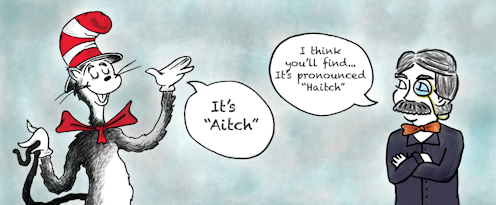
Like Dr. Seuss’ Star-Belly Sneetches and Plain-Belly Sneetches, there are two types of creatures — haitchers with H on their 8th letter name and aitchers with “none upon thars”.
That H isn’t so big. It’s really so small You might think such a thing wouldn’t matter at all.
But it does — the tiny H on “(h)aitch” divides the nation. The pronunciation has become something of a social password, a spoken shibboleth distinguishing in-groupers from out-groupers. Those with social clout set the standards for what’s “in” and what’s “out” — no H has the stamp of approval.
The best kind of people are people without!
Shibboleths die hard — the opprobrium attached to haitch probably derives from its long association with Irish Catholic Education. There’s no real evidence for this, mind, as Sue Butler points out, but never let facts get in the way of a good shibboleth.
Read more: War of words: why journalists need to understand grammar to write accurately about violence
Aitchers’ reactions are often visceral. Someone once reported to us an encounter with haitch is like an encounter with fire ants. We’ve no doubt that psycho-physiological testing would show that haitch can raise goosebumps. Linguistic pinpricks are established early on in the acquisition process (“Don’t say ‘haitch’”!) and they arouse emotions like other childhood reprimands (including swearwords).
The ins and outs of H
The story of the weakly articulated H is murkily entwined with the story of its name. Long gone from Old English words like hring “ring”, hnecca “neck” and hlūd “loud”, it would have disappeared entirely if writing hadn’t thrown out a lifejacket.
It was once usual for speakers to drop aspirates at the beginning of words — in fact up until the 1700s, it was fashionable to do so. But a spelling-obsessed 18th century stigmatised the loss of many consonants, including H.
R-less pronunciations of arm and car might have snuck under the radar, but H-dropping fell well and truly from grace.
In 1873, Thomas Laurence Kington-Oliphant wrote about this “revolting habit” in his chapter “Good and Bad English”, advising:
Few things will the English youth find in after-life more pro-fitable than the right use of the aforesaid letter.
And so, the English youth restored H to words like hat, and even at the start of many French words like humble, which had entered English H-less (the Romans pronounced their Hs, but the French dropped theirs). Spellers who weren’t quite sure whether or not to include H added a few extras along the way — umble pie (“offal pie”) turned into humble pie.
Haitch has the pedigree
There’s an ironic wrinkle to this story. The name aitch might be a sign of high education in some circles, but is itself an example of H-dropping. Deriving from medieval French hache or “axe” (hatchet and hashtag are relatives), it also arrived in English H-less (like humble and herb).
It’s a curious letter name being, as the Oxford English Dictionary describes, “so remote from any connection with the sound”. In fact there’s solid evidence supporting haitch as the better option. To understand why, we need to appreciate the primacy of initial letter sounds in words.
Learning and alliteration
English speakers find it easiest to attend to and manipulate the beginning sounds of words. For example, it’s easier for us (orally, that is - by sound, not spelling) to take away the “b” sound in beat (to make it eat) or to replace the “b” with a “p” to make it Pete than it is to take away the “t” sound in beat (to make it be) or to replace it with a “k” to make it beak.
It’s more natural for us to focus on initial sounds, especially for children.
We often make use of alliteration in names and tongue twisters. Dr. Seuss (think Aunt Annie’s Alligator or The Butter Battle Book), Walt Disney (such as Donald Duck; Mickey Mouse), and J.K. Rowling (Godric Gryffindor; Helga Hufflepuff; Rowena Ravenclaw; Salazar Slytherin) all capitalised on this phenomenon.
Tongue twisters highlight the special quality of alliteration for learning as well; who can forget Peter Piper and his pickled peppers, Silly Sally and her sheep, or Betty Botter and her butter?
The ABCs of the ABC
Many letters of the alphabet are phonetically iconic; their names represent the sound they make. In places where letter names are learned before letter sounds, such as Australia and the US, these letter names can facilitate children in learning letter sounds and, ultimately, word reading. The letter sounds that are easiest to remember are those that begin with their corresponding letter, such as B, D, J, K, P, or T.
Read more: Get yer hand off it, mate, Australian slang is not dying
Research shows it’s more difficult to learn sounds made by letters that end with their letter sound, such as F, L, and M. Those that have no correspondences to the letter sound are the most difficult. Logically, W should make the “d” sound (or change its name to wubble-u).
Haitch vs. aitch, round 2
Whatever your visceral reaction to pronouncing H one way or the other, haitch has definite benefits for letter sound learning.
So it’s not surprising it’s taking off in some parts of the English-speaking world. When the letter H is pronounced beginning with the letter sound it makes, children have an easier time learning its correspondence as they learn to read.
Dr. Seuss implicitly understood this. We suggest that a follow-up primer for young readers will one day include Horton hearing a Haitch.
Authors: Kate Burridge, Senior Fellow at the Freiburg Institute for Advanced Studies and Professor of Linguistics, Monash University


















