

Why we must not allow COVID to become endemic in New Zealand
- Written by: John Donne Potter, Professor, Research Centre for Hauora and Health, Massey University
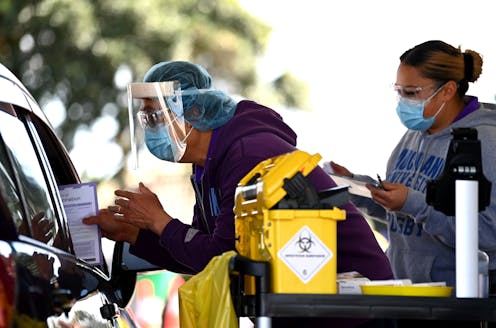
As New Zealand switches from elimination to suppression, those who argue that COVID-19 will become endemic and part of our lives either do not understand or ignore what this would actually mean.
Elimination has always been a tricky word because it implies eradication. But we have only ever eradicated one human disease — smallpox — and are close with several others.
For some, the end of elimination now means we should let the virus spread. But semantics matter less than policy. If we don’t eliminate, we must still aim to contain, mop up, reduce close to zero and thwart this pandemic.
Because we certainly cannot live with endemic SARS-CoV-2.
The Delta variant spreads ominously and without controls, every infected person, on average, would infect six more, then 36, 216, 1296, 7776, 46,656 — we would get to more than twice New Zealand’s five million with three more cycles.
We must continue to either stamp out the virus or keep case numbers very low. To contain case numbers, we need to keep up border protection, mask wearing, distancing, bubbles, contact tracing, testing of people and waste water, and vaccination.
In the current Delta outbreak, more than 95% of those infected were either unvaccinated or had received only their first dose.
Read more: COVID will likely shift from pandemic to endemic — but what does that mean?
Delta is nothing like the flu
Our most common endemic infections include the common cold (caused by hundreds of different viruses that circulate freely) and the flu (caused by a group of influenza viruses).
Those who dismiss a mild case of COVID-19 as being “no worse than the flu” have forgotten how appalling a case of flu really is. They might also have forgotten that, even with effective vaccination, influenza has a case fatality risk of about 0.1% — it kills about 500 people in New Zealand each year.
Yet some seem to expect that COVID-19 will learn to behave and become endemic. Some even seem to welcome this, claiming a “disease becomes endemic when it is manageable”.
This is not true. Being manageable is not part of the definition of endemic disease. A disease becomes endemic when it is more or less always present in a population. It does not care whether it is manageable.
Seasonal influenza has a basic reproduction number (R0) of about 1.5, meaning one infected person spreads the disease to fewer than two other people, on average. This is why it takes very little to break the chain of transmission. The annual flu epidemic declines because we have effective vaccines and because seasonal conditions during summer are less favourable to the survival of the virus.
However, as we already mentioned, the Delta variant has an R0 of at least six. This will be as low as it gets from here onward. If a new variant supplants Delta, it will do so because it is even more transmissible.
There will be no season for COVID-19, no breaks in transmission, no declines in infectiousness. We have been struggling worldwide with this virus for 18 months, with spikes everywhere in every season.
School and business closures part of new normal
If COVID-19 becomes endemic, there will not be one or two people sick in a workplace or a home. We will have waves and clusters and multiple local outbreaks. Schools and businesses will close for days, even weeks, because too many people are sick. It will cost the world trillions — consider what it has already done to global supply chains.
If COVID-19 becomes endemic, the burden on our healthcare system will be immense. It will not involve a predictable, modest increase in hospital admissions. Waves and clusters will characterise endemic COVID-19 in the same way they have characterised pandemic COVID-19, overwhelming local healthcare without warning.
If COVID-19 becomes endemic, Merck’s new antiviral drug Molnupiravir will be an important addition to the toolkit because it will be much cheaper than monoclonal antibodies, easy to store, easy to transport and people can take it at home.
The as yet unpublished trials suggest the treatment could cut hospitalisations in half, markedly improving outcomes for those already infected. But it will not reduce the number of cases by even one.
Treatment never does — only prevention, public health measures and vaccination reduce case numbers. Those who are less sick and treated at home could spread the virus even more.
If COVID-19 becomes endemic, when the healthcare system fails to accommodate the latest wave, more people will die.
Long-term costs to health and economy
Even if we managed to get COVID-19 down to the severity of influenza (for an individual), endemic Delta – with an R0 about five times that of flu and the fully vaccinated still able to become infected and spread – would still mean thousands of hospitalisations and deaths each year.
Just four cycles of Delta infection could result in more than 250 times as many cases as four cycles of flu.
If COVID-19 becomes endemic, every year, many of us will know someone who dies.
If COVID-19 becomes endemic, more than a third of unvaccinated cases, even the asymptomatic, will have symptoms months later. Flu leaves little lasting damage. Long COVID damages the lungs, heart, brain, hearing and vision as well as the insulin-producing cells of the pancreas, causing diabetes.
The cost of COVID-19 is so much higher than that of the flu, not just because of higher case numbers, hospitalisations and deaths, but more long-term damage and disability.
If COVID-19 becomes endemic, we will live with a stressed, often overwhelmed healthcare system, with schools subject to unpredictable closures, with unsafe workplaces, with a disrupted economy, with our children under threat, with death and disability at a persistently higher level than we have known — probably for decades.
We do not care what the current strategy is called as long as we persist with border protection and public health measures until we achieve close to universal vaccination. Otherwise, many thousands of New Zealanders will be hospitalised, die or experience long COVID.
Ultimately, we will need a sterilising vaccine (one that protects people from getting infected) because we cannot live with endemic COVID-19.
Authors: John Donne Potter, Professor, Research Centre for Hauora and Health, Massey University
Read more https://theconversation.com/why-we-must-not-allow-covid-to-become-endemic-in-new-zealand-169608


















