

I live in an apartment. How can I cut my risk of getting COVID?
- Written by: Geoff Hanmer, Honorary Professional Fellow, Faculty of Design, Architecture and Building, University of Technology Sydney

Governments are pressing ahead with home quarantine for returning travellers and people are isolating at home due to COVID-19. So now is a good time to think about what you can do to reduce your risk of infection if you live in an apartment.
Earlier in the pandemic, apartments were described as “vertical cruise ships” due to the ease of spread of the coronavirus between many people sharing confined spaces. But apartments are nothing like cruise ships because apartments do not have common ventilation supply and eating areas, among other things. The “cruise ship” description is inaccurate, if colourful.
Since then, we’ve learned more about how SARS-CoV-2, the virus that causes COVID-19, spreads via the air we breathe and the importance of good ventilation in a range of settings.
Here are nine things you can do to minimise your risk of catching the virus if you live in an apartment.
1. Avoid poorly ventilated indoor spaces
Aside from getting vaccinated, the first step to minimising your risk of catching the virus is to avoid poorly ventilated indoor spaces without using a mask (see also point 4).
This reduces the risk of sharing air with neighbours and reduces risks associated with common facilities, such as lifts, gyms and garbage areas.
Read more: We could have more coronavirus outbreaks in tower blocks. Here's how lockdown should work
2. Watch laundries and indoor garbage areas
But you’ll still need to do your laundry and dispose your garbage. Shared laundries, gyms and indoor garbage areas are an obvious risk, particularly if poorly ventilated.
So perhaps arrange a rota to give people access at set times and ensure at least one hour elapses between use to allow for enough air changes.
Where there is a mechanical ventilation system, ensure ducts and fans are working. Where there are windows, ensure they are open.
Consider installing a combined washer-dryer in your kitchen or bathroom.
3. Ask strata about shared basement garages
These are often mechanically ventilated by a system with fans that only operate when carbon monoxide is sensed. With modern vehicles, the ventilation may not run often, resulting in poor ventilation.
It may be possible to override the sensors; request the strata to ask people who maintain the system.
Read more: Many of our buildings are poorly ventilated, and that adds to COVID risks
4. Wear a mask before opening the door
Ensure you and all members of your household put on a mask before opening the door to your apartment. Many people are used to wearing surgical or cloth masks.
However, OzSAGE, an independent group of researchers providing evidence-based advice about the pandemic, recommends an N95 mask, which provides greater protection against the Delta variant.

You should wear this mask when receiving deliveries or letting in visitors, as well as when leaving the apartment to move through shared areas.
Where there’s an outbreak, wearing a mask in shared areas can be mandatory. Even if it’s not, you can still request your strata corporation to ask residents and visitors to wear a mask, and to require this of contractors.
5. Ask about the lifts
Lifts are a particular hazard in taller buildings. So ask your strata about the following:
limiting lift capacity to one person per 2.5 square metres. If a high-efficiency particulate air (HEPA) purifier can operate continuously in the lift, the density limits may be relaxed if health orders allow
making sure lifts go to an unoccupied level with the doors open when not in use. Some lifts can be programmed to do this; the firm servicing the lift will advise.
6. If you can smell your neighbour’s cooking …
Some apartment buildings in Australia have gaps at the top of walls between adjacent apartments. This faulty “fire isolation” means fire can potentially spread between apartments. In theory, so can shared air containing contaminated aerosols.
So if you can smell your neighbour’s cooking or something worse, you are sharing their air. If you suspect an air leakage and are unable to do anything about it in the short term, using a HEPA air purifier in your apartment will reduce your risk.
If you can smell odours in the common space, you may want to seal up your apartment door with self-adhesive draft stripping from a hardware store and a door draught stopper.
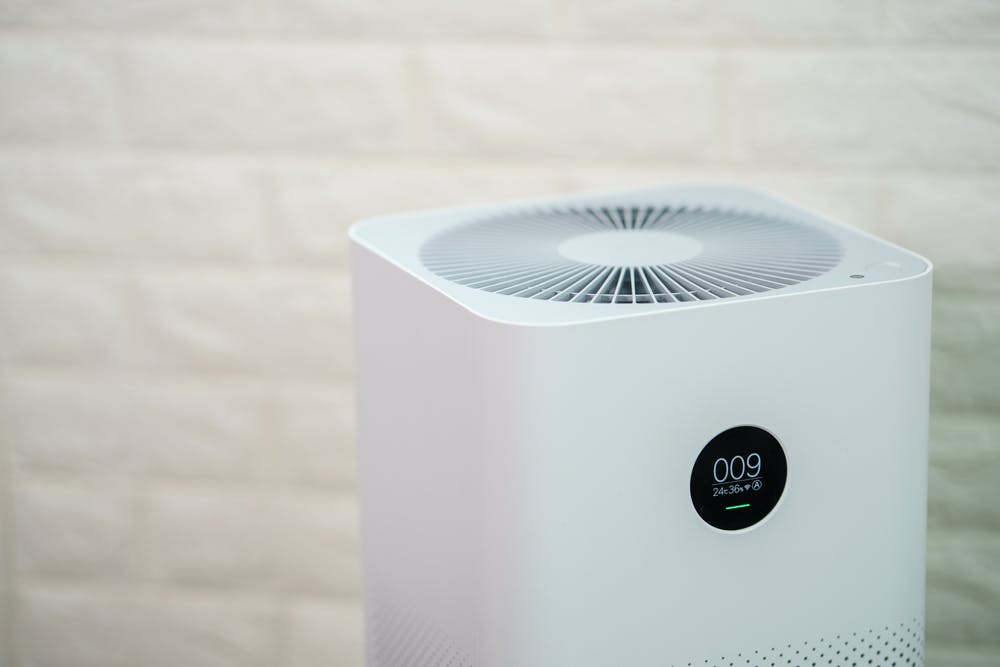 If you can smell a neighbour’s cooking, consider getting an air purifier.
Shutterstock
If you can smell a neighbour’s cooking, consider getting an air purifier.
Shutterstock
7. Open your windows
Open your windows to increase ventilation in your apartment when visitors or maintenance staff are there. Wear a mask if the visitor is not double-vaccinated or if you’re otherwise concerned.
There is relatively little evidence showing cross contamination between external windows of neighbouring apartments, which is reassuring.
Nevertheless, if you are opening a window, opening one onto your balcony poses less of a risk (as the air is better dispersed) than opening one directly above or below another apartment’s window.
8. Test your service riser
Service risers are the vertical ducts that run pipework for plumbing and ventilation through kitchens and bathrooms in apartment buildings.
Hong Kong research suggests such ducts were linked with infections between several floors of the Amoy Gardens buildings during the SARS outbreak.
In Australia, many apartment blocks have rudimentary sealing to these service risers. So check inspection panels are sealed in place and that pipes are sealed where they enter any cavity. You might need to hunt inside kitchen or bathroom cupboards to find these.
Light an incense stick (or similar) to see if the smoke wafts around to indicate air is blowing into or out of service risers. But be careful not to set off the smoke alarm while testing. If in doubt, cover up the smoke alarm on the ceiling with plastic wrap and a rubber band, but don’t forget to take it off afterwards.
If you’re handy, you can buy fire-rated expanding foam or other products from a hardware store to seal these gaps. If you’re not, contact the strata to discuss the work. And don’t let any waste traps dry out.
 Light an incense stick to see where the smoke wafts.
Shutterstock
Light an incense stick to see where the smoke wafts.
Shutterstock
9. Fix broken exhaust fans
Another potential source of leaks and cross contamination is shared bathroom and kitchen ventilation systems that operate permanently. These are more common in older buildings and you can recognise them by continuous exhaust noise from vents in the bathroom, toilet or kitchen.
Ensure fans are operating normally and if the fan stops, ensure it is repaired promptly.
More recent apartments may have self-contained exhaust fans that operate only when the light or a fan switch is operated. The risk of cross contamination with this type of installation is low.
Authors: Geoff Hanmer, Honorary Professional Fellow, Faculty of Design, Architecture and Building, University of Technology Sydney
Read more https://theconversation.com/i-live-in-an-apartment-how-can-i-cut-my-risk-of-getting-covid-169364


















