

Indigenous people cannot be aliens in their own land. Why challenging this fact (again) is so concerning
- Written by: Kate Galloway, Associate Professor of Law, Griffith University
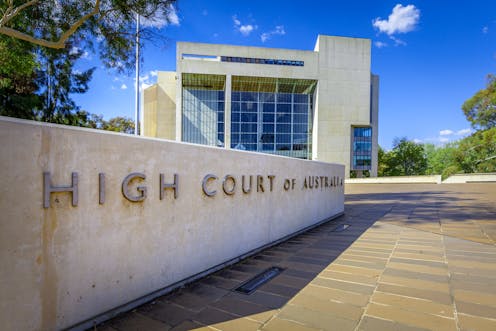
Last year, we wrote an overview of the High Court decision in Love, Thoms v Commonwealth. The case concerned whether the Commonwealth had the power to deport two Aboriginal men who were born overseas.
Neither man was an Australian citizen under Commonwealth law. If the men were deemed “aliens”, then the Commonwealth could validly deport them.
This raised the question of whether it was possible for an Aboriginal person to be an alien in their own land. This question is important because if the men were not “aliens”, the Commonwealth could not deport them, even if they were not citizens.
The Love, Thoms case has been explained elsewhere in great detail. In summary, four out of the seven judges on the High Court found that
Aboriginal Australians […] are not within the reach of the ‘aliens’ power conferred by [section] 51(xix) of the Constitution.
This meant that Brendan Thoms, a New Zealand-born Gunggarri man and native title holder, could not be deported. The case of the other man, Daniel Love, who was born in Papua New Guinea to a PNG mother and Aboriginal father, was returned to the lower court to determine his status as an Aboriginal person.
We concluded our previous piece by saying
the closeness of the decision and the qualified finding in relation to Love’s case means this question of belonging for non-citizen Indigenous people will likely be raised again.
That time has now come.
A new case comes before the court
Last week, the High Court heard submissions in another case, Attorney General v Montgomery. In this case, the Commonwealth wishes to deport a man, Shayne Paul Montgomery, who was born in New Zealand and has been traditionally adopted by Aboriginal people. Traditional adoption is recognised in both Aboriginal and Australian law.
The question is whether the principle in Love, Thoms also applies to Montgomery.
The solicitor-general for the Commonwealth has asked the High Court to reconsider the decision in Love, Thoms. He suggests there were three “very powerful dissenting reasons” in the case highlighting the opposite view, namely that Aboriginal people can indeed be aliens (and can therefore be deported).
Since Love, Thoms was handed down, two new justices have joined the High Court. Justices Simon Steward and Jacqueline Gleeson now replace Justices Virginia Bell and Geoffrey Nettle, who had agreed an Aboriginal person who was not a citizen could not be considered an alien under the relevant law.
The change of the court’s composition may account for the focus of commentators on the likelihood of overturning the original decision.
Despite this interesting question of High Court practice, the Montgomery case raises other important questions about the unique legal status of First Nations peoples in Australia.
Significance of the Love, Thoms decision
In our view, the Love, Thoms decision was significant beyond questions of deportation and immigration. It invokes a deeper question of whether Aboriginal and Torres Strait Islander people can be aliens and therefore excluded from being Australian.
The effect of the decision applies only to a small and specific group of people - Indigenous people who are not citizens. But its broader impact is in understanding the special status of Indigenous people in Australia.
This status is not new to the law. It was the underlying foundation of the decision in the Mabo native title case.
Read more: Australian politics explainer: the Mabo decision and native title
Although Mabo acknowledged the rights of First Nations people to land, full legal recognition of First Nations peoples is still evolving in Australian law. Therefore, the decision in Love, Thoms does not negate the importance of constitutional reform to embrace the status of First Nations peoples, and a constitutionally enshrined Voice to Parliament.
Rather, it highlights the lack of clarity in the law concerning the implications of indigeneity – the state of being an Indigenous person.
Indigeneity as the legal issue
In Love, Thoms, the High Court majority acknowledged the effect of indigeneity on an Aboriginal or Torres Strait Islander person’s status according to law.
The prior possession of the territory of Australia by First Nations peoples is the basis of indigeneity, as a form of legal and cultural identity. Following the majority decision in Love, Thoms, this has important implications for a person’s status – making it impossible for them to be considered aliens.
By contrast, some commentators – and the minority of the High Court – frame the issue raised by Love and Thoms as one of differential treatment because of race. The majority treated the issue differently by instead considering the consequences of being Indigenous.
Justice Gerard Brennan was at pains in Mabo to remind us that the court and the nation can make choices when interpreting the law. The court should be mindful not to reiterate faulty fictions such as terra nullius and “land practically unoccupied”. We are no longer trapped in the common law constructs of colonial acquisition and dispossession.
In the same vein, international legal frameworks such as the United Nations Declaration on the Rights of Indigenous Peoples, and the work of the Uluru Statement and the Victorian First People’s Assembly, invite us to reconsider colonial assumptions about self-determination, sovereignty, and status.
Read more: What did the public say about the government’s Indigenous Voice co-design process?
We note that Justice James Edelman’s approach in the majority judgment in the Love, Thoms case allows for this accommodation, acknowledging that while the Constitution endures, it is also flexible. Edelman wrote it can – and should – adapt to “new circumstances and in different ways, as time passes”.
This is the lesson from Mabo. And this was affirmed as a consequence of the majority decision in Love, Thoms.
The contemporary context for considering the status of First Nations peoples, therefore, demands proper consideration of the effect of indigeneity in the law.
This already occurs in native title law, state constitutions, and human rights laws. The decision in Love, Thoms shows that the common law and Australian constitutional law can also understand indigeneity and its legal consequences.
We are progressing towards substantive political engagement with First Nations peoples through a constitutionally enshrined Voice to Parliament, treaty processes and other agreements throughout Australia.
It is not acceptable for the law to disregard, or further constrain, the reality of First Nations’ prior possession of this country.
The Montgomery case is expected to be heard by the High Court early in the new year.
Authors: Kate Galloway, Associate Professor of Law, Griffith University
-is-so-concerning?highlight=WyJsZWdhbCJd&media=https://www.modernaustralian.com/https://images.theconversation.com/files/427153/original/file-20211019-26-1qo956i.jpg?ixlib=rb-1.1.0&q=45&auto=format&w=496&fit=clip&description=Indigenous%20people%20cannot%20be%20aliens%20in%20their%20own%20land.%20Why%20challenging%20this%20fact%20(again)%20is%20so%20concerning "Pin It")

















