

Despite lockdowns, 1,142 Australians, including 66 kids, died on our roads in the past year. Here's what we need to do
- Written by: Matthew Mclaughlin, PhD Candidate, School of Medicine and Public Health, University of Newcastle

Despite lengthy lockdowns, new data show that 1,142 Australians, including 66 children, died on Australian roads in the past year.
Road traffic deaths remain the number one killer of children in Australia.
Despite fewer cars on the road, we have seen a 25% increase in deaths of children this year, compared to the average from 2017-2020. Although minor fluctuations are typical, this year’s rise represents an additional 13 children dying on our roads.
Deaths on our roads are not inevitable: they are not “accidents”, they are preventable. There are more than 150 cities across the world where no kids or adults have died on their roads for five or more years since 2009.
So far this year, in Sydney, Newcastle and Melbourne, 52, 6 and 69 lives have been lost, respectively. Across New South Wales as a whole, 203 people, including 14 children, have died so far this year.
We can learn from cities such as Oslo and Helsinki, where pedestrian and cyclist deaths were cut to zero in 2019. We can also learn from Belfast and Edinburgh, where they have managed to reduce speed, crashes and road traffic deaths.
So how do we get to zero traffic deaths in Australia? And what other benefits could better safety measures bring?
5 actions to get to zero deaths
We have to start by acknowledging that “humans are human, and we make mistakes”. Therefore, training and education are not enough. We also need to invest in safely designed streets that attract people to walk and cycle, and mitigate the risk of human error.
This is the basis of an approach that has enabled hundreds of cities globally to continually achieve Vision Zero – zero deaths from road crashes.
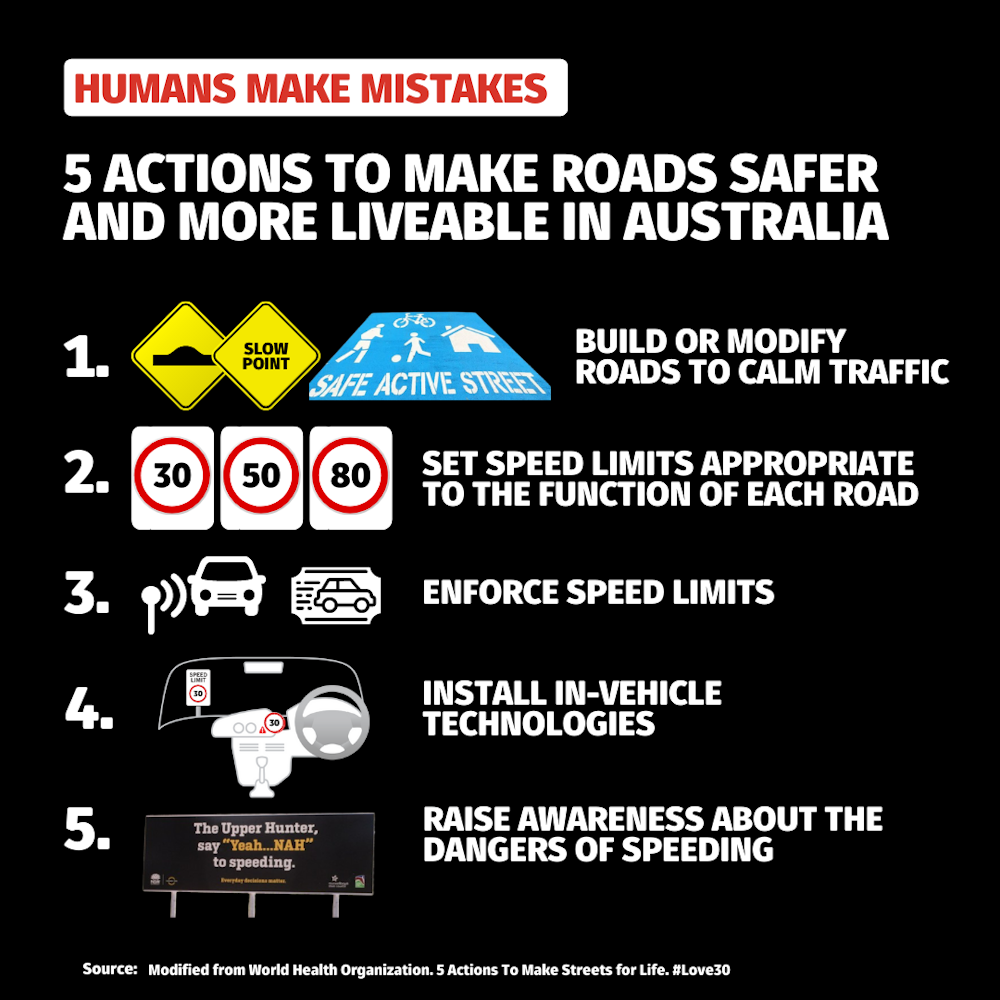
The World Health Organization outlines five combined actions to make streets safer and more liveable:
implementing traffic-calming strategies – such as those that limit vehicle speeds and reduce congestion by making walking and cycling the default mode for short journeys (for example, road diets that reallocate street space, speed bumps, continuous crossings)
setting lower speed limits for particular roads – such as 30km/h on streets where people live, play and shop
issuing speeding penalties, such as fines
embracing in-vehicle technologies as they emerge, such as intelligent speed assist to support drivers to avoid speeding, and autonomous emergency braking to avoid crashes
raising awareness of the dangers of speeding through mass media campaigns.
Speeding is the most common factor in road traffic deaths: more than drink-driving and fatigue. Two-thirds of Australians admit to speeding, and a third of these drivers now admit to speeding weekly. The problem is getting worse, with 17% more drivers admitting to speeding since the COVID lockdowns.
Read more: Busted: 5 myths about 30km/h speed limits in Australia
Campaigns and programs that focus on children may be particularly helpful, but not sufficient on their own. For example, a new grassroots campaign called Safe Streets to School calls on councils to either build crossings and footpaths, or request 30km/h speed limits within 2km of schools.
5 co-benefits of safer roads
Beyond the strikingly obvious benefit of reducing the numbers of children and adults dying and being seriously injured on Australia’s roads, what other benefits would safer streets bring?
There are at least five compelling co-benefits:
Local businesses benefit – designing enticing shopping streets that feel safe leads to more spending in local shops. Big shopping centres have recognised this and have designed people-friendly shopping arcades that are safely separated from cars. Councils should adopt some of these design principles for local shopping streets.
Less congestion, more walking and cycling – more than one-third of city car journeys in Australia are so short they could be cycled in 12 minutes or less, or even walked. More people walking and cycling for short journeys means less congestion. Walking and cycling are also fun, safe, inexpensive and good for our physical, mental and social health.
Improved air and noise pollution – we can save fuel and reduce air and noise pollution by driving at lower speeds, particularly on streets with many intersections and junctions. We can save even more fuel when we feel safe and enticed to walk and cycle short journeys instead.
Social connection and neighbourliness – 7 in 10 Australians value traffic-calming measures and a sense of community. Walkable and appealing streets encourage healthy social connections.
Protecting our community – children, people on lower incomes, the elderly and people living with mobility impairments equitably benefit from streets that are safer and more appealing to walk and cycle.
Don’t fall for the ‘nanny state’ rhetoric: it can save lives
Similar to many of these 150 public health examples, personal responsibility and education are not enough to reduce the daily Australian toll of three deaths and more than 100 hospitalisations due to road traffic crashes.
The key is acknowledging that humans make mistakes and designing road networks with this in mind. Safer and more liveable streets are a win-win public health policy.
The authors would like to thank Professor Jasper Schipperijn for his expert input and feedback.
Authors: Matthew Mclaughlin, PhD Candidate, School of Medicine and Public Health, University of Newcastle


















