

First Nations people are turning to human rights law to keep access to cultural sites
- Written by: Shelley Marshall, Associate Professor and Director of the RMIT Business and Human Rights Centre, RMIT University
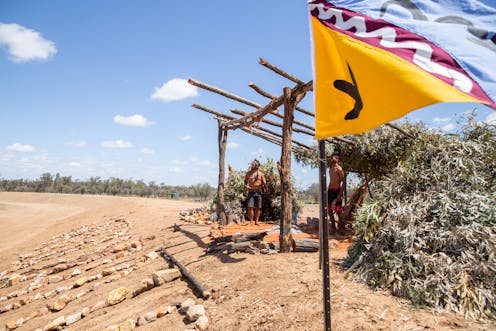
In a shift from their usual conduct, Queensland police have recognised the cultural rights of Wangan and Jagalingou cultural custodians to conduct ceremony under provisions of the 2019 Queensland Human Rights Act.
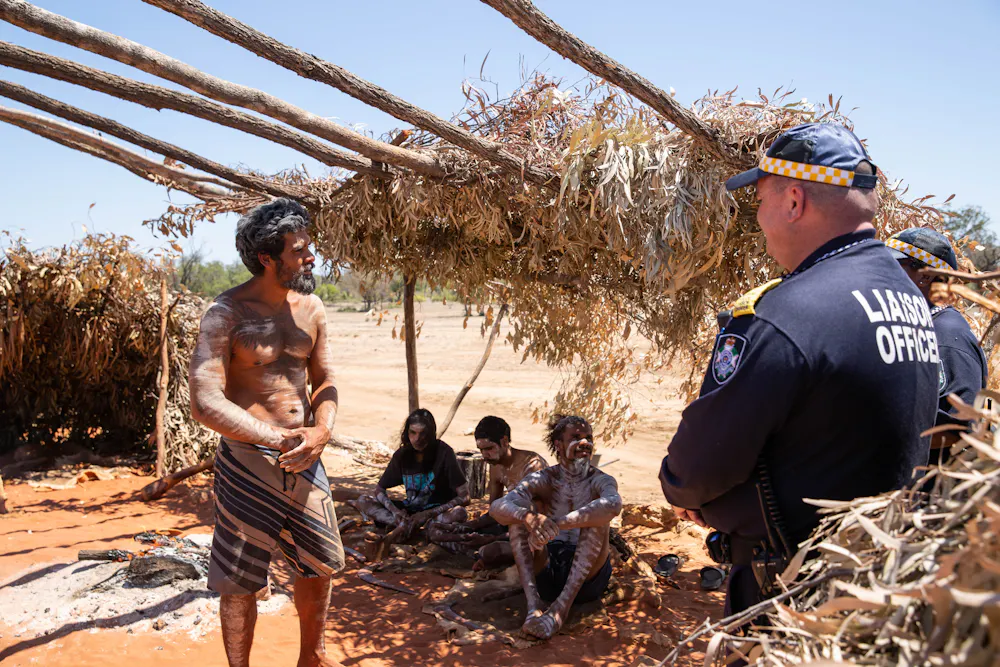
Because of this act, the police were able to refuse to action a complaint from Adani to remove Wangan and Jagalingou cultural custodians camping on their ancestral lands adjacent to the Adani coal pit.
The police also issued a “statement of regret” for removing the group several months earlier.
The ceremonial grounds are on highly contested land that has been granted to Adani’s Carmichael coal mine by the state government.
In August 2019, Adani was granted freehold title over critical infrastructure areas of the Carmichael mine site by the Queensland government, without first notifying the Wangan and Jagalingou peoples.
This extinguished their native title over the site, affecting a number of peoples including the Juru, Jaang and Birrah, as well as the Wangan and Jagalingou.
Why was practising cultural ceremony so controversial?
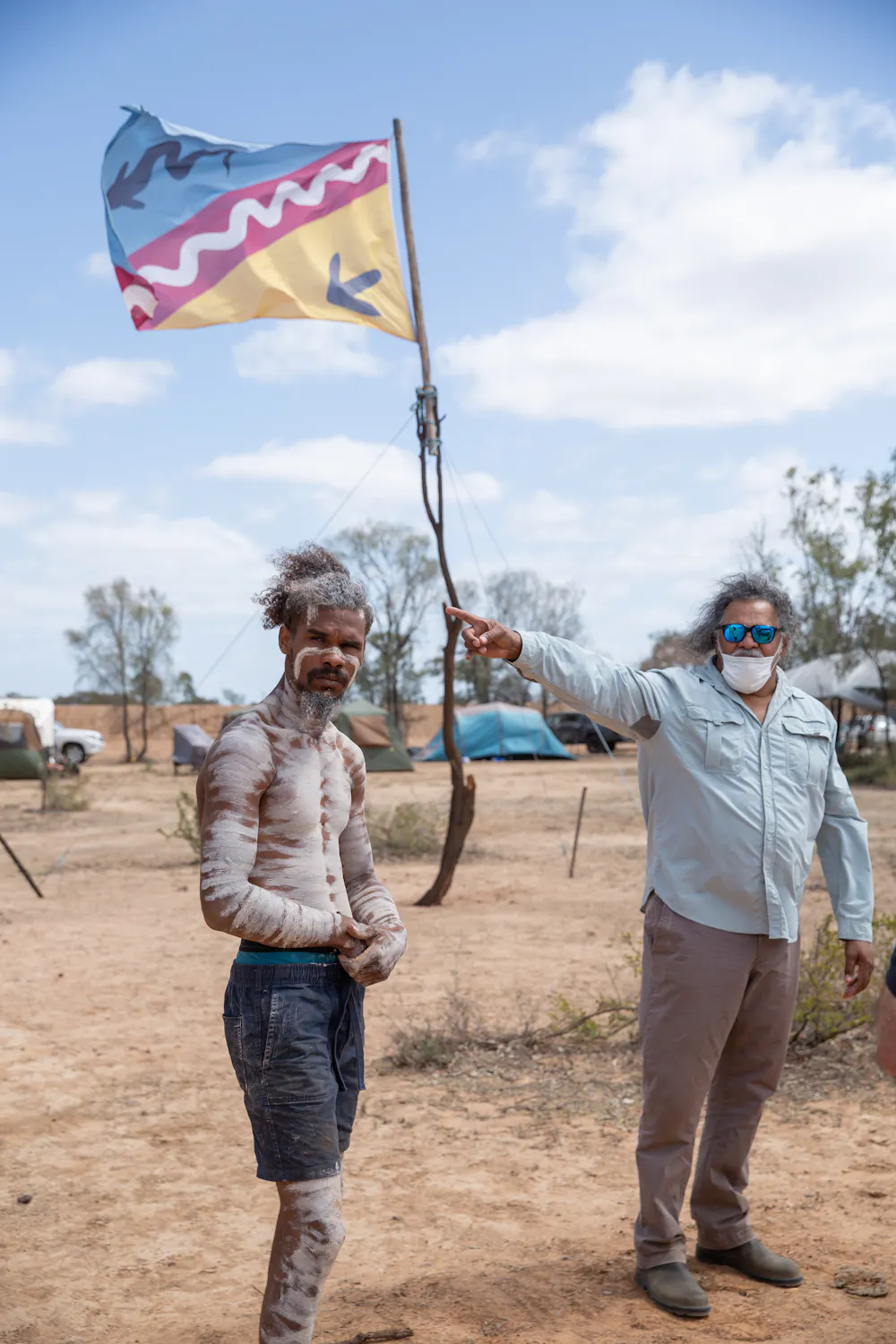
Over the past six weeks, Jagalingou cultural custodians have been conducting the Waddananggu ceremony, translated to English as “The Talking”. Describing the ceremony, Cultural Custodian Coedie McAvoy has said
We have set up a stone Bora ring and ceremonial ground opposite Adani’s mine and are asserting our human rights as Wangan and Jagalingou people to practice culture.
Since the leases were granted to Adani, police have repeatedly removed the Wangan and Jagalingou people from their traditional lands when conducting ceremonies. They have also been accused by journalists of acting as a “shield” to Adani’s corporate interests.
Adani’s proposed Carmichael open-cut and underground coal mine in the Galilee Basin in Central Queensland covers 200 square kilometres of land.
If built, it will be Australia’s largest and the world’s second largest coal mine. The project includes the construction of a 189-kilometre rail connection between the proposed mine and the Adani-operated Abbot Point Terminal adjacent to the Great Barrier Reef.
The proposed mining and railway developments encompass much of the Wangan and Jagalingou ancestral lands.
Read more: Protest art: rallying cry or elegy for the black-throated finch?
What led to the change in police attitudes?
Cultural Leader Adrian Burragubba brought a complaint to the Queensland Human Rights Commission after police broke up a Wangan and Jagalingou ceremonial campsite in August 2020. The complaint resulted in mediation between the police and Burragubba on behalf of his family and community over March to July of this year.
One outcome of the mediation was the Queensland police’s “statement of regret”, in which Assistant Commissioner Kev Guteridge said police recognise that Burragubba represents a group of traditional owners “aggrieved by Adani’s occupation of the land”, adding:
We acknowledge that the incident on 28 August, 2020, was traumatic for Mr Burragubba and his extended family, and caused embarrassment, hurt and humiliation.
According to The Guardian, Burragubba is thought to be the first Indigenous person to extract a public apology from a state agency since the enactment of the Queensland Human Rights Act.
Section 28 of the Act recognises Aboriginal and Torres Strait Islander peoples hold distinct cultural rights as Australia’s First Peoples:
They must not be denied the right, with other members of their community, to live life as an Aboriginal or Torres Strait Islander person who is free to practice their culture.
 Leah Light Photography
This is modelled on article 27 of the International Covenant on Civil and Political Rights and Articles 8, 25, 29 and 31 of the 2007 United Nations Declaration on the Rights of Indigenous Peoples.
The inclusion of this section is highly significant given Australia only endorsed the United Nations Declaration on the Rights of Indigenous Peoples in 2019. Australia is yet to implement the declaration into law, policy or practice at a federal level.
The Greens senator Lidia Thorpe said the inquiry’s recommendation of “free, prior and informed consent” did not go far enough to protect traditional owners.
Burragubba’s complaint under the Queensland Act was likely strengthened by the Wangan and Jagalingou peoples’ ongoing legal assertion of native title. 44b of the Native Title Act confers rights of access for traditional activities to a native title claim group.
This legal principle of “right of access” was bolstered by the findings in the case of Western Australia v Brown, 2014, which confirmed title was not wholly extinguished by the lease of land as long as native title is “not inconsistent with the lease”.
Leah Light Photography
This is modelled on article 27 of the International Covenant on Civil and Political Rights and Articles 8, 25, 29 and 31 of the 2007 United Nations Declaration on the Rights of Indigenous Peoples.
The inclusion of this section is highly significant given Australia only endorsed the United Nations Declaration on the Rights of Indigenous Peoples in 2019. Australia is yet to implement the declaration into law, policy or practice at a federal level.
The Greens senator Lidia Thorpe said the inquiry’s recommendation of “free, prior and informed consent” did not go far enough to protect traditional owners.
Burragubba’s complaint under the Queensland Act was likely strengthened by the Wangan and Jagalingou peoples’ ongoing legal assertion of native title. 44b of the Native Title Act confers rights of access for traditional activities to a native title claim group.
This legal principle of “right of access” was bolstered by the findings in the case of Western Australia v Brown, 2014, which confirmed title was not wholly extinguished by the lease of land as long as native title is “not inconsistent with the lease”.
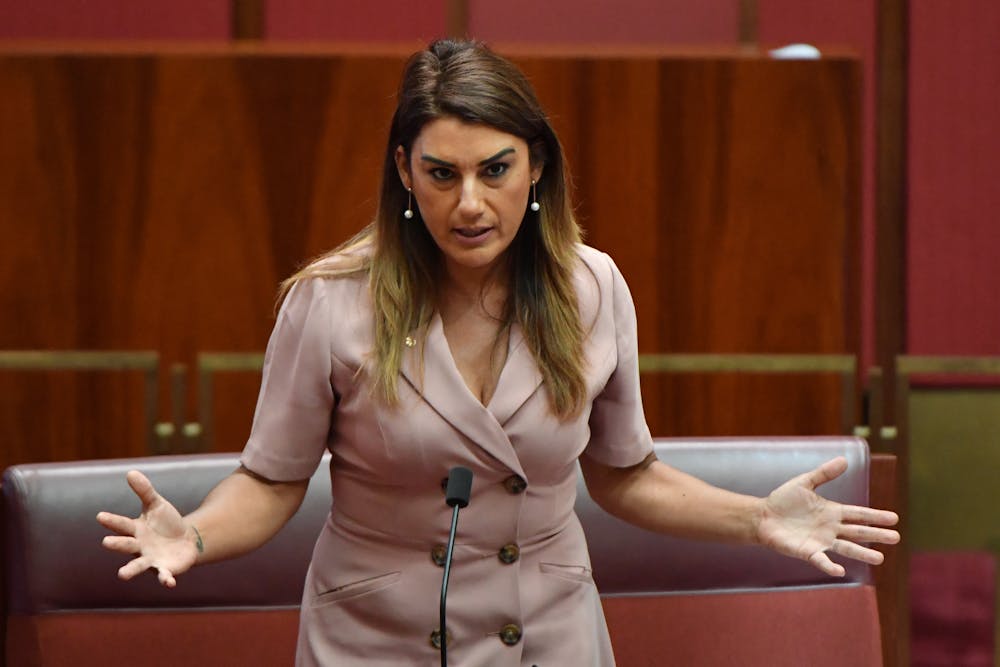 Greens senator Lidia Thorpe has stated the Greens supported calls from traditional owners for a right veto projects impacting cultural heritage.
Mick Tsikas/AAP
The significance of this police action could be far reaching
The new respect shown by Queensland police for the cultural rights of the Wangan and Jagalingou will not reinstate Wangan and Jagalingou native title. Nor will it stop the Adani mine.
But it means the Wangan and Jagalingou can continue to practice culture on Country, as they have for thousands of years, instead of being treated “like trespassers on their own land”. Their living connection to Country is not broken by the lease of land to Adani.
For Adani, it means the Wangan and Jagalingou people are an ongoing presence: a public reminder of cultural claim over the land where the mine is situated.
For the police, the significance goes beyond the struggle over the Adani mine. This change in police conduct could mark the end of police complicity in removing First Nations people from their ancestral land in the state of Queensland. Other state agencies will now also be forced to take the cultural rights of First Nations custodians seriously.
Read more:
Australia listened to the science on coronavirus. Imagine if we did the same for coal mining
It is an important step on a national journey towards recognition of First Nations’ cultural rights. Like the Queensland Human Rights Act, Victoria and the ACT also enshrine human rights in state law, providing legal avenues validating cultural practice on Country against public authorities. If the federal government adopts the findings of the parliamentary inquiry into the destruction of the Juukan Gorge rock shelters, handed down earlier this week, First Nations’ cultural rights will be further protected.
The Inquiry committee recommended new Commonwealth legislation for stricter protection of sacred sites, and improvements to the Native Title Act. The committee has said new legislation should be underpinned by the United Nations Declaration on the Rights of Indigenous Peoples.
The practice of Waddananggu is significant for the whole country. It is an opportunity for all of us to respectfully witness, talk and learn towards meaningful reconciliation.
McAvoy issued a broad invitation to the Waddananggu:
Stand with us to protect our human rights to practice ceremony and culture, and protect our homelands. ngali yinda banna, yumbaba-gi. We need you, to be heard.
Authors: Shelley Marshall, Associate Professor and Director of the RMIT Business and Human Rights Centre, RMIT University
Greens senator Lidia Thorpe has stated the Greens supported calls from traditional owners for a right veto projects impacting cultural heritage.
Mick Tsikas/AAP
The significance of this police action could be far reaching
The new respect shown by Queensland police for the cultural rights of the Wangan and Jagalingou will not reinstate Wangan and Jagalingou native title. Nor will it stop the Adani mine.
But it means the Wangan and Jagalingou can continue to practice culture on Country, as they have for thousands of years, instead of being treated “like trespassers on their own land”. Their living connection to Country is not broken by the lease of land to Adani.
For Adani, it means the Wangan and Jagalingou people are an ongoing presence: a public reminder of cultural claim over the land where the mine is situated.
For the police, the significance goes beyond the struggle over the Adani mine. This change in police conduct could mark the end of police complicity in removing First Nations people from their ancestral land in the state of Queensland. Other state agencies will now also be forced to take the cultural rights of First Nations custodians seriously.
Read more:
Australia listened to the science on coronavirus. Imagine if we did the same for coal mining
It is an important step on a national journey towards recognition of First Nations’ cultural rights. Like the Queensland Human Rights Act, Victoria and the ACT also enshrine human rights in state law, providing legal avenues validating cultural practice on Country against public authorities. If the federal government adopts the findings of the parliamentary inquiry into the destruction of the Juukan Gorge rock shelters, handed down earlier this week, First Nations’ cultural rights will be further protected.
The Inquiry committee recommended new Commonwealth legislation for stricter protection of sacred sites, and improvements to the Native Title Act. The committee has said new legislation should be underpinned by the United Nations Declaration on the Rights of Indigenous Peoples.
The practice of Waddananggu is significant for the whole country. It is an opportunity for all of us to respectfully witness, talk and learn towards meaningful reconciliation.
McAvoy issued a broad invitation to the Waddananggu:
Stand with us to protect our human rights to practice ceremony and culture, and protect our homelands. ngali yinda banna, yumbaba-gi. We need you, to be heard.
Authors: Shelley Marshall, Associate Professor and Director of the RMIT Business and Human Rights Centre, RMIT University 

















