

Restrictions on cultural hunting practices are limiting Indigenous people's access to food during the pandemic
- Written by: Stewart Sutherland, Senior Lecturer Indigenous Health, Australian National University
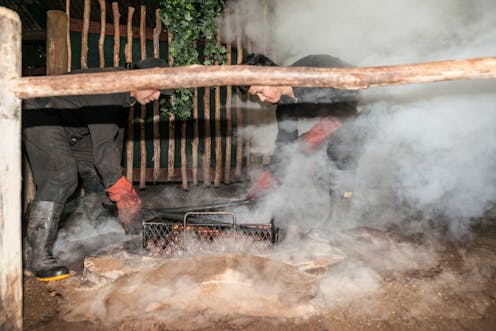
Indigenous people are some of the most food insecure people in Australia and Aotearoa (New Zealand). The COVID-19 pandemic and lockdowns have made food security an even greater problem in both countries, though it has generally gone unnoticed.
The pandemic has worsened some Indigenous people’s food security by limiting their ability to partake in cultural food harvesting.
The diets of Indigenous people before colonisation were rich, varied, and seasonal. Indigenous people in both Australia and Aotearoa would eat a variety of plants, water and land fowl, seafood, and protein from animals, insects and reptiles.
In Australia, Aboriginal people had approximately 150 different plants and animals as a food source.
However since colonisation, Indigenous people’s diets have dramatically changed. This change has contributed to food insecurity, in part due to the reliance on western cultural methods for food sourcing and the displacement of Indigenous people from their land.
Some Indigenous people rely on agricultural traditions and cultural practices to not only be food secure, but as a way of maintaining cultural identity and connections to Country.
In Aotearoa, mahika kai (food knowledge and practices for Māori) is linked to wealth and hospitality. It connects families through kinship and whakapapa (genealogy) to whenua (the land) and te taiao (natural resources).
Mahika kai is also fundamentally linked to Māori people’s underlying principles of manaakitaka (care and hospitality) and to the protection and stewardship of the land (totems, kaitiakitaka).
Food traditions also honour cultural lore and laws regarding access to seasonal foods and sites. These have protective factors for social and emotional wellbeing, providing a connection to culture and community.
Although governments and volunteer programs have been providing food and medical supplies to areas affected by COVID lockdowns, the loss of cultural practices can cause significant disconnect for Indigenous communities.
Cultural practices stifled in Australia
Western New South Wales has been significantly affected by rising COVID-19 cases in Aboriginal communities. People have also become increasingly food insecure. Some have limited financial resources to purchase food, which in rural and remote areas, is comparatively overpriced.
People are also having to rely on food donations. This has worsened the longer lockdowns have continued and may have lasting effects once they are over.
Read more: The COVID-19 crisis in western NSW Aboriginal communities is a nightmare realised
Earlier in the pandemic, Aboriginal people in Wilcannia had maintained their cultural practice of hunting kangaroo and distributing the butchered meat to families within the township.
According to NITV News, however, health authorities discouraged residents from hunting and distributing roo meat in August.
Said one resident,
I got a cousin telling me that him and his family went out and got kangaroo and they delivered it into Wilcannia, but health officials were saying that they can’t hand out wild meat to Aboriginal families because it’s not fit for consumption.
The NSW government has long made engaging in cultural food practices difficult, with game meat regulations, and culling and licensing legislation.
The Native Title (New South Wales) Act 1994 acknowledges the land has social, cultural, economic and spiritual importance to Aboriginal people, but it does not define these as legal rights or say how they can be asserted to support cultural food practice, including resource sharing.
Authorities eventually permitted roo meat from Broken Hill to be delivered. Since late August, Malyangapa Barkindji Wiimpatja man Leroy Johnson has reportedly been delivering kangaroo meat to affected communities in Wilcannia, with the support of local police.
Protection of Māori food practices
In Aotearoa, mahika kai is an enduring and intergenerational food practice for Māori protected by law. In March 2020, when Aotearoa first went into lockdown, all New Zealanders were required to remain at home. This prohibited activities such as hunting, seaside fishing, and food gathering.
Concerns were raised by kaumātua (Elders) acknowledging these restrictions were affecting whānau (families) who regularly relied on hunting for food security and staples within the home.
In the current lockdown, Prime Minister Jacinda Ardern’s government adjusted the lockdown rules to allow Māori to hunt and fish within a culturally acceptable framework.
This resulted in a resurgence in food gardens (maara kai) and traditional hospitality and service exchanges (kai hau kai) to support kaumātua and whānau. Other mahika kai activities, such as preserving and utilising local waterways, have also returned.
This demonstrates that lockdown rules can be tailored to allow cultural food sourcing, while still reducing the spread of the virus.
Read more: Explainer: the significance of the Treaty of Waitangi
However, Māori rights are protected through both treaty and legislation, whereas Indigenous people in Australia still have no treaty. This means the protection of cultural activities are not prioritised within the public health orders in NSW. This contributes to growing food insecurity in affected communities.
Although the Commonwealth Native Title Act 1993 provides limited protections, Aboriginal and Torres Strait Islander cultural rights still have no equivalent national protection.
Both Australia and Aotearoa have signed the UN’s Declaration on the Rights of Indigenous Peoples, however. This declaration could provide some protections to cultural hunting rights.
Without social distancing measures taking these rights into account, food insecurity will continue to occur. This could lead to poorer ill-health in communities beyond the pandemic.
Restoring cultural practices should be considered in federal and state governments’ exiting plans once crisis-level case numbers are down.
Australia’s governments must follow Aotearoa’s lead and find a way for public health orders and cultural food practices to work together.
Authors: Stewart Sutherland, Senior Lecturer Indigenous Health, Australian National University


















