

It's time for Anthony Albanese to get angry
- Written by Judith Brett, Emeritus Professor of Politics, La Trobe University
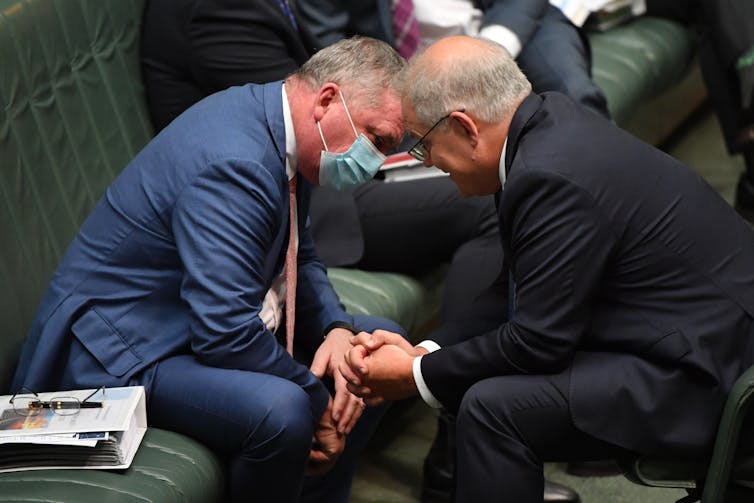
Remember Scott Morrison’s promise in May 2019: “You vote for me, you’ll get me. You vote for Bill Shorten and you’ll get Bill Shorten.” As well as attacking Shorten, Morrison was also signalling that the rules around the Liberal leadership had changed. Shortly after Morrison came through the middle of Peter Dutton and Malcolm Turnbull to become PM, the federal parliamentary Liberal Party changed the rules for selecting the leader. The person who led the party to electoral victory would lead it to the next election, so was now immune from the challenges and simple majorities that had unseated Tony Abbott and Turnbull.
This was the subtext. The main text was you don’t want Bill. To be sure, we didn’t get Bill, but now it seems that instead of the man himself, we’ve got Barnaby Joyce and the government’s climate policy was outsourced to the Nationals Party room.
It reminds me of 1963 when Arthur Calwell and Gough Whitlam, then the leader and deputy leader of the federal Labor Party, were photographed after midnight, waiting under a street light outside the Hotel Kingston for the federal executive to determine Labor’s policy on US bases. Before Whitlam reformed the party, policy was made in the organisational wing by the federal executive with no automatic representation of the parliamentary leadership. The 36 Faceless Men, journalist Alan Reid called them, and the term took off.
When then-Prime Minister Robert Menzies called a snap election a few months later, he pilloried Calwell as a man who took instruction from others, and so, was unfit to be Australia’s prime minister. Today we have a prime minister so lacking in authority and conviction that his emissions reduction policy depended on the outcome of Nationals’ Party meetings on not one but two Sunday afternoons.
As I have said many times, the National Party, and the Country Party before it, wields far more power than its electoral support warrants. It did do especially well at the 2019 election, winning around 10% of the vote, with which it won 16 lower house seats. It also provides the deputy prime minister, the deputy speaker, and, with Keith Pitt’s return to Cabinet, five Cabinet ministers. Its vote was about the same as the Greens, who have one lonely voice in the House of Reps. Thanks goodness for the Senate, where the proportional voting system gives the Greens representation that more truly reflects their support in the electorate – they have nine senators to try to hold back the more egregious of the government’s legislation and probe its actions.
Read more: Want to understand how the Coalition works? Take a look at climate policy
Why won’t Anthony Albanese now say, “You vote for Morrison, you get Barnaby. You vote for me, you get me”? And why won’t he say it over and over and over? Like Abbott did with the brutal retail politics of calling the Gillard government’s price on carbon a tax, when, as Peta Credlin later admitted, it wasn’t one at all. “It took Abbott about six months to cut through,” she said, “but when he cut through, Gillard was gone”.
Albanese desperately needs some cut-through lines, to up his public profile, to simplify the political contest, and to land some blows on Morrison. The Nationals’ grandstanding should be a gift. It plays into two already existing doubts about Morrison: his capacity to lead, and his focus on electoral strategy rather than national problems.
The Nationals, with six Queenslanders, two Victorians and eight from New South Wales, are a party of the eastern states. There are no Nationals members from South Australia, Tasmania or Western Australia. This plays into the suspicion many already have that Morrison is the prime minister for New South Wales, an impression reinforced by his decision to live in Sydney in Kirribili House rather than the Lodge in Canberra.
Then there are the 38,000 or so coal miners we hear so much about, whose jobs are at risk if we move too fast to reduce our emissions. About as many people have already lost their jobs in universities over the past two years because the COVID pandemic stopped international students, and the government did nothing as the university sector shrank. The most obvious explanation for this difference is that people in universities are less likely to vote for the Coalition than the coal miners, with little consideration of their contributions to the national interest.
So, Labor and Albanese have plenty of opportunity to channel anger towards Morrison. Why are they so reluctant? I have been thinking a lot about anger in politics lately. In the book of essays I have just published, Doing Politics: Writing on Public Life, I pay tribute to the profound influence of Alan Davies and Graham Little from the University of Melbourne Politics Department on my thinking about politics. Davies and Little looked to psychoanalysis to help understand politics. Both wrote about emotions in public life, their risks and opportunities and the way they come in sets: fear, anger and paranoia; envy and resentment; pathos and compassion; guilt and denial; hope, possibility and delusion. The book includes a series of essays on our most recent leaders, and all draw on their wisdom.
Read more: Labor's wicked problem: how to win back Queensland
Since John Howard’s time as prime minister, the Liberals have specialised in the politics of fear and anger, fear of being over-run by refugees, of others getting what you deserve, and of change; and anger at anyone who opposed them. And they have succeeded, again and again, at turning fear and anger against Labor, such as at the last election when they whipped up fear of Labor’s policies on franking credits, negative gearing, electric cars and an ambitious climate target. It was negative campaigning and it worked enough to get the government back across the line.
Labor is not shy of negative campaigning, as in the 2016 “Mediscare” campaign, but it is more uneasy with anger. At present, Albanese seems mired in the politics of pathos, with the oft-repeated story of his childhood upbringing by a single mum in council housing, and his unfulfillable promise that there will be no one left behind. What he needs is some anger and to direct it at Morrison; to play the man like Morrison did against Shorten.
I can understand why he might be reluctant to do this. For many of us, anger is not a comfortable emotion. But anger has big advantages for a campaigning politician - its energy and its illusion of conviction – especially if it can be condensed into cut-through slogans and images. The emotions are not skilled workers, as the fictional poet Ern Malley so wisely observed, especially when they are abroad in public life. They need to be handled with black and white gloves to be effective. Morrison the electoral strategist knows this. Albanese needs to learn, and fast. If he cuts through, Morrison is gone.
A collection of Judith Brett’s essays, Doing Politics: Writing on Public Life, went on sale last week through Text Publishing.
Authors: Judith Brett, Emeritus Professor of Politics, La Trobe University
Read more https://theconversation.com/its-time-for-anthony-albanese-to-get-angry-170771

















