

To reach net zero, we must decarbonise shipping. But two big problems are getting in the way
- Written by: Peter van Duyn, Maritime Logistics Expert, Centre for Supply Chain and Logistics (CSCL), Deakin University
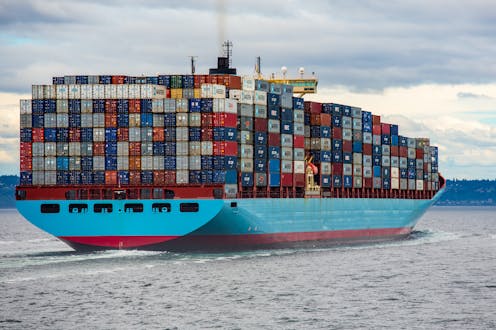
Shipping, which transports 90% of the world’s trade, contributes nearly 3% of global emissions – a little more than the carbon footprint of Germany. If gone unchecked, this share could increase to 17% by 2050 as the world’s GDP keeps growing.
Curbing shipping emissions has been a hot topic at the international climate summit in Glasgow, with 14 nations signing a declaration last week to bring shipping emissions down to net zero by 2050.
On Saturday, shipping industry heavyweights and senior government representatives met to iron out details of this lofty promise, ahead of the key transportation talks at COP26. Important differences emerged in whether market or regulatory rules will be most effective to push the industry towards net zero.
Shipping and aviation are notoriously difficult industries to decarbonise. They require vast amounts of fuel for international travel, and the questions of which country is responsible for emissions makes reaching agreements a mammoth and glacial task.
Growing momentum
Shipping’s total emissions are set to increase this year for the first time since the global financial crisis of 2008.
If left unregulated, shipping and aviation will be responsible for almost 40% of all carbon dioxide emissions in 2050, according to a study published by the European Parliament.
With so much at stake, we’re finally starting to see change, with businesses (and their customers) placing more emphasis on shipping’s contribution to climate change. In October this year, nine big companies – including Amazon, Ikea, and Unilever – pledged to move their cargo only on ships using zero-carbon fuel by 2040.
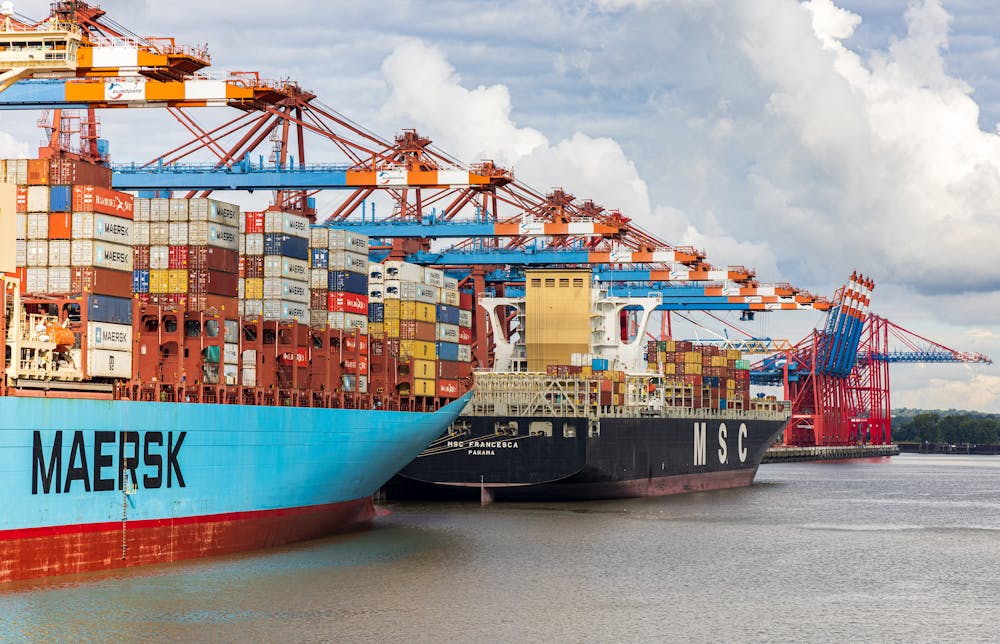
What’s more, three of the world’s largest container shipping lines – Maersk, CMA CGM, and MSC – are actively pursuing the use of alternative fuels and aim to be net-zero compliant by 2050 or before.
A lack of technology
Most ship engines use a low-grade, carbon-heavy fuel oil, which creates significant air pollution. So some shipowners are moving to build new ships or convert existing ships to run on liquefied natural gas (LNG) instead.
While this presents a 25% reduction in CO₂ emissions compared to the current low-grade fuel, LNG still releases methane into the atmosphere – a heat-trapping gas roughly 30 times more potent than CO₂.
This points to a big problem getting in the way of decarbonising shipping: zero-carbon technologies that can be applied at scale to large ocean-going ships do not yet exist.
Read more: Shipping emissions must fall by a third by 2030 and reach zero before 2050 – new research
Commercially viable technologies that create alternative, zero-emissions fuels, such as hydrogen and ammonia, are still in development by ship engine manufacturers.
A significant challenge is the requirement for vast fuel storage on board ships, and replenishing these fuels in port, especially after long voyages. Battery power using renewable sources can only be used on short voyages such as ferries or on coastal trips.
Nuclear propulsion has also been considered, but there are associated risks and it doesn’t have the support of the general public.
 The IMO’s target to halve emissions by 2050 is not in line with Paris Agreement.
Chuttersnap/Unsplash, CC BY
The IMO’s target to halve emissions by 2050 is not in line with Paris Agreement.
Chuttersnap/Unsplash, CC BY
Global disunity
In October, shipping was under fire from United Nations Secretary General Antonio de Guterres, who accused the industry of not doing enough to stop global warming. So, is he right?
One of the difficulties in cutting emissions in shipping is that it’s hard to decide which country the emissions should be assigned to.
Should it be based on where the ship’s fuel is sold, where a ship is registered, or the origins or destinations of the ship’s cargo? Each option would lead to radically different emissions responsibilities and associated costs for individual countries.
Read more: Cargo ships are emitting boatloads of carbon, and nobody wants to take the blame
The International Maritime Organization (IMO) is the UN body that addresses emissions from ships engaged in international trade. It’s currently coordinating measures to curb maritime emissions among its more than 170 member states. And each state has competing interests.
In April 2018, the IMO set a goal of halving greenhouse gas emissions by 2050 from 2008 levels. This has been met with fierce criticism from environmental organisations, who call it weak and unambitious.
This target falls well short of the net-zero by 2050 target declared by nations last week at COP26. The declaration was led by Denmark and includes the US. Notably, it was not signed by countries with big maritime shipping sectors, such as Japan and Greece.
The IMO has agreed, after collecting more data, to revisit their target in 2023. Given growing public interest in climate change and large companies demanding zero emissions in shipping their goods, I believe it’s likely the IMO will bolster its target, and start working towards net-zero emissions by 2050.
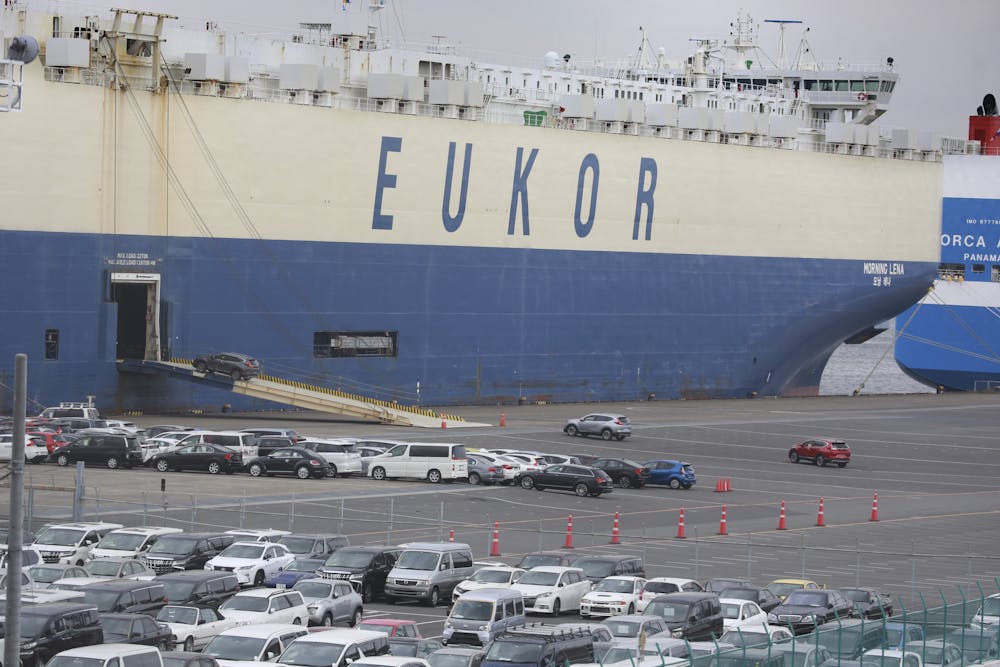 Cars for export are loaded onto a cargo ship at a port in Yokohama, Japan.
AP Photo/Koji Sasahara
Cars for export are loaded onto a cargo ship at a port in Yokohama, Japan.
AP Photo/Koji Sasahara
So what needs to happen now?
At Saturday’s conference, it became clear most shipowners present were in favour using the market to solve the emissions problem, and suggested using a carbon price.
This echoes the calls of trade groups, representing more than 90% of the world’s merchant fleet. They have asked the IMO to prioritise a carbon tax for the industry to encourage shipowners to invest in alternative fuel technologies.
On the other hand, the representative for Japanese shipowners was in favour of letting politicians come up with the rules, saying the shipping industry would comply with them.
And shipowners that recently invested in ships fuelled by LNG were, understandably, advocating its use, saying no zero-carbon alternative fuels are currently available, and are still a long way off.
But before we can make any real headway to decarbonise shipping, we must have global unity. It is imperative more member states get on board with the net zero by 2050 declaration.
The IMO needs to set international standards around who’s responsible for emissions. Countries with large shipping fleets such as Japan and Greece need to come on board to expedite the process. IMO resolutions take years to develop and even longer to be ratified by its member countries.
A well-funded research and development program, which the industry has agreed to pay for within a global regulatory framework, needs to commence immediately under the supervision of the IMO.
The heightened interest we’re seeing across the supply chains and at COP26 is an important opportunity for the shipping industry to be on the front foot, and reduce their emissions sooner rather than later.

















