

How to help your child get the most protection out of their face mask
- Written by: Joel Rindelaub, Research Fellow, School of Chemical Sciences, University of Auckland
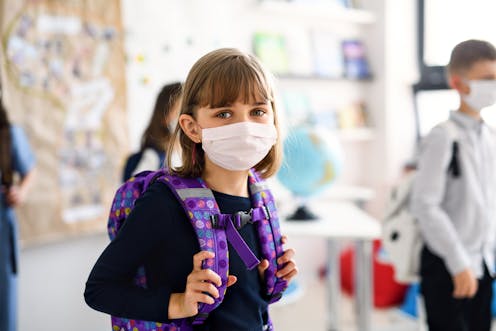
With many children around the country required to wear masks in classrooms, including those as young as eight in Victoria, parents are wondering how they can support their kids’ mask use.
Schools are a breeding ground for respiratory viruses. When a large number of people are gathered together for extended periods of time within indoor areas, it’s a perfect recipe for aerosol transmission.
Along with proper ventilation, physical distancing and good hygiene, face masks can help reduce the spread of COVID.
So what masks are best for kids? And how can children increase the likelihood their mask will protect them from COVID?
Read more: From vaccination to ventilation: 5 ways to keep kids safe from COVID when schools reopen
Masks cut COVID transmission
The dominant route for COVID transmission is through the inhalation of infectious aerosols. When someone with COVID coughs, sneezes, talks or even breathes, they are exhaling scores of tiny virus-laden particles into the air that others around them can breathe in.
Evidence from the United States shows wearing masks in classrooms may reduce the chance of children contracting COVID from their classmates. Regions with school mask mandates have roughly half the rates of COVID infection among children than those without.
While randomised clinical studies focusing on mask use in schools are not available, data from larger community mask use trials support their ability to reduce the number of symptomatic COVID cases in the community.
The World Health Organization recommends mask use in students 12 years or older, and in students from six to 11 years old under appropriate supervision.
Masks don’t impact the air exchange in children or their ability to breathe, so they’re safe to use. However, masking students with specific needs should be evaluated on a case-by-case basis.
Mask use in children aged five and younger is not recommended, in part because facial expressions are important for social and emotional learning.
What masks are best for kids?
When selecting a mask, pay close attention to the fit; a mask will lose much of its effectiveness if it’s not worn appropriately. There shouldn’t be any gaps around the nose or along the sides of the face.
While many masks are capable of preventing the release of large droplets in those who are infected, a tighter fit will improve the filtration of the smaller aerosol particles.
Read more: Can't get your kid to wear a mask? Here are 5 things you can try
Of the available mask varieties, N95 or P2 types have the best filtration efficiency, capturing more than 95% of particles. Though they need to be tested to ensure a proper fit to be most effective, and they may prove uncomfortable when worn for long periods.
Surgical masks (the disposable kind you can buy at supermarkets and pharmacies) are the next best at filtration, with efficiencies from 50–75%.
Surgical mask efficiency can be improved if a tighter fit is created around the face, such as by wearing the surgical mask underneath a cloth mask, or through the “knot & tuck” method.
Here’s what we mean by knot & tuck.While useful for older students, N95s and most surgical masks may not be as effective in protecting young children, as many of these masks were designed for adults.
Cloth varieties, on the other hand, usually fit children much better. Being able to use fun prints and colours can help kids feel more comfortable with mask-wearing.
However, single-layer cloth masks are typically not recommended due to their low filtration efficiency. Well-fitting triple-layered masks are much better, and they are as effective as surgical varieties.
Three layers are better than one.Tips for young mask-wearers
The recommendations for children’s mask use mirror those for adults, so:
try to avoid touching the outside of the mask. This means using the ear loops to put on and remove the mask. If the mask is doing its job effectively, there could be virus particles on the outside of the mask. Always wash or sanitise hands after touching the mask
use a separate bag for storage. It’s important that a mask does not contaminate or be contaminated by other items
ensure the mask covers both the mouth and nose
wash cloth masks after every use. It may help to have several cloth masks so a fresh one can be used daily
throw out surgical and N95 masks after each use
don’t use a mask with valves. These won’t prevent an infected person spreading the virus.
Read more: 7 tips for making masks work in the classroom
Focus on masks indoors
While the advice might feel relatively complicated, research shows that even children in the first two years of school are very compliant with mask guidelines, using them appropriately for 77% of the school day, on average.
For best results, instructions on mask use and safety are needed alongside the rollout of masks in schools.
The use of masks is less important during outside recess and breaks, because outdoor areas are generally well-ventilated.
In indoor areas where masks can’t be used, such as during lunch, physical distancing is encouraged.
Authors: Joel Rindelaub, Research Fellow, School of Chemical Sciences, University of Auckland


















