

The government's net-zero modelling shows winners, we've found losers as well
- Written by: Philip Adams, Professor at the Centre of Policy Studies, Victoria University
On Friday November 12, after a wait of a fortnight, the government released a 100-page summary of the modelling and analysis behind its claim that an emissions target of net-zero by 2050 would leave the economy no worse off.
The report details both formal in-house modelling using a large global economic model and a relatively informal but detailed assessment of employment outcomes prepared by the consultancy McKinsey & Company.
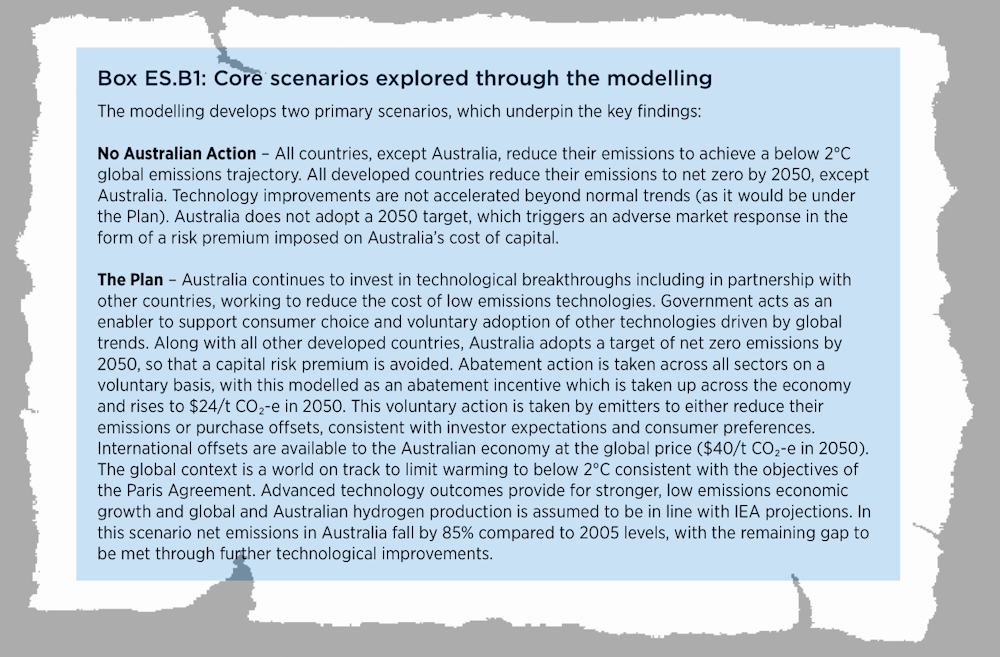
The formal modelling starts with a scenario labelled “no Australian action”, in which every developed country other than Australia cuts its emissions to net-zero by 2050, and when taken together every country other than Australia does whatever else is needed to hold global warming to 2°C.
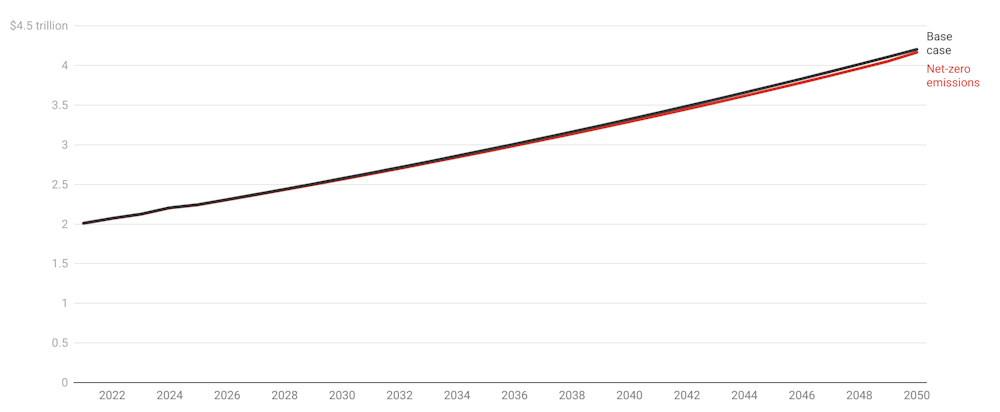 Zero Greenhouse Gas Emissions by 2050: What it means for the Australian Economy, Industries and Regions.
Centre of Policy Studies, 2021
What’s significant is that when we last did this work in 2014, we estimated a larger loss in GDP of 3.8%.
The loss is smaller now because the task has become easier, thanks to lower than previously expected renewable generation costs and a faster than expected uptake of both light and heavy electric vehicles.
On employment, we found Australia would have about the same number of jobs by 2050 under either scenario.
Industries such as coal mining would suffer, although not as much as might be thought. Coal mining would continue in 2050 due to continued international demand, with production down 34% and hours worked down 37% compared to no more toward net-zero.
But more detail on jobs
Decarbonisation will provide an impetus to many industries, especially renewable electricity and forestry which would almost double as decarbonisation boosted tree planting in order to take advantage of bio-sequestration opportunities.
This would lead to significant increases in forested land and increased sales of logs for processing and export as forest pulp. Surprisingly, we found little mention of forestry or wood processing and exports in the government’s summary.
Change in hours worked by industry under net zero scenario, 2050
Zero Greenhouse Gas Emissions by 2050: What it means for the Australian Economy, Industries and Regions.
Centre of Policy Studies, 2021
What’s significant is that when we last did this work in 2014, we estimated a larger loss in GDP of 3.8%.
The loss is smaller now because the task has become easier, thanks to lower than previously expected renewable generation costs and a faster than expected uptake of both light and heavy electric vehicles.
On employment, we found Australia would have about the same number of jobs by 2050 under either scenario.
Industries such as coal mining would suffer, although not as much as might be thought. Coal mining would continue in 2050 due to continued international demand, with production down 34% and hours worked down 37% compared to no more toward net-zero.
But more detail on jobs
Decarbonisation will provide an impetus to many industries, especially renewable electricity and forestry which would almost double as decarbonisation boosted tree planting in order to take advantage of bio-sequestration opportunities.
This would lead to significant increases in forested land and increased sales of logs for processing and export as forest pulp. Surprisingly, we found little mention of forestry or wood processing and exports in the government’s summary.
Change in hours worked by industry under net zero scenario, 2050
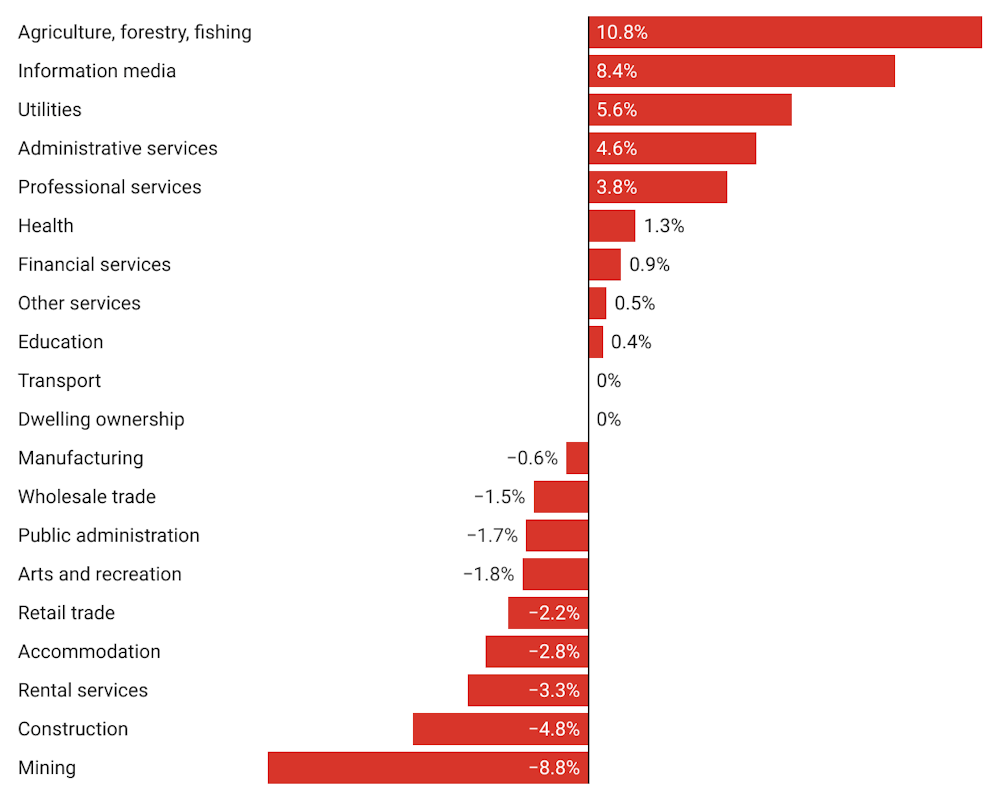 ANZSIC industry divisions.
Centre of Policy Studies, November 11, 2021
Electricity would replace more than all the jobs lost in coal generation with additional jobs in renewables generation and electricity distribution and supply as more of the economy became electric-powered.
Although vulnerable industries account for less than 4% of employment across the country, some regions are much more heavily dependent on them than others.
Read more:
How government modelling found net-zero would leave us better off
We identify nine of Australia’s 88 statistical area level 4 regions as vulnerable to loss of employment. They include the coal-dependent regions such as Hunter in NSW, Fitzroy in Queensland and Gippsland in Victoria.
On the other hand, another 46 regions are identified as likely to gain employment. They are more highly exposed to the industries that would grow.
Change in real state product by industry under net zero scenario, 2050
ANZSIC industry divisions.
Centre of Policy Studies, November 11, 2021
Electricity would replace more than all the jobs lost in coal generation with additional jobs in renewables generation and electricity distribution and supply as more of the economy became electric-powered.
Although vulnerable industries account for less than 4% of employment across the country, some regions are much more heavily dependent on them than others.
Read more:
How government modelling found net-zero would leave us better off
We identify nine of Australia’s 88 statistical area level 4 regions as vulnerable to loss of employment. They include the coal-dependent regions such as Hunter in NSW, Fitzroy in Queensland and Gippsland in Victoria.
On the other hand, another 46 regions are identified as likely to gain employment. They are more highly exposed to the industries that would grow.
Change in real state product by industry under net zero scenario, 2050
 Centre of Policy Studies, November 11, 2021
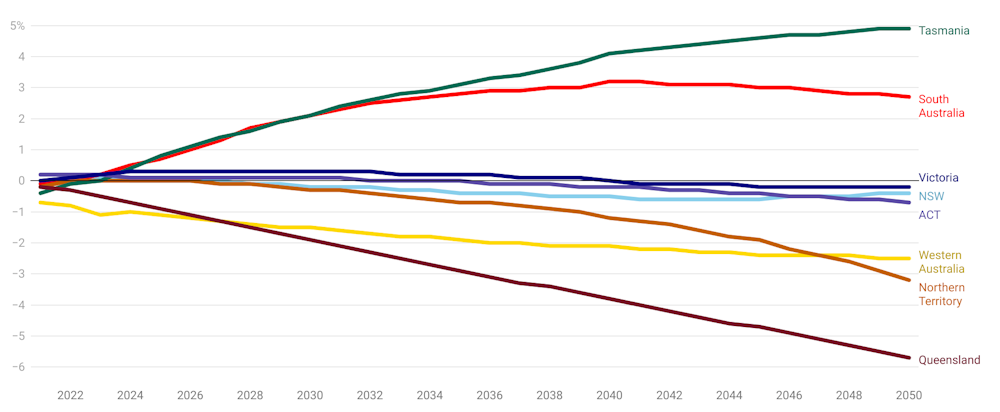
By state, Tasmania benefits the most under net-zero, having more hydroelectricity, forestry and wood products industry than other states as well as no coal-fired generation. Its real gross state product would be 4.9% higher than otherwise in 2050, and employment 11,600 higher
Queensland suffers the most, because of an over-representation of coal mining, broadacre agriculture and coal-generated electricity in its economy. Its real gross state product would be 5.9% lower than otherwise in 2050, and employment 97,800 lower.
Read more:
COP26: experts react to the UN climate summit and Glasgow Pact
The worse outcomes need to be put into perspective. Queensland is expected to employ an extra 1.2 million people by 2050 without decarbonisation. With decarbonisation it would be slightly fewer extra people, an extra 1.1 million.
It’s important our leaders do this work too
Whatever the government does to achieve zero emissions there will be a clear need for adjustment packages to cushion impacts on those most affected.
Given that we will be embarking on decarbonisation to secure community-wide benefits, it will be appropriate for the community to fund those packages.
To do that we will need detailed projections for the parts of the economy (regions, industries, occupations by skill) that will most benefit from the changes and the parts that will be most hurt. To date, the government hasn’t told us.
Authors: Philip Adams, Professor at the Centre of Policy Studies, Victoria University
Centre of Policy Studies, November 11, 2021
By state, Tasmania benefits the most under net-zero, having more hydroelectricity, forestry and wood products industry than other states as well as no coal-fired generation. Its real gross state product would be 4.9% higher than otherwise in 2050, and employment 11,600 higher
Queensland suffers the most, because of an over-representation of coal mining, broadacre agriculture and coal-generated electricity in its economy. Its real gross state product would be 5.9% lower than otherwise in 2050, and employment 97,800 lower.
Read more:
COP26: experts react to the UN climate summit and Glasgow Pact
The worse outcomes need to be put into perspective. Queensland is expected to employ an extra 1.2 million people by 2050 without decarbonisation. With decarbonisation it would be slightly fewer extra people, an extra 1.1 million.
It’s important our leaders do this work too
Whatever the government does to achieve zero emissions there will be a clear need for adjustment packages to cushion impacts on those most affected.
Given that we will be embarking on decarbonisation to secure community-wide benefits, it will be appropriate for the community to fund those packages.
To do that we will need detailed projections for the parts of the economy (regions, industries, occupations by skill) that will most benefit from the changes and the parts that will be most hurt. To date, the government hasn’t told us.
Authors: Philip Adams, Professor at the Centre of Policy Studies, Victoria University 

















