

How do pigeons find their way home? We looked in their ears with a diamond-based quantum microscope to find out
- Written by: David Simpson, School of Physics, Senior Lecturer, The University of Melbourne
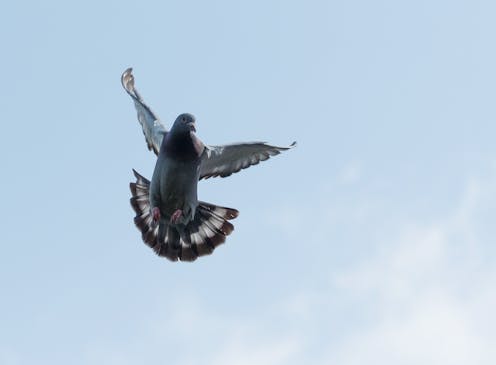
Homing pigeons are known for their uncanny ability to find their way home – navigating complex and changing landscapes. In fact, they do this so well they were used as a source of secure communication more than 2,000 years ago.
Julius Caesar reportedly sent news of his conquest of Gaul back to Rome via pigeons, as did Napoleon Bonaparte following his defeat by England in the 1815 Battle of Waterloo.
We know pigeons use visual cues and can navigate based on landmarks along known travel routes. We also know they have a magnetic sense called “magnetoreception” which lets them navigate using Earth’s magnetic field.
Read more: Explainer: how do homing pigeons navigate?
But we don’t know exactly how they (and other species) do this. In research published today in the Proceedings of National Academy of Sciences, my colleagues and I tested a theory that attempts to link magnetoreception in homing pigeons with tiny lumps of iron-rich material found in their inner ears.
By using a new kind of magnetic microscope, we confirmed this isn’t the case. But the technology has opened the door for us to investigate the phenomenon in several other species.
The current hypotheses
Scientists have spent decades exploring the possible mechanisms for magnetoreception. There are currently two mainstream theories.
The first is a vision-based “free-radical pair” model. Homing pigeons and other migratory birds have proteins in the retina of their eyes called “cryptochromes”. These produce an electrical signal that varies depending on the strength of the local magnetic field.
This could potentially allow the birds to “see” Earth’s magnetic field, although scientists have yet to confirm this theory.
The second proposal for how homing pigeons navigate is based on lumps of magnetic material inside them, which may provide them with a magnetic particle-based directional compass.
We know magnetic particles are found in nature, in a group of bacteria called magnetotactic bacteria. These bacteria produce magnetic particles and orient themselves along the Earth’s magnetic field lines.
Scientists are now looking for magnetic particles in a range of species. Potential candidates were found in the upper beak of homing pigeons more than a decade ago, but subsequent work indicated these particles were related to iron storage and not magnetic sensing.
Read more: New evidence for a human magnetic sense that lets your brain detect the Earth's magnetic field
A peek inside a pigeon’s ear
The new search is now underway in the inner ear of pigeons, where iron particles known as “cuticulosomes” were first identified in 2013.
Single cuticulosomes have been located within distinct regions in the pigeon inner ear where other known sensory systems exist (such as for hearing and balancing during flight). In theory, if there were a magnetic sensing system in pigeons, it should be located close to other sensory systems.
But to determine whether iron cuticulosomes can act as magnetoreceptors in pigeons, scientists need to determine their magnetic properties. This is no mean feat, since cuticulosomes are 1,000 times smaller than a grain of sand.
What’s more is they are only found in 30% of the hair cells within the inner ear, making them difficult to identify and characterise.
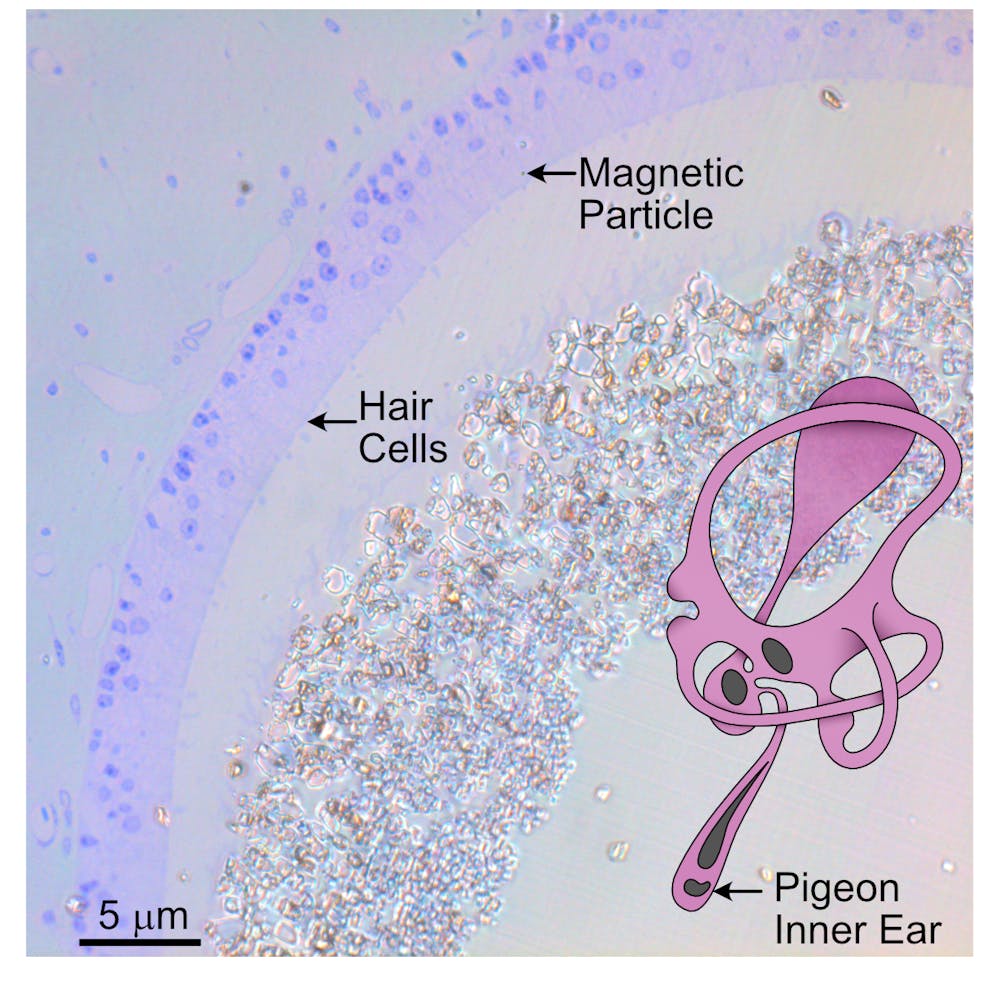
To tackle this problem our group at the University of Melbourne, together with colleagues from Vienna’s Institute of Molecular Pathology and the Max Planck Society in Bonn, turned to a new imaging technology to explore the magnetic properties of iron cuticulosomes in the pigeon inner ear.
We developed a magnetic microscope that uses diamond-based sensors to visualise delicate magnetic fields emanating from tiny magnetic particles.
Disproving the theory
We carefully studied thin sections of the pigeon inner ear placed directly onto the diamond sensors. By applying magnetic fields of varying strengths to the tissue, we were able to gauge the magnetic susceptibility of single cuticulosomes.
Our results showed the magnetic properties of the cuticulosomes were not strong enough for them to act as a magnetic particle-based magnetoreceptor. In fact, the particles would need to be 100,000 times stronger to activate the sensory pathways required for magnetoreception in pigeons.
However, despite the search for the elusive magnetoreceptor coming up short, we are extremely excited by the potential of this magnetic microscope technology.
We hope to use it study a host of magnetic candidates across a variety of species including rodents, fish and turtles. And by doing so we can focus not only on cuticulosomes, but a range of other potentially magnetic particles.
Authors: David Simpson, School of Physics, Senior Lecturer, The University of Melbourne


















