

Henri Matisse was an artist of colour and sensuous line; an unerring eye until the end
- Written by Joanna Mendelssohn, Principal Fellow (Hon), Victorian College of the Arts, University of Melbourne. Editor in Chief, Design and Art of Australia Online, The University of Melbourne
Review: Matisse: Life & Spirit, Art Gallery of New South Wales
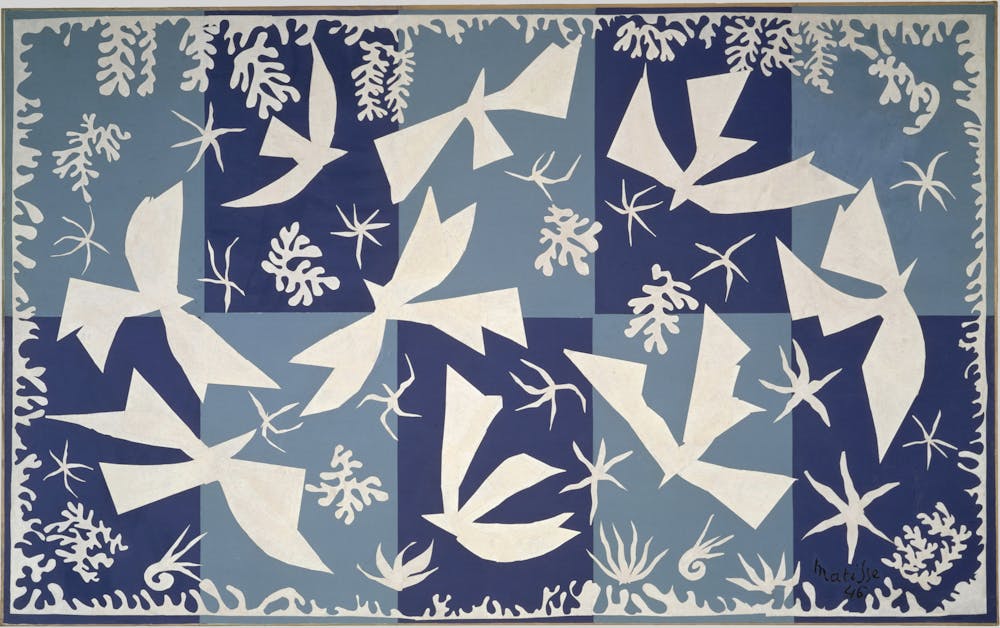
I saw work by Henri Matisse (1869-1954) for the first time when I was seven. It was a tapestry, Polynesia, newly acquired for the collection of the Art Gallery of NSW. I wondered at the simplicity of the clean, white, marine shapes floating on blue squares.
Matisse: Life & Spirit, the gallery’s summer blockbuster, shows how this rhythmic elegance was achieved. It includes the original maquette of that tapestry, called Polynesia, the sea, as well as its partner, Polynesia, the sky.
They hang in the final room of the exhibition, a celebration of the creativity and unerring eye of an old man, ravaged by illness.
His hand that once defined feminine beauty with a single curving line could no longer draw, but, as an accompanying video shows, he remained a master with scissors and used a stick to direct assistants where to place the shapes he cut.
Matisse’s Polynesia was the distilled memory of his visit to Tahiti in 1930. Although he had made some drawings at the time, he was never the kind of artist to paint a travelogue. Rather, years later in war-torn France, he took elements of that place of sun, sea, light and colour to make it his own.
Read more: From the Tate to the MoMA: cross-continental perspectives of Matisse's cut-outs
Polynesia also gave Matisse the technique of tivaevae – traditional Polynesian appliqué fabric – which he adapted to make cut-outs which Justin Paton, one of the exhibition’s co-curators, has called “one of the great flowerings of modern art”.
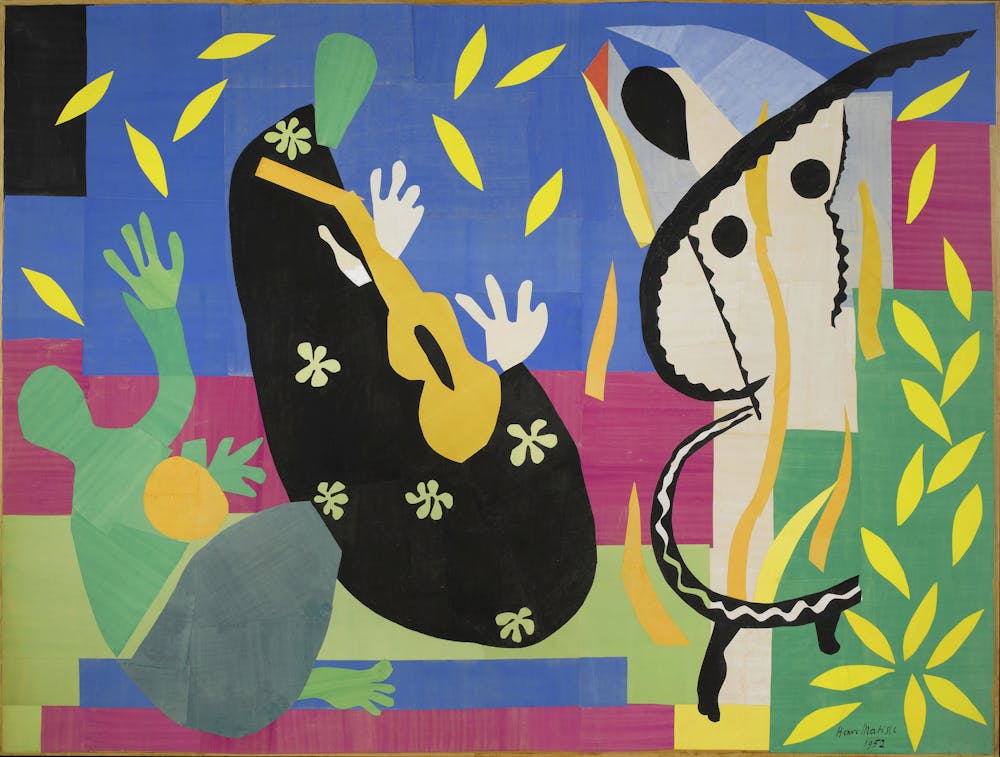 Henri Matisse, The sorrow of the king (La tristesse du roi) 1952. Gouache on paper, cut and pasted, mounted on canvas, 292 x 386 cm.
Centre Pompidou, Paris, MNAM-CCI, purchased by the state, 1954 AM 3279 P. © Succession H Matisse/Copyright Agency 2021. Photo: © Centre Pompidou, MNAM-CCI / Philippe Migeat / Dist RMN-GP
Henri Matisse, The sorrow of the king (La tristesse du roi) 1952. Gouache on paper, cut and pasted, mounted on canvas, 292 x 386 cm.
Centre Pompidou, Paris, MNAM-CCI, purchased by the state, 1954 AM 3279 P. © Succession H Matisse/Copyright Agency 2021. Photo: © Centre Pompidou, MNAM-CCI / Philippe Migeat / Dist RMN-GP
The greatest of these is the exquisite melancholy of The Sorrow of the King: a self-portrait in extreme old age and a contemplation of the music of death. It is so large, so fragile, it sits enthroned, shielded by glass, overseeing the final room of this very large exhibition.
It shares this room with the wild music of Jazz, Matisse’s first substantial series of cutouts devised as an illustrated book. Here, the individual pieces are placed as though they are musical notation, giving them a syncopated rhythm on the wall.
Matisse’s chapel
The architect Richard Johnson designed the exhibition, a masterly homage to great art.
This homage is most obvious in the exhibition’s centrepiece, an evocation of Matisse’s last great work, the Chapel of the Rosary at Vence.
 Installation view of ‘Matisse: Life & Spirit Masterpieces from the Centre Pompidou, Paris’ exhibition, on display at the Art Gallery of New South Wales, 20 November 2021 – 13 March 2022.
Photo © AGNSW, Mim Stirling
Installation view of ‘Matisse: Life & Spirit Masterpieces from the Centre Pompidou, Paris’ exhibition, on display at the Art Gallery of New South Wales, 20 November 2021 – 13 March 2022.
Photo © AGNSW, Mim Stirling
Matisse designed the chapel, built between 1947 and 1951, as a tribute to the Dominican nuns who nursed him during his illness, and as an exploration of how spiritual values let in the light after the darkness of war.
Despite being a Christian chapel, the forms evoke both nature and plants from other cultures, so it becomes more of a universal affirmation of spirituality.
Here, the gallery’s central court has been modified to match the size and proportions of the chapel. The artist’s drawings on the tiles are screened in a video loop, while the walls are hung with full size studies for the stained glass windows.
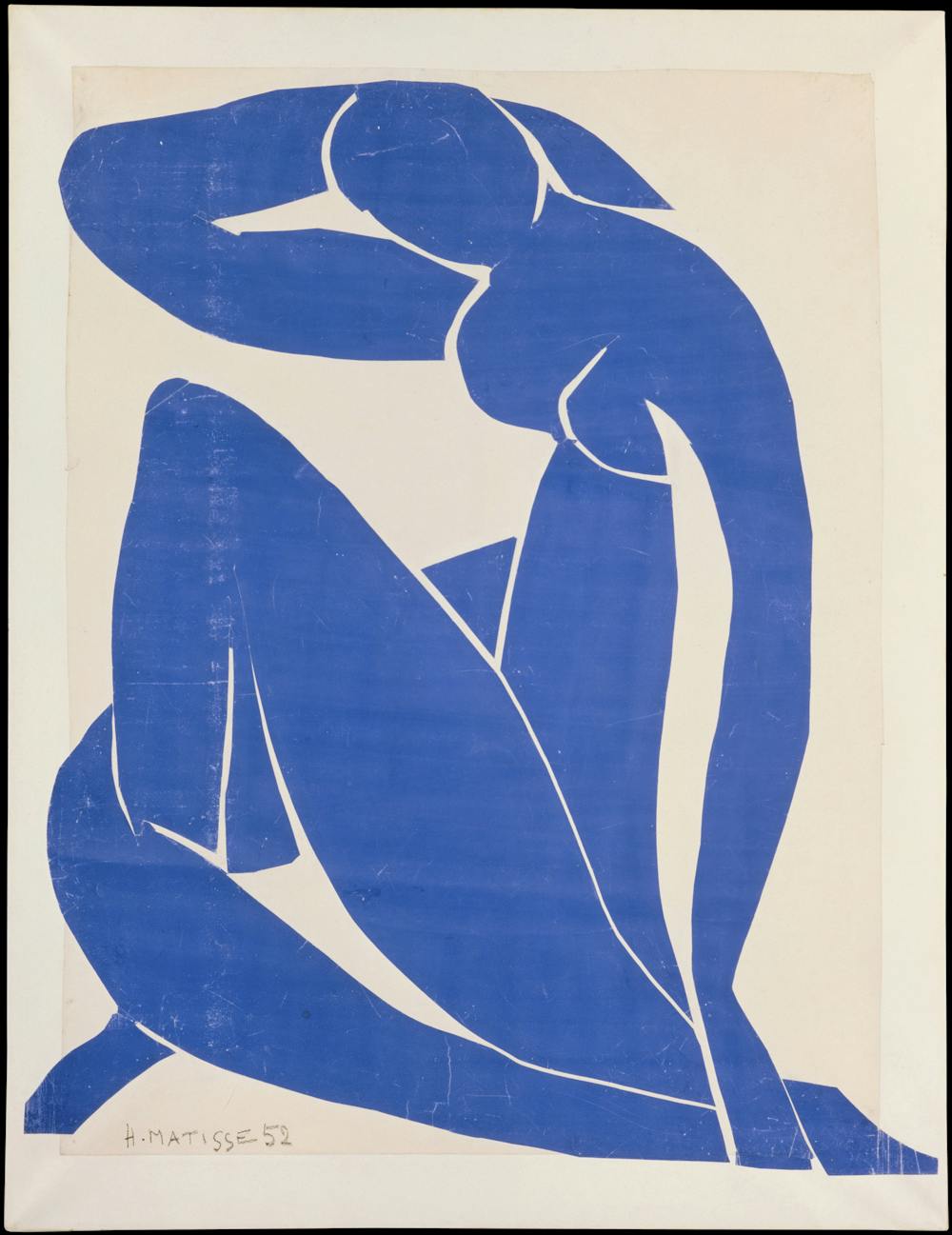 Henri Matisse. Blue nude II (Nu bleu II) 1952. Gouache on paper, cut and pasted on paper, mounted on canvas, 103.8 x 86 cm. Centre Pompidou, Paris, MNAM-CCI, purchased 1984 AM 1984-276. © Succession H Matisse/Copyright Agency 2021.
© Succession H Matisse/Copyright Agency 2021. Photo: © Centre Pompidou, MNAM-CCI / Service de la documentation photographique du MNAM / Dist RMN-GP
Henri Matisse. Blue nude II (Nu bleu II) 1952. Gouache on paper, cut and pasted on paper, mounted on canvas, 103.8 x 86 cm. Centre Pompidou, Paris, MNAM-CCI, purchased 1984 AM 1984-276. © Succession H Matisse/Copyright Agency 2021.
© Succession H Matisse/Copyright Agency 2021. Photo: © Centre Pompidou, MNAM-CCI / Service de la documentation photographique du MNAM / Dist RMN-GP
There are the two collage designs for the chasubles (a priest’s outermost liturgical vestments), while the entrance shows both an evocation of the chapel’s exterior and a wall quoting the plain white tiles of the interior.
Matisse the sculptor
Thanks to the Centre Pompidou’s generosity in lending many works that have never travelled so far before, it is possible to see here the full range of Matisse’s art, including sculpture.
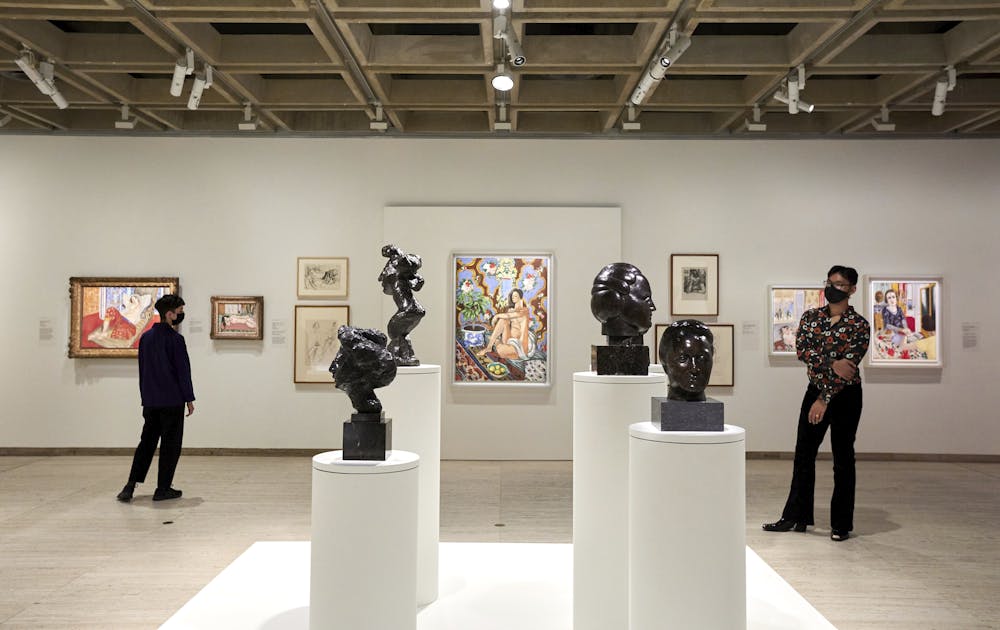 Installation view of ‘Matisse: Life & Spirit Masterpieces from the Centre Pompidou, Paris’ exhibition, on display at the Art Gallery of New South Wales.
Photo © AGNSW, Mim Stirling
Installation view of ‘Matisse: Life & Spirit Masterpieces from the Centre Pompidou, Paris’ exhibition, on display at the Art Gallery of New South Wales.
Photo © AGNSW, Mim Stirling
It is one thing to read of the ongoing influence of his Back series (four bronze sculptures of female backs) on his decorative paintings, but an altogether different experience to see these large bronze relief works of the bodies of powerful women.
Other, smaller, sculptures serve as a reminder of the importance of African art to Matisse as he was exploring form. This was more than a search for the exotic.
Rather, Matisse seems to have been on an endless quest for new ways of seeing and then incorporating what he found into his world.
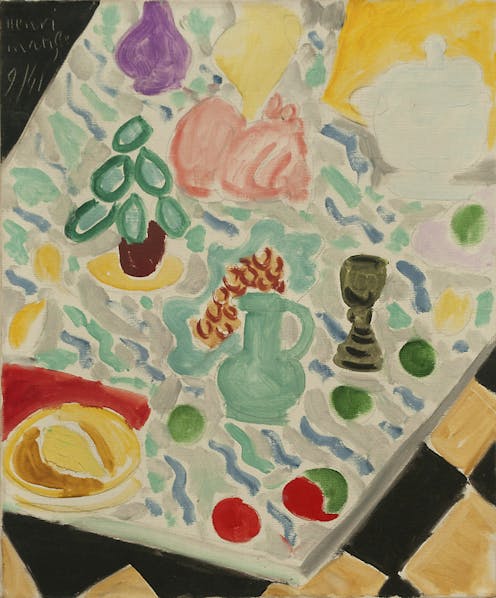
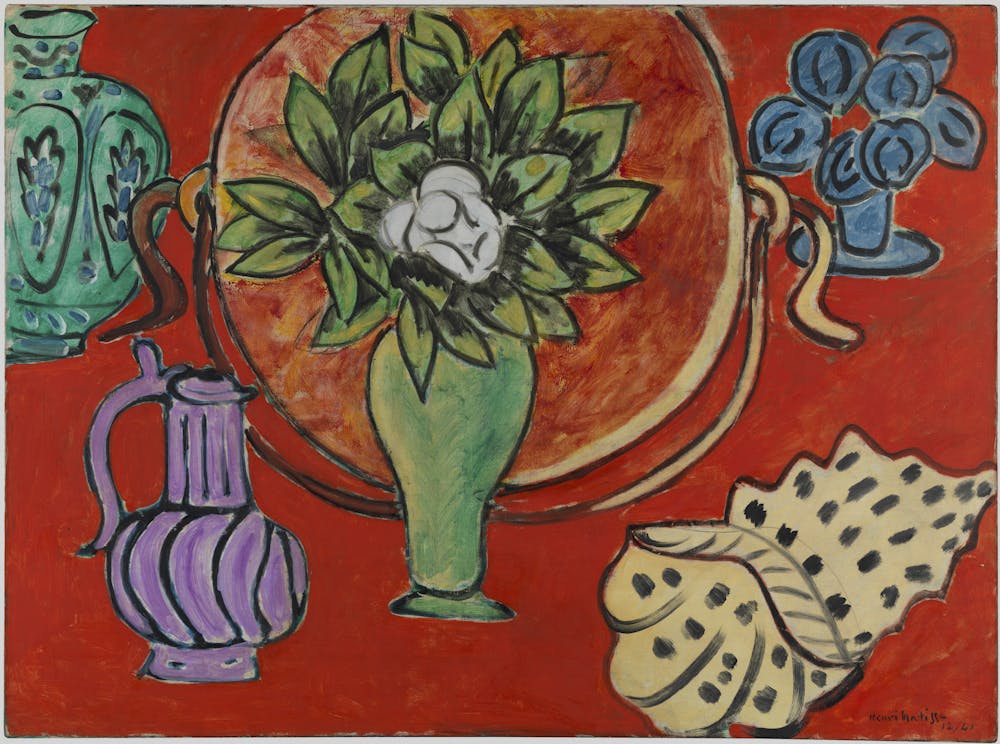 Henri Matisse, Still life with magnolia (Nature morte au magnolia) 1941. Oil on canvas, 74 x 101 cm. Centre Pompidou, Paris, MNAM-CCI, purchased 1945 AM 2588 P.
© Succession H Matisse/Copyright Agency 2021. Photo: © Centre Pompidou, MNAM-CCI / Philippe Migeat / Dist RMN-GP
Henri Matisse, Still life with magnolia (Nature morte au magnolia) 1941. Oil on canvas, 74 x 101 cm. Centre Pompidou, Paris, MNAM-CCI, purchased 1945 AM 2588 P.
© Succession H Matisse/Copyright Agency 2021. Photo: © Centre Pompidou, MNAM-CCI / Philippe Migeat / Dist RMN-GP
The influences of Matisse
Matisse surrounded himself with objects and people that become recurring images within his work. This has enabled the curators to place the blocky bronze Reclining Nude (1907) adjacent to Still Life with Ivy (1916), a painting that includes the Reclining Nude sculpture.
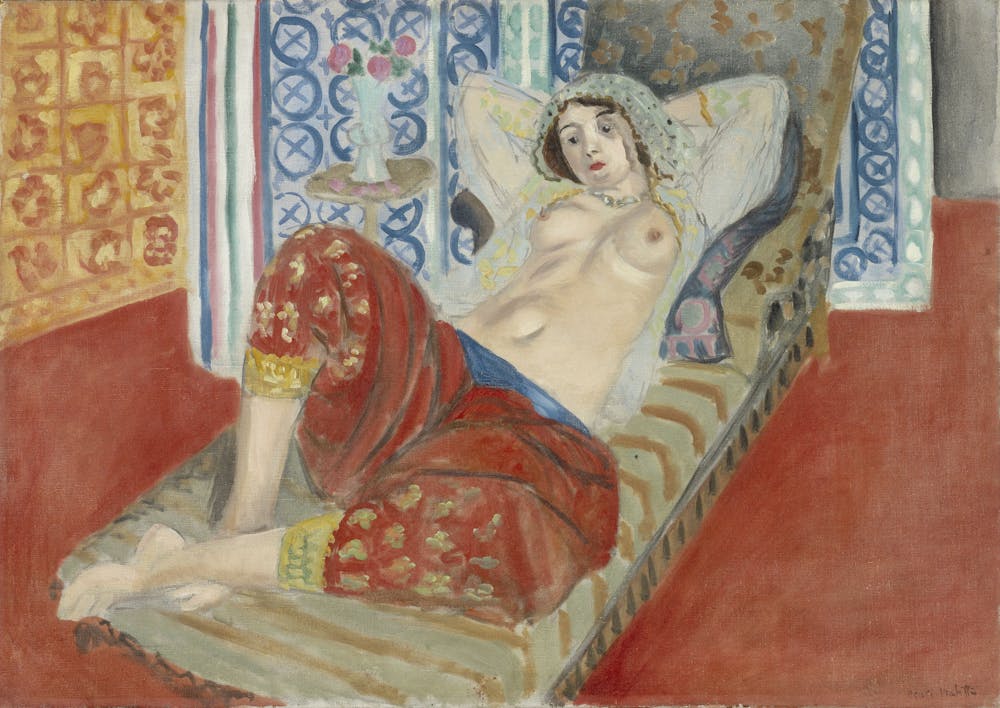 Henri Matisse, Odalisque with red culottes (Odalisque à la culotte rouge) 1921. Oil on canvas, 65.3 x 92.3 x 2.5 cm. Centre Pompidou, Paris, MNAM-CCI, purchased by the state, 1922 LUX.0.85 P.
© Succession H Matisse/Copyright Agency 2021. Photo: © Centre Pompidou, MNAM-CCI / Philippe Migeat / Dist RMN-GP
Henri Matisse, Odalisque with red culottes (Odalisque à la culotte rouge) 1921. Oil on canvas, 65.3 x 92.3 x 2.5 cm. Centre Pompidou, Paris, MNAM-CCI, purchased by the state, 1922 LUX.0.85 P.
© Succession H Matisse/Copyright Agency 2021. Photo: © Centre Pompidou, MNAM-CCI / Philippe Migeat / Dist RMN-GP
Other works appear to quote, with variations, some of his colleagues. As with other artists of his generation, he was influenced by Cézanne, famous for his blocky, structured still lifes. Matisse painted Still life with green buffet, where the structure is flattened while the perfectly placed fruit seems to levitate into the ether.
Matisse’s career is a reminder not all artists start young. He was studying law when he suffered from appendicitis. While he was recovering, his mother gave him a paint box and he was seduced by colour.
With Matisse it was always about colour.
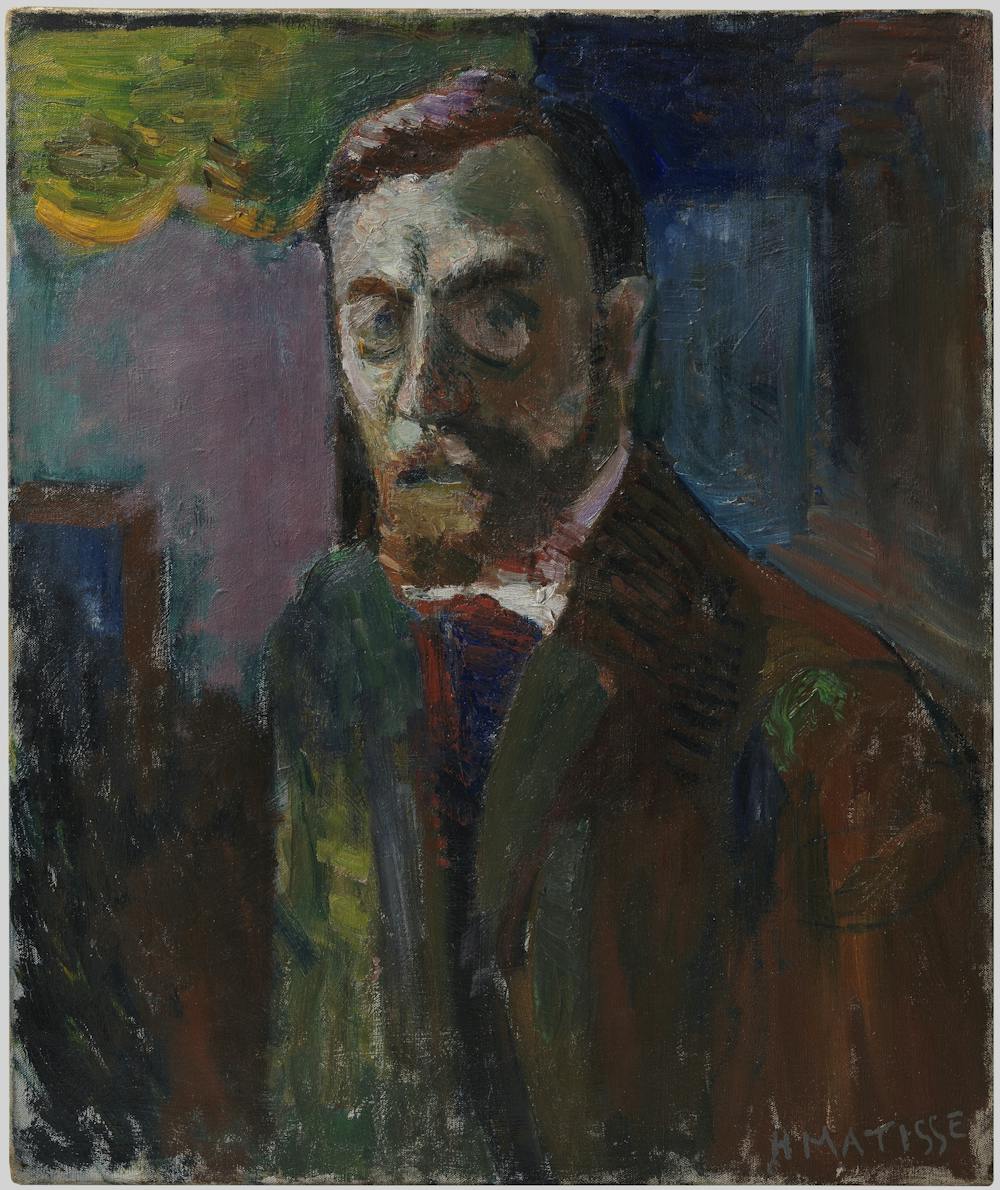 Henri Matisse, Self-portrait (Autoportrait) 1900. Oil on canvas, 55 x 46 cm. Centre Pompidou, Paris, MNAM-CCI, donation Pierre Matisse, 1991 AM 1991-271.
© Succession H Matisse/Copyright Agency 2021. Photo: © Centre Pompidou, MNAM-CCI / Philippe Migeat/Dist RMN-GP
Henri Matisse, Self-portrait (Autoportrait) 1900. Oil on canvas, 55 x 46 cm. Centre Pompidou, Paris, MNAM-CCI, donation Pierre Matisse, 1991 AM 1991-271.
© Succession H Matisse/Copyright Agency 2021. Photo: © Centre Pompidou, MNAM-CCI / Philippe Migeat/Dist RMN-GP
One of the earlier works in the exhibition is a portrait of the Italian model Bevilaqua. The sheer intensity of the pure cobalt blue of the shadows around his face show the power of colour that would first bring Matisse to critical attention with the Fauve exhibition in 1905. Then there is the brilliance of The Red Carpets, with contrasting patterns of a flamboyant, intense red.
It may be the impact of the dogmatic Cubists, or perhaps the trauma of World War I muted his tone for some time – Minimalists could learn from the rich black in French Window at Collioure. But colour and sensuous line soon reasserted themselves as his dominant mode.
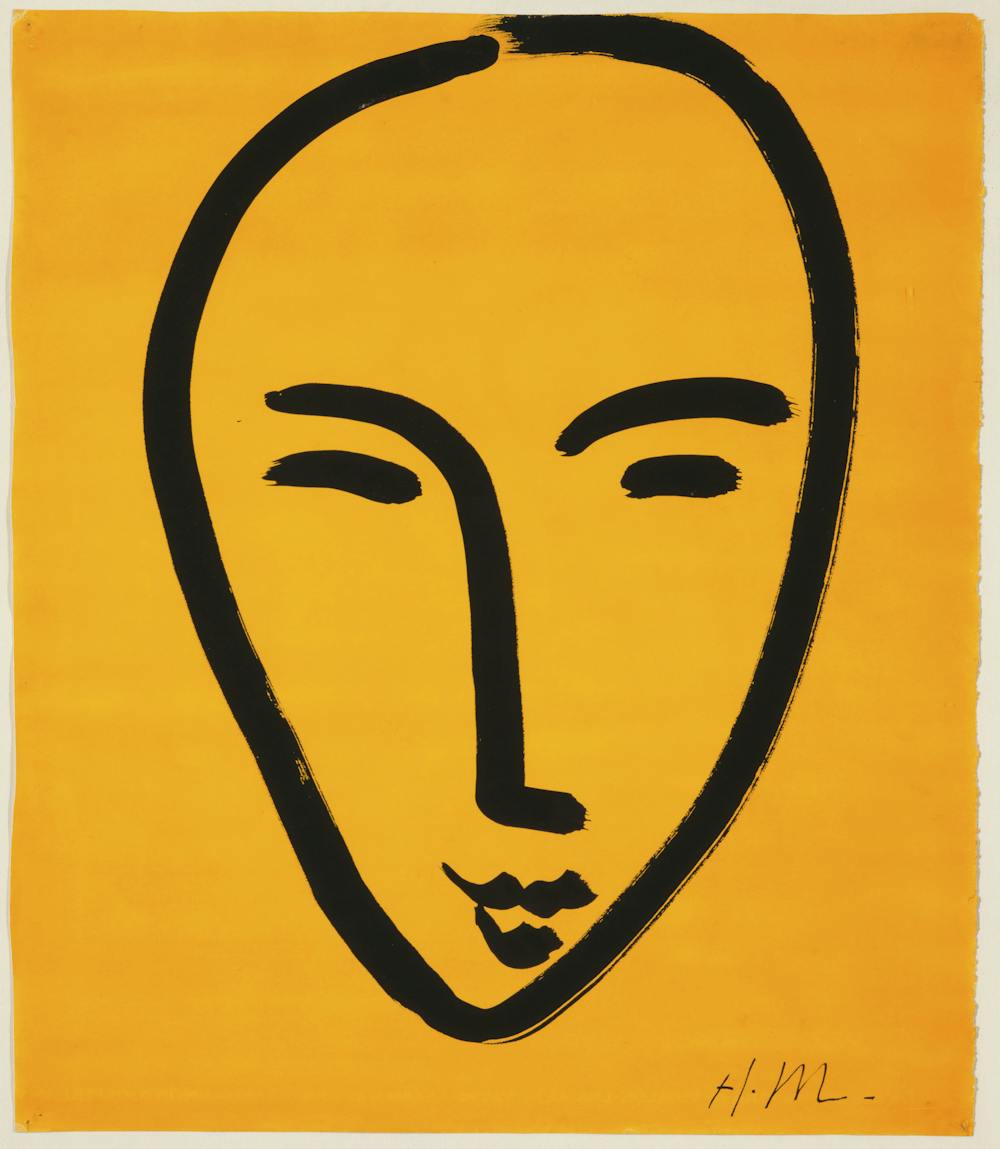 Henri Matisse, Face on yellow ground (Visage sur fond jaune) 1952. Gouache and ink on paper, 75.3 x 64.6 cm. Centre Pompidou, Paris, MNAM-CCI, donation Pierre Matisse, 1991, at Musée de Grenoble since 1993 AM 1991-281.
© Succession H Matisse/Copyright Agency 2021. Photo: © Centre Pompidou, MNAM-CCI / Philippe Migeat / Dist RMN-GP
Henri Matisse, Face on yellow ground (Visage sur fond jaune) 1952. Gouache and ink on paper, 75.3 x 64.6 cm. Centre Pompidou, Paris, MNAM-CCI, donation Pierre Matisse, 1991, at Musée de Grenoble since 1993 AM 1991-281.
© Succession H Matisse/Copyright Agency 2021. Photo: © Centre Pompidou, MNAM-CCI / Philippe Migeat / Dist RMN-GP
The beauty of this exhibition is the way it unfolds the development of the artist’s life, underpinned by his exquisite drawings, which act as background music. As well as the art, it is enlivened by rare archival film footage – including one delightful sequence where he shows he has no power over his dog.
Matisse: Life & Spirit Masterpieces from the Centre Pompidou, Paris is at the Art Gallery of NSW until March 13 2022
Authors: Joanna Mendelssohn, Principal Fellow (Hon), Victorian College of the Arts, University of Melbourne. Editor in Chief, Design and Art of Australia Online, The University of Melbourne

















