Total solar eclipse will bring 2 minutes of darkness to Antarctica's months of endless daylight
- Written by Tanya Hill, Honorary Fellow of the University of Melbourne and Senior Curator (Astronomy), Museums Victoria
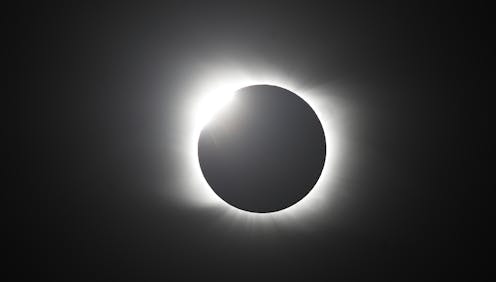
The Sun hasn’t set in Antarctica since October. Earth’s southernmost continent is currently experiencing a long summer’s day, one that stretches from mid-October until early April.
But on Saturday December 4, darkness will sweep across the ice of West Antarctica. The Moon will pass directly in front of the Sun, blocking its light and producing a total solar eclipse.
The path of totality crosses the Argentine, British and Chilean Antarctic Territories (which consist of overlapping regions), as well as the unclaimed territory known as Marie Byrd Land. Areas along the path will experience almost 2 minutes of darkness in the otherwise months-long stretch of daylight.
Meanwhile, the southern tips of South America, Africa, Australia and New Zealand will see a fairly minor partial eclipse. For South America and Africa, the eclipse will be in the early morning; for Australia and New Zealand it will happen as the Sun is setting.
The Moon’s goodnight kiss
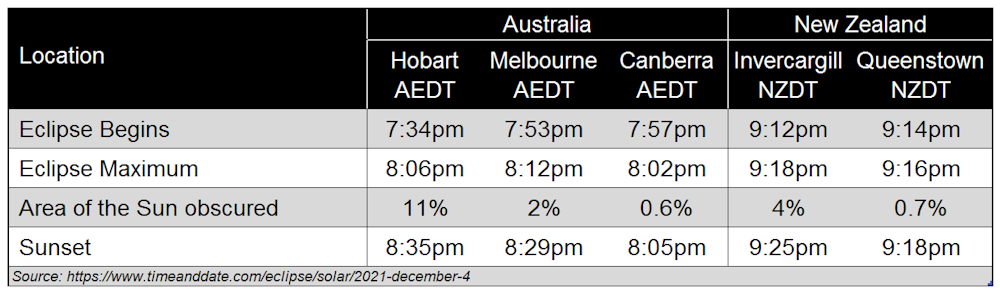
As the Sun sinks towards the horizon the Moon will appear to kiss the top-left of the Sun. Of all Australia’s capital cities, Hobart will see the largest eclipse, but even so only 11% of the Sun’s area will be covered. For Melbourne, this drops to just 2%, while in Canberra it’s hardly visible – the Sun is crossing the horizon as a tiny eclipse occurs.
It’s a similar situation in New Zealand. Invercargill will see 4% of the Sun obscured by the Moon, with the Moon passing by the Sun’s left side. But move further north to Queenstown and the eclipse is barely visible for the setting Sun.
 A great way to safely share a view of a solar eclipse.
Sid/flickr
The rarity of totality
Solar eclipses are relatively rare experiences, because the Moon’s orbit is tilted by 5 degrees relative to Earth’s orbit around the Sun, so they don’t quite move in the same plane. However, roughly every six months the orbits align to produce a pair of eclipses – a lunar eclipse at Full Moon, followed by a solar eclipse at New Moon (as we are experiencing now), or vice versa.
Read more:
Tonight's 'eclipse moonrise' will put on a special twilight show for most of Australia
Lunar eclipses are seen by more people because everyone on the night side of the Earth during a lunar eclipse will see the event. Solar eclipses happen just as often, but they are seen by far fewer people because the shadow created by the Moon passing in front of the Sun covers a much smaller fraction of the Earth.
Furthermore, partial solar eclipses are difficult to observe and they pale in comparison to the experience of a total solar eclipse. While total solar eclipses happen roughly every 18 months being able to see totality is rarer still.
The Moon’s shadow as it crosses the Earth is only 100-260km wide, and you have to be located within that narrow path to see the totally eclipsed Sun. This is why eclipse-chasers travel the world to be in the right place at the right time. But when totality occurs in a remote location like Antarctica it’ll be mainly the penguins who get to see it.
The next total solar eclipse visible from Australia will happen in April 2023. The band of totality will just clip Australia near Exmouth at the tip of the North West Cape in Western Australia.
But many more Aussies and New Zealanders will get to see a total solar eclipse on July 22 2028. Totality will stretch across Australia, from the top of WA down through New South Wales, passing directly over Sydney. It will also cross the South Island of New Zealand, passing through Queenstown and Dunedin.
Authors: Tanya Hill, Honorary Fellow of the University of Melbourne and Senior Curator (Astronomy), Museums Victoria
A great way to safely share a view of a solar eclipse.
Sid/flickr
The rarity of totality
Solar eclipses are relatively rare experiences, because the Moon’s orbit is tilted by 5 degrees relative to Earth’s orbit around the Sun, so they don’t quite move in the same plane. However, roughly every six months the orbits align to produce a pair of eclipses – a lunar eclipse at Full Moon, followed by a solar eclipse at New Moon (as we are experiencing now), or vice versa.
Read more:
Tonight's 'eclipse moonrise' will put on a special twilight show for most of Australia
Lunar eclipses are seen by more people because everyone on the night side of the Earth during a lunar eclipse will see the event. Solar eclipses happen just as often, but they are seen by far fewer people because the shadow created by the Moon passing in front of the Sun covers a much smaller fraction of the Earth.
Furthermore, partial solar eclipses are difficult to observe and they pale in comparison to the experience of a total solar eclipse. While total solar eclipses happen roughly every 18 months being able to see totality is rarer still.
The Moon’s shadow as it crosses the Earth is only 100-260km wide, and you have to be located within that narrow path to see the totally eclipsed Sun. This is why eclipse-chasers travel the world to be in the right place at the right time. But when totality occurs in a remote location like Antarctica it’ll be mainly the penguins who get to see it.
The next total solar eclipse visible from Australia will happen in April 2023. The band of totality will just clip Australia near Exmouth at the tip of the North West Cape in Western Australia.
But many more Aussies and New Zealanders will get to see a total solar eclipse on July 22 2028. Totality will stretch across Australia, from the top of WA down through New South Wales, passing directly over Sydney. It will also cross the South Island of New Zealand, passing through Queenstown and Dunedin.
Authors: Tanya Hill, Honorary Fellow of the University of Melbourne and Senior Curator (Astronomy), Museums Victoria