Labor’s 2030 climate target betters the Morrison government, but Australia must go much further, much faster
- Written by Wesley Morgan, Research Fellow, Griffith Asia Institute and Climate Council researcher, Griffith University
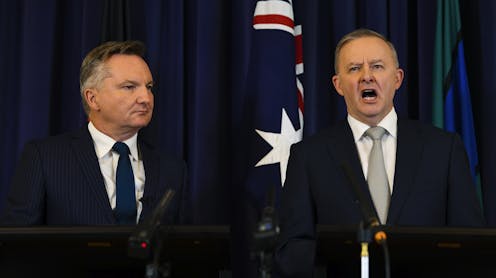
The Labor opposition has pledged to reduce Australia’s greenhouse gas emissions by 43% this decade based on 2005 levels, claiming the plan will create jobs, cut power bills, boost renewables and provide business certainty.
Labor says the policy would create 604,000 jobs – mostly in regional areas – unlock A$52 billion in private sector investment in Australian industry, and cause electricity prices to fall by $275 per household by 2025.
Announcing the policy on Friday, Labor leader Anthony Albanese said the plan was backed by comprehensive modelling. He said Labor has produced a policy Australia can be proud of, while the Morrison government was “frozen in time while the world warms around it”.
Labor’s emissions-reduction goal is a significant step up on what the Morrison government has offered – 26-28% over the same time frame. And it’s a firm step to build on in coming years.
But it falls short of what experts say is needed for Australia to do its share on emissions reduction under the Paris Agreement, and is less ambitious than the targets adopted by Australia’s international peers.
What the science says is needed
While Labor’s 2030 target is higher than the Coalition’s, and provides a solid foundation on which to build, it still falls well below what the science says is necessary.
Earlier this year an independent Climate Targets Panel - made up of high-profile Australian climate scientists and experts - examined the action required by Australia if it’s to act consistently with the Paris Agreement goals.
To do its share in limiting global warming to below 1.5℃ this century, Australia must cut emissions by 75% below 2005 levels this decade. Limiting warming to well below 2℃ this century would require a 50% emissions reduction in the same time frame.
The last official government review of Australia’s climate targets was conducted by the Climate Change Authority, and updated in 2015. It found that to act in line with the 2℃ goal, Australia should aim for 45–65% emissions reduction by 2030, based on 2005 levels.
Notably, the Coalition government ignored this recommendation when it set Australia’s 2030 target of 26-28%. This recommendation is also more ambitious than the target announced by Labor today.
The global picture
The Glasgow Climate Pact, agreed to at COP26 last month, called on nations to bring a stronger 2030 target to the next United Nations climate conference in November 2022. It said limiting global warming to 1.5℃ would require global emissions reduction of at least 45% below 2010 levels by 2030.
To play their part, wealthy nations need to cut emissions by much more than 45% this decade. This particularly applies to Australia – a skilled, wealthy, developed nation blessed with sunshine and wind.
While the Glasgow pact uses a baseline year of 2010 rather than Australia’s 2005, our national emissions were similar in both years. So Labor’s new 43% commitment approaches, but still falls short of, the Glasgow pact.
Pacific island countries have called on Australia to cut emissions by at least 50% by 2030. So again, Labor’s target comes close but does not actually fulfil what island states want to see from Australia to help ensure their survival.
Read more: The seas are coming for us in Kiribati. Will Australia rehome us?
Labor’s 43% target also brings us closer to, but not into line with, our major allies. Over the same time frame, the United States is aiming for a 50-52% reduction, Japan 46% and New Zealand 50%. The United Kingdom plans to reduce emissions by 68% below 1990 levels, and the European Union 55%.
And special treatment afforded Australia under the Kyoto protocol – the precursor to the Paris Agreement – means the country is uniquely advantaged. We are allowed to count emissions from land use change in the base year from which emissions reduction is measured – something most countries don’t do.
Because of this, an Australian commitment to 43% below 2005 levels - a year when land use emissions were high - involves far less real-world emissions reduction than that of our international peers.
Building on the work of others
Thanks to the head-start gifted by the states and territories, Australia could achieve emissions reduction far beyond the target set by Labor with just a modest amount of federal effort.
The Morrison government may claim Australia’s woeful 2030 target is “fixed”, but state and territory commitments made it redundant long ago.
The two most populous states – New South Wales and Victoria – both plan to halve their emissions over the same period. South Australia and the ACT intend to outperform even that, and Tasmania is already at net-zero emissions.
Even in Western Australian – where energy sector emissions have grown by two-thirds since 2005 as a result of unrestrained gas expansion – the state government announced yesterday it will establish a process to set emissions reductions targets in line with its net-zero goal.
Read more: COP26 left the world with a climate to-do list: Here are 5 things to watch for in 2022
Assuming state targets are only met and not exceeded, Australia’s emissions would fall by 34% from 2005 levels by 2030 with no effort from the federal government whatsoever.
In 2019, the Business Council of Australia loudly opposed Labor’s 2030 target of 45% below 2005 levels in 2030. In the context of increased state and territory ambition, it has now adopted this target as its own. Far from being “economy-wrecking” or other such hyperbole, such a target is in fact a humble but important additional effort that builds on existing state and territory action.
As has been shown time and again – most recently just yesterday in research the Climate Council commissioned from Deloitte Access Economics – good climate policy is good economic policy, and will drive job creation in regional areas.
Setting a stronger 2030 target is important for driving investment in the clean energy economy of the future. Australia is well-placed to take advantage of a world shifting toward net-zero emissions, and it makes no sense to delay the inevitable transition. This is especially so when Australia is so acutely vulnerable to climate impacts.
Go further, faster
Announcing the policy on Friday, Albanese said the planned emissions reduction was consistent with that of Canada, which has a comparable economy.
If Labor wins government at next year’s election, Australia could “go to international climate conferences and not be in the naughty corner”, Albanese said. “I wanted to make sure we have a policy that doesn’t leave people behind, that supports industry, supports jobs and gets the balance right.”
There’s no question that Labor’s target is inadequate. But it provides a solid framework for further action in the next decade.
Any federal government that implements meaningful policy to reduce emissions will quickly realise it’s in Australia’s interests to go further, faster. Doing so will leave households better off, grow jobs in regional Australia, and ensure we play a role in the global effort to avert climate catastrophe.
Authors: Wesley Morgan, Research Fellow, Griffith Asia Institute and Climate Council researcher, Griffith University