Modern Australian
Men's Weekly

.

we asked fast-fashion shoppers how ethical concerns shape their choices

  • Written by Tara Stringer, PhD Candidate, Queensland University of Technology
we asked fast-fashion shoppers how ethical concerns shape their choices

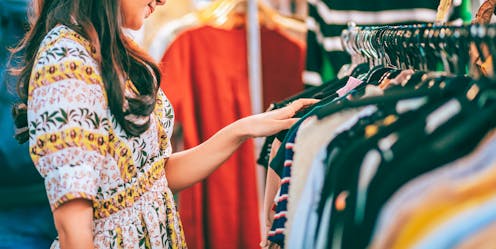
You’ve found the perfect dress. You’ve tried it on before and you know it looks great. Now it’s on sale, a discount so large the store is practically giving it away. Should you buy it?

For some of us it’s a no-brainer. For others it’s an ethical dilemma whenever we shop for clothes. What matters more? How the item was made or how much it costs? Is the most important information on the label or the price tag?

Of the world’s industries that profit from worker exploitation, the fashion industry is notorious, in part because of the sharp contrast between how fashion is made and how it is marketed.

There are more people working in exploitative conditions than ever before. Globally, the garment industry employs millions of people, with 65 million garment sector workers in Asia alone. The Clean Clothes Campaign estimates less than 1% of what you pay for a typical garment goes to the workers who made it.

Clean Clothes Campaign/The Conversation, CC BY-ND Some work in conditions so exploitative they meet the definition of being modern slaves – trapped in situations they can’t leave due to coercion and threats. But their plight is hidden by the distance between the worker and the buyer. Global supply chains have helped such exploitation to hide and thrive. Do we really care, and what can we do? We conducted in-depth interviews with 21 women who buy “fast fashion” – “on-trend” clothing made and sold at very low cost – to find out how much they think about the conditions of the workers who make their clothes, and and what effort they take to avoid slave-free clothing. Well-known fast-fashion brands include H&M, Zara and Uniqlo. Read more: Four Corners’ forced labour exposé shows why you might be wearing slave-made clothes What they told us highlights the inadequacy of seeking to eradicate exploitation in the fashion industry by relying on consumers to do the heavy lifting. Struggling to seek reliable information on ethical practices, consumers are overwhelmed when trying to navigate ethical consumerism. Out of sight, out of mind The 21 participants in our research were women aged 18 to 55, from diverse backgrounds across Australia. We selected participants who were aware of exploitation in the fashion industry but had still bought fast fashion in the previous six months. This was not a survey but qualitative research involving in-depth interviews to understand the disconnect between awareness and action. Our key finding is that clothing consumers’ physical and cultural distance from those who make the clothes makes it difficult to relate to their experience. Even if we’ve seen images of sweatshops, it’s still hard to comprehend what the working conditions are truly like. Garment workers sew clothes at a factory in Huaibei, Anhui province, China.
Garment workers sew clothes at a factory in Huaibei, Anhui province, China. Xie Zhengyi/AP

As Fiona*, a woman in her late 30s, put it: “I don’t think people care [but] it’s not in a nasty way. It’s like an out of sight, out of mind situation.”

This problem of geographic and cultural distance between garment workers and fashion shoppers highlights the paucity of solutions premised on driving change in the industry through consumer activism.

Who is responsible?

Australia’s Modern Slavery Act, for example, tackles the problem only by requiring large companies to report to a public register on their efforts to identify risks of modern slavery in their supply chains and what they are doing to eliminate these risks.

While greater transparency is certainly a big step forward for the industry, the legislation still presumes that the threat of reputational damage is enough to get industry players to change their ways.

The success of the legislation falls largely on the ability of activist organisations to sift through and publicise the performance of companies in an effort to encourage consumers to hold companies accountable.

Read more: Modern Slavery Bill a step in the right direction – now businesses must comply

All our interviewees told us they felt unfairly burdened with the responsibility to seek information on working conditions and ethical practices to hold retailers to account or to feel empowered to make the “correct” ethical choice.

“It’s too hard sometimes to actually track down the line of whether something’s made ethically,” said Zoe*, a woman in her early 20s.

Given that many retailers are themselves ignorant about their own supply chains, it is asking a lot to expect the average consumer to unravel the truth and make ethical shopping choices.

Confusion + overwhelm = inaction

“We have to shop according to what we care about, what is in line with our values, family values, budget,” said Sarah*, who is in her early 40s.

She said she copes with feeling overwhelmed by ignoring some issues and focus on the ethical actions she knew would make a difference. “I’m doing so many other good things,” she said. “We can’t be perfect, and I can only do so much.”

Other participants also talked about juggling considerations about environmental and social impacts.

“It’s made in Bangladesh, but it’s 100% cotton, so, I don’t know, is it ethical?” is how Lauren*, a woman in her early 20s, put it. “It depends on what qualifies as ethical […] and what is just marketing.”

Comparatively, participants felt their actions to mitigate environmental harm made a tangible difference. They could see the impact and felt rewarded and empowered to continue making positive change. This was not the case for modern slavery and worker rights more generally.

Fast fashion is a lucrative market, with billions in profits made thanks to the work of the lowest paid workers in the world.

Read more: Fashion production is modern slavery: 5 things you can do to help now

There is no denying consumers wield a lot of power, and we shouldn’t absolve consumers of their part in creating demand for the cheapest clothes humanly – or inhumanly – possible.

But consumer choice alone is insufficient. We need a system where all our clothing choices are ethical, where we don’t need to make a choice between what is right and what is cheap.

The names of study participants have been changed to protect their anonymity.

Authors: Tara Stringer, PhD Candidate, Queensland University of Technology

Read more https://theconversation.com/i-can-only-do-so-much-we-asked-fast-fashion-shoppers-how-ethical-concerns-shape-their-choices-172978

5 Things to Consider Before Choosing a Commercial Painter

Choosing the right painter for a commercial business can be challenging. Regardless of the type and the size of the property, all commercial project...

Why Medical Fitout Melbourne Practices Rely on for Modern Healthcare Spaces

A well-planned medical fitout Melbourne is essential for creating healthcare environments that support patient care, clinical efficiency, and regula...

Luxury Builders Melbourne Crafting Homes Defined by Design and Detail

Building a premium home is about far more than size or appearance. It is about precision, craftsmanship, and a deep understanding of how refined spa...

Electric Sliding Door Solutions for Modern Living and Commercial Spaces

The way people move through spaces has changed dramatically over the years, and the electric sliding door has become a defining feature of that evol...

Australia’s New Fast Track to Advanced Care in Vietnam

For many Australians, the decision to seek medical care abroad often begins with a specific feeling: the quiet frustration of waiting. According to ...

Cardboard Boxes: A Practical Packaging Solution for Modern Businesses

Reliable cardboard boxes play a vital role in how goods are stored, protected, and transported across industries. From small retailers to large-sca...

The Rise of Smart Homes in Australia: What’s Worth Investing In?

Australia is in the midst of a home technology revolution. From energy efficiency to integrated security, today’s homeowners are transforming thei...

Winter Hairstyling Tips to Prevent Dryness

Winter can be particularly harsh on your hair. Cold air outside, dry indoor heating, and frequent temperature changes can strip moisture from the ha...

Short Term Loans in Australia: Practical Insights for Borrowers and Finance Professionals

Short term loans play a crucial role in Australia’s personal finance landscape. They are designed to cover short-term expenses, unexpected bills, ...

Best EPD Consultants in Australia

Environmental Product Declarations (EPDs) play an increasingly important role in the Australian construction, manufacturing, and infrastructure sect...

I/O Controller And Its Role In Modern Industrial Automation

Industrial automation relies on a range of advanced technologies to ensure precision, speed, and reliability in day-to-day operations. Among these t...

Hydraulic Systems And Their Importance In Modern Industry

A hydraulic system plays a vital role in powering machinery, controlling movement, and delivering high-force performance across countless industrial...

Why Australian Businesses Are Having a Second Think About Digital Growth

Running a business these days is a whole lot different to how it was even a few short years ago. Customers are better informed, there's more competi...

Restaurants Risk Compliance Issues Amid Commercial Plumber Shortage

As demand for housing, roads and facilities increases, so does the demand for trade workers. According to Infrastructure Australia, the construction i...

The Importance Of A Professional Medical Fitout Melbourne For Modern Healthcare Facilities

Healthcare environments must operate with precision, efficiency, and a strong focus on patient comfort. A well-planned medical fitout Melbourne hel...

Top Safety and Comfort Features to Consider in Family Off Road Caravans

Exploring Australia’s coastline, bush tracks or outback locations is far more enjoyable when travelling in a caravan designed for both comfort and...

“Logistical Nightmare” – Rural and Remote Communities Supply Chain Nightmares

Australia’s road logistics need major reform to counteract the supply chain issues that are hitting rural and regional communities hard. With 80% of...

The Importance Of Quality Bait Boards For Boats To Enhance Fishing Efficiency And Comfort

Fishing enthusiasts understand that having the right equipment on board makes every trip smoother and more enjoyable. One essential accessory for an...