why now is the best time to shed them
- Written by Hoi Lun Cheng, Marie Bashir Clinical Research Fellow in Adolescent Health, University of Sydney
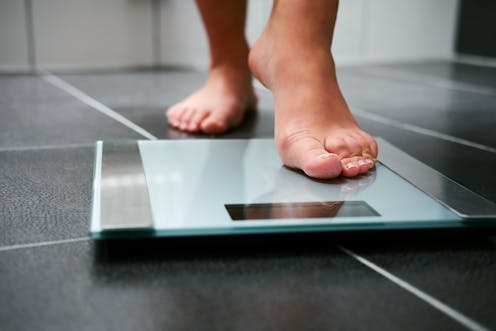
If your clothes are feeling snug after lockdown, you’re not alone. A survey of more than 22,000 people across 30 countries found almost one-third of respondents gained weight during the COVID pandemic.
Major contributors include stress, takeaway and working from home. Sound familiar?
As you gain more freedom of movement post-lockdown, some of this extra weight may come off naturally. However, your body might need a nudge to return to its pre-lockdown weight, and it’s probably better to act now than wait until New Year’s resolutions time.
Read more: You don't have to be the biggest loser to achieve weight loss success
Harness your inner ‘fat brake’
Humans tend to maintain a steady weight over time, give or take a few kilos.
One scientific theory on how the body does this is the “set point” theory. It posits that whenever we deviate from our weight set point, our body activates defence mechanisms that tend to shift us back to base.
When your weight goes up, your body may react by:
reducing hunger and the amount of food needed to feel satisfied, possibly brought on by changing appetite hormones
increasing your propensity to be physically active, which can involve conscious activity like walking, or even subconscious activity like fidgeting
raising your metabolic rate, a change that some people exhibit more than others (you may notice feeling hot-under-the-collar if this happens to you).
This array of physiological responses, which we call the “fat brake” because it slows fat gain, has been documented in experiments where adults were overfed for periods spanning several hours to several weeks. This time frame is similar to the time frame of feasting over a holiday season.
Practically speaking, this means in the aftermath of a brief period of overeating, you may find yourself having less interest in food and wanting to move more than usual.
In other words, a window of opportunity exists where your body is likely to work alongside you in shedding weight.
Read more: Why now is the best time to go on a diet, or the science of post-holiday weight loss
What happens if we overeat for months?
The latest Sydney lockdown lasted almost four months (107 days). Melbourne’s lockdown was more fragmented, but no shorter in duration.
It’s not entirely clear how our bodies react to this length of potential overeating. This is because most human overfeeding experiments don’t last beyond two months.
One of the longest is a classic study where “lean young men” were fed an excess of 4,200 kilojoules (1,000 calories) per day for 100 days. At the end, their metabolic rate was found to be higher than before the overfeeding began.
Importantly, in the four months post-experiment, they lost 82% of the weight and 74% of the fat they had gained.
These results are encouraging because they suggest the “fat brake” can remain active even after several months of overeating.
All things, however, tend to come to an end. In animal studies, the effects of the fat brake have been shown to subside with time.
We can’t predict if or when this might happen in humans, but we do know genes play a major role in determining how our bodies respond to overeating.
We also know that loss of excess weight tends to be more permanent in children and young people, which could be related to a more flexible weight set point.
So, the aforementioned study in “lean young men” likely presents the best-case scenario in terms of recovering from prolonged overeating.
For those of us who don’t have genes or age on our side, being proactive about post-lockdown weight loss and seizing the window of opportunity our fat brakes offer could provide a path of least resistance, at least from a physiological view point.
How to go about losing COVID kilos
It’s important to listen to your body’s signals. Eat only when you’re hungry and stop as soon as you’re satisfied.
When you are hungry, aim for smaller portions and lighter foods. One way to do this at mealtimes is to prioritise and “fill up” on vegetables before eating any other food on your plate. You may be surprised by how little it takes to feel satisfied, especially if your fat brake is activated.
Read more: Health Check: how to work out how much food you should eat
If you have an iPhone, a free app (Wink by Amanda Salis) can help you learn to eat according to your body signals.
The Australian Dietary Guidelines provide evidence-based information on what foods to eat and how much to eat. For more personalised information, this free quiz offers a quick assessment of your diet and tailored ideas on things you could improve on.
To avoid eating when you’re not hungry, it’s helpful to do things that are active and exciting. Think team sports, dancing, or other activities you couldn’t do during lockdown.
It’s also a good idea to remove snacks and temptations around the house to minimise “mindless” grazing.
If you’re carrying more weight than a few excess COVID kilos, consider professional help. Young people who have support from a dietitian tend to lose more weight than older adults who seek the same help.
For adults with related medical issues that would improve with weight loss, there are more intensive treatments that are effective for a majority of people, such as severely energy restricted liquid meal replacement diets but this must be done under medical supervision.
Read more: Concerned about overeating? Here's what you need to know about food addiction
Authors: Hoi Lun Cheng, Marie Bashir Clinical Research Fellow in Adolescent Health, University of Sydney
Read more https://theconversation.com/covid-kilos-why-now-is-the-best-time-to-shed-them-171933