Instead of putting more massive trucks on our roads, we need to invest in our rail network
- Written by Philip Laird, Honorary Principal Fellow, University of Wollongong
In recent years, the Victoria and New South Wales governments have both unveiled strategies to move more freight across the country by rail and ease the increasing pressure of goods moving through the two largest container ports.
The reality is, however, the numbers of containers coming and going by rail to the Port of Melbourne and Sydney’s Port Botany have been going backwards.
More massive trucks on Victoria’s highways
The Port of Melbourne moves more containers than any other port in Australia. In 2020-21, 3.3 million containers passed through the port, a 30% increase from ten years ago.
Over this time, the percentage of containers moving by rail has fallen, reaching a low of 6.1% in 2020-21. This has meant the number of trucks going to and from the Port of Melbourne has significantly increased.
Read more: Trucks are destroying our roads and not picking up the repair cost
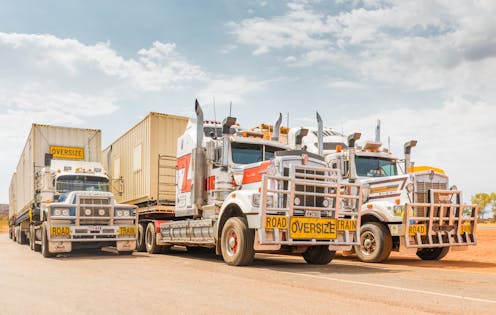
This has been assisted by improvements to the state’s roads and bridges. But the Victoria government also in mid-2021 approved large “A Double” trucks being able to access the Port of Melbourne. These trucks can carry two 12-metre containers and be up to 36 metres long – much longer than the standard semitrailer at 19 metres.
Large numbers of trucks accessing the ports not only add to road construction and maintenance bills, they also make our roads less safe and more congested, and add to noise and air pollution.
The recently released report into the health effects of air pollution in Victoria notes the city of Maribyrnong has some of Australia’s highest levels of diesel pollution. This is mostly due to the number of trucks accessing the Port of Melbourne each day.
The report also notes the transport sector is accountable for 20% of Victoria’s total greenhouse gas emissions.
In 2018, Victoria introduced a new freight plan that included initiatives to move more goods from the port by rail. One of these projects was the Port Rail Shuttle Network, a $28 million investment to connect the freight terminal in South Dandenong to the rail network. This is now underway.
Increasing the amount of freight moving by rail will not only make our roads safer and reduce maintenance costs, it makes environmental sense – rail freight produces one-third the emissions of road freight.
However, rail freight in Victoria is crippled by two different track gauges and tracks with too many temporary and permanent speed restrictions. Without greater investment to improve the rail system, it remains a less feasible option than moving freight on massive trucks on our roads.
Read more: Transport is letting Australia down in the race to cut emissions
Sydney’s situation is not much better
A recent NSW auditor-general report said the volume of freight passing through Greater Sydney is expected to increase by 48% by 2036.
In 2020-21, 2.7 million containers moved through Port Botany. The NSW government had planned to increase the number of containers moving by rail from the port to 28% by 2021. However, the auditor-general report said this effort would fall short. Just 16% is currently carried by rail.
This means more trucks on the roads in NSW, as well. The NSW government has also recently given permission for “A Double” trucks to access Port Botany.
The auditor-general report made recommendations on how NSW Transport could improve the operation of the state’s rail network to allow for more rail freight. It noted, for example, 54 trucks could be replaced by one 600-metre-long port shuttle freight train.
Rail moving less intercity freight
The rail network between Australia’s two largest cities is outdated and under-utilised. In fact, the proportion of freight moving between Melbourne and Sydney on rail has fallen to about 1% today. In 1970, it was about 40%.
This is, in part, due to the total reconstruction of the Hume Highway from a basic two-lane road to a modern dual carriageway, completed in 2013. There are now over 20 million tonnes of freight moved each year on the Hume Highway, with over 3,800 trucks on the road each day (and night at Gundagai).
The result is more road trauma, higher maintenance bills and pressure for further road upgrades. Plus more emissions.
The Sydney-Melbourne rail track, meanwhile, has been left with severe speed weight restrictions and a “steam age” alignment characterised by tight curves. It is also over 60 kms longer than it needs to be.
From a national perspective
Getting more freight on rail is not helped by hidden government subsidies to heavy truck operations, which in my estimations exceed $2 billion per year.
It is also made harder by the current National Freight and Supply Chain strategy, which puts much more emphasis on increasing truck productivity with ever larger trucks.
Instead, much more attention is needed to improving the efficiency and competitiveness of rail freight.
Authors: Philip Laird, Honorary Principal Fellow, University of Wollongong