Google AI


Modern Australian

Amid global crisis, how can universities be regenerated to serve the common good?

  • Written by: Kristen Lyons, Professor Environment and Development Sociology, The University of Queensland
Amid global crisis, how can universities be regenerated to serve the common good?

Universities are among the many institutions that sustain settler colonialism in Australia. The public university system was, and continues, to be part of the state’s investment in its own future.

Universities emerged in Australia during the mid-19th and early 20th centuries against a backdrop of frontier violence and dispossession of First Nations’ lands, labour and relationships. While nature was privatised and commodified, universities grew in scale and influence. Knowledge hierarchies that perpetuate racial, class and gender divides were normalised.

Read more: Five shifts to decolonise ecological science – or any field of knowledge

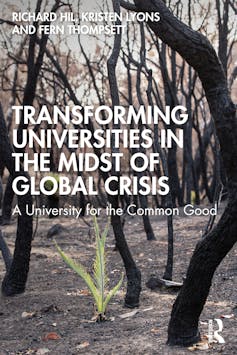
Cover of Transforming Universities in the Midst of Global Crisis, a book by the authors
Routledge Our new book, Transforming Universities in the Midst of Global Crisis: A University for the Common Good, scrutinises the role of universities today. We argue these institutions, and indeed the entire higher education sector, must be considered as not only in crisis – though they clearly are – but also as drivers of crisis. Universities have become fully integrated into the neoliberal economy. They fixate on vocational “job-ready” curriculums and commercial research agendas. They enable industries built on extracting natural resources and thereby support endless economic growth. The problems arising from this system are destructive and life-threatening. Climate chaos, biodiversity destruction, the COVID-19 pandemic, the democracy recession and deepening socio-economic inequalities have reshaped our very ways of relating, being and knowing. Transforming universities therefore demands we seek out ideas, practices and values beyond the university’s walls. Only then will universities be capable of responding to interconnected ecological, health and social challenges. Drawing from case studies and examples around the world, we show how this transformation is possible - and, indeed, already under way. Read more: After coronavirus, universities must collaborate with communities to support social transition Crisis as a catalyst for change In the 21st century, multiple mega-crises have ravaged ecological systems, human lives and livelihoods. A small but powerful lobby of political interests continues to deny, downplay or divert attention from such problems. Yet turning to face these challenges may shed light on solutions. US scholar Lauren Berlant suggested: At some crisis times like this one politics is defined by a collectively held sense that a glitch has appeared in the reproduction of life […] A glitch is also the revelation of an infrastructural failure.“ But glitches can – and must – provide the impetus to bring alternative worlds into being. For universities, the challenge now is to situate human relations and responsibilities in the web of life on Earth. The Ecoversities Alliance, for example, is working for a change of ecological consciousness. This involves a shift away from the pursuit of private interest and towards ecological integrity and the common good. The goal is to orient universities towards "service of our diverse ecologies, cultures, economies, spiritualities and life within our planetary home”. Another challenge is to decolonise universities. The Dechinta Bush University in the Northwest Territories in Canada provides an exemplar. The university has embraced Indigenous land-based practices and values. In this context, Indigenous pedagogies and practices refuse the colonial enclosures of traditional “education-based” institutions. In countless other ways, in Australia and elsewhere, Indigenous scholars, educators and activists are leading decolonising, anti-racist and ecological governance agendas. Read more: How a university can embed Indigenous knowledge into the curriculum and why it matters What will it take to transform universities? Universities, of course, cannot be transformed in isolation from the wider world. Change must engage with the values, practices and leadership of progressive movements. Examples include Black Lives Matter, #MeToo and movements for Indigenous sovereignty and treaty. Our book documents the possibilities for radically transforming the political and economic structures that universities are built on and continue to uphold. The change agenda needs to be bold, not piecemeal. We showcase activities and interventions that move beyond superficial reformism to more radical possibilities for change. Among many other things, we call for: more democratic university governance a return to the idea of the public university (as set out in state and territory legislation) decoupling from market-oriented extractivist ideas of growth resistance to “job-ready” graduate tropes genuine and inclusive communities of learning centring Indigenous rights and knowledges in curriculums and research agendas fostering cultures of appreciation, generosity and collaboration as opposed to competition, individualism and hierarchy. Read more: Honouring Te Tiriti means ‘getting into the stream together’ — so this vice-chancellor has become a student again Working for a just and resilient future These transformations are urgent if universities are to be relevant to meeting the challenges of the 21st century. A university for the common good could enable human society to connect with more-than-human communities and operate within the limits of nature. By ensuring accountability to all communities, human and more-than-human, such a university could build more sustainable and just worlds. Vanessa de Oliveira Andreotti and colleagues from the Gesturing Towards Decolonial Futures collective assert that only through the decay of the modern university will regeneration be possible. If so, the challenge for those committed to the future of the university is to ensure that, through its dwindling, a new regenerative approach – within and beyond its walls – flourishes. Authors: Kristen Lyons, Professor Environment and Development Sociology, The University of Queensland

Read more https://theconversation.com/amid-global-crisis-how-can-universities-be-regenerated-to-serve-the-common-good-172495

Breach of Contract in Business: What Are Your Options?

Contracts are essential to business relationships. They establish expectations, allocate responsibilities and provide a framework for delivering goods...

How Pest Control Companies Can Rank for the Problems Customers Search First

Introduction SEO for Pest Control needs to start with the customer’s problem. Most people do not search for pest services in a neat or technical wa...

What Are the Benefits of Renovating an Older Home in Sydney?

Sydney has plenty of character homes, from Federation cottages to mid-century brick homes. Renovating rather than rebuilding can preserve what makes t...

Pool and Deck Design: How to Plan the Perfect Outdoor Living Space for Your Sydney Home

For many Australians, the backyard is where life happens. Summer barbecues, weekend swims and long evenings outdoors are all part of the lifestyle, ...

Is Solar Pool Heating Worth It? What Sydney Homeowners Should Know

There's nothing quite like a backyard pool on a hot Sydney day. But once autumn rolls in, many pools sit unused for months because the water is simp...

Planning a Luxury House Move: A Week-by-Week Timeline for Prestige Sydney Homes

Selling or buying a prestige home is a major milestone. Whether it's a waterfront residence in Birchgrove, a grand Federation home in Haberfield or ...

Downsizing or Upgrading Your Caravan? Here's How to Sell It Without the Hassle

Selling a caravan can feel like a major task, especially when you are unsure about its value, paperwork, or how to find a buyer. Whether you are dow...

The Best Overseas Adventure Holidays for Australians Who Love the Outdoors

Australia offers no shortage of incredible outdoor experiences, but sometimes the best way to satisfy your sense of adventure is to head overseas. A...

Cape Town Wine Shuttle: Winelands Tasting & Tours

Embark on an unforgettable journey through the picturesque Cape Winelands, where world-class wines and breathtaking scenery await. Our Cape Town Win...

Metal Fabrication: Choosing Metal Fabrication Melbourne Services for Custom Projects

What Modern Metal Fabrication Involves From individual components to complete structures, metal fabrication brings together processes such as desig...

Why Giant Rats Tail Grass Keeps Coming Back After Spraying

Giant Rats Tail Grass (GRT) is one of the most frustrating pasture weeds for farmers and lifestyle property owners. You spray an infested area, see th...

When Custom Cardboard Boxes Make Sense for Your Business

Custom cardboard boxes can be useful when a standard carton does not fit a product, packing method or presentation requirement particularly well. A ...

Full-Height vs. Pop-Top Caravan: Which Is Better for Family Travel across WA?

A pop-top caravan is an excellent choice for travellers who want the comfort of a caravan without committing to a larger, bulkier setup. With a lowe...

Bottle Label Printing: Key Factors for a Professional Finish

Why the Printing Method Matters When businesses need packaging or printed containers developed for a particular application, the right supplier can m...

Virtual Livestock Fencing and GPS Tracking: Improving Visibility Across Cattle Properties

What Virtual Livestock Fencing Means for Modern Cattle Management Managing cattle across extensive properties requires more than knowing where anim...

Sydney Pawnbrokers Explained: How Hocking Your Car Actually Works

Sometimes you need cash, and you need it soon. If you own a car, you may already have a way to get it. That's what people mean when they say they've...

Moving Interstate from the Gold Coast to Brisbane (or Back)? What Removalists Wish You Knew First

Have you talked to anyone who’s done the move? They say the same thing: the drive up the M1 is the easy part. It's everything around it that catches...

Why the Spring School Holidays Are a Great Time to Visit Coffs Harbour

The spring school holidays are a good time to spend a few days on the Coffs Coast. The weather is starting to warm up, there is plenty to do outdoor...