

Has the pandemic fundamentally changed our ethics?
- Written by: Hugh Breakey, Deputy Director, Institute for Ethics, Governance & Law. President, Australian Association for Professional & Applied Ethics., Griffith University
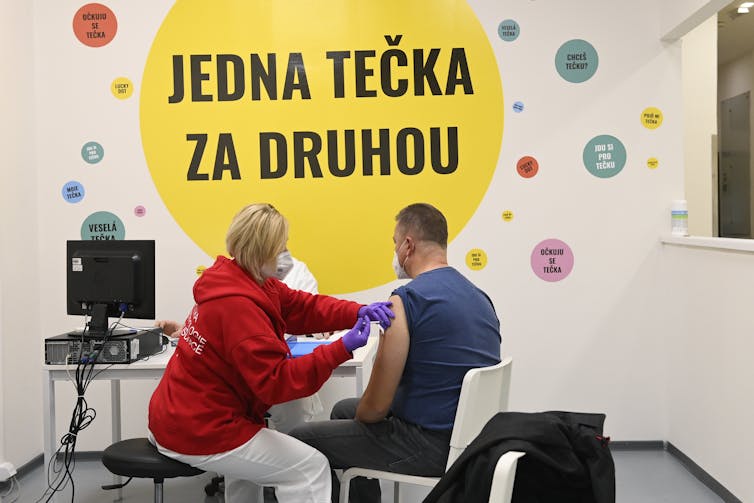
Over the past two years, our lives have changed in unprecedented ways. In the face of the pandemic, we have been required to obey demanding new rules and accept new risks, making enormous changes to our daily lives.
These disruptions can challenge us to think differently about ethics – about what we owe each other.
As we head into the third year of the pandemic, debates continue to rage over the ethics of vaccine mandates, restrictions on civil liberties, the limits of government power and the inequitable distribution of vaccines globally.
With so much disagreement over questions like these, has the pandemic fundamentally changed the way we think about ethics?
Ethics became more visible
In daily life, ethical decision-making often isn’t front of mind. We can often just coast along.
But the pandemic changed all that. It highlighted our human inter-connectedness and the effects of our actions on others. It made us re-litigate the basic rules of life: whether we could work or study, where we could go, who we could visit.
Because the rules were being rewritten, we had to work out where we stood on all manner of questions:
Read more: 5 questions to ask yourself before you dob — advice for adults and kids, from an ethicist
At times, politicians tried to downplay these ethically-loaded questions by insisting they were “just following the science”. But there is no such thing. Even where the science is incontrovertible, political decision-making is unavoidably informed by value judgements about fairness, life, rights, safety and freedom.
Ultimately, the pandemic made ethical thinking and discussion more common than ever — a change that might well outlast the virus itself. This might itself be a benefit, encouraging us to think more critically about our moral assumptions.
Who to trust?
Trust has always been morally important. However, the pandemic moved questions of trust to the very centre of everyday decision-making.
We all had to make judgments about government, scientists, news and journalists, “big pharma”, and social media. The stance we take on the trustworthiness of people we’ve never met turns out to be pivotal to the rules we will accept.
One good thing about trustworthiness is that it’s testable. Over time, evidence may confirm or refute the hypothesis that, say, the government is trustworthy about vaccine health advice but untrustworthy about cyber privacy protections in contract tracing apps.
Perhaps more importantly, one common concern throughout the pandemic was the unprecedented speed with which the vaccines were developed and approved. As the evidence for their safety and effectiveness continues to mount, quickly developed vaccines may be more readily trusted when the next health emergency strikes.
Legitimacy, time and executive power
When we’re thinking about the ethics of a law or rule, there are lots of questions we can ask.
Is it fair? Does it work? Were we consulted about it? Can we understand it? Does it treat us like adults? Is it enforced appropriately?
In the context of a pandemic, it turns out that delivering good answers to these questions requires a crucial resource: time.
The development of inclusive, informed, nuanced and fair rules is hard when swift responses are needed. It’s even more challenging when our understanding of the situation – and the situation itself – changes rapidly.
This doesn’t excuse shoddy political decision-making. But it does mean leaders can be forced to make hard decisions where there are no ethically sound alternatives on offer. When they do, the rest of us must cope with living in a deeply imperfect moral world.
All of this raises important questions for the future. Will we have become so inured to executive rule that governments feel confident in restricting our liberties and resist relinquishing their power?
On a different front, given the enormous costs and disruptions governments have imposed on the public to combat the pandemic, is there now a clearer moral obligation to marshal similar resources to combat slow-motion catastrophes like climate change?
Read more: To be truly ethical, vaccine mandates must be about more than just lifting jab rates
Ethics and expectations
Expectations, in the form of predictions about the future, are rarely at the forefront of our ethical thinking.
Yet as the 18th century philosopher Jeremy Bentham argued, disruption is inherently ethically challenging because people build their lives around their expectations. We make decisions, investments and plans based on our expectations, and adapt our preferences around them.
When those expectations are violated, we can experience not only material losses, but losses to our autonomy and “self efficacy” — or our perceived ability to navigate the world.
This plays out in several ways in the context of vaccine mandates.
For example, it’s not a crime to have strange beliefs and odd values, so long as you still follow the relevant rules. But this creates problems when a new type of regulation is imposed on an occupation.
A person with strong anti-vaccination beliefs (or even just vaccine hesitancy) arguably should never become a nurse or doctor. But they may well expect their views to be a non-issue if they are a footballer or a construction worker.
While there are powerful ethical reasons supporting vaccine mandates, the shattering of people’s life expectations nevertheless carries profound costs. Some people may be removed from careers they built their lives around. Others may have lost the sense their future is able to be predicted, and their lives are in their control.
Read more: Vaccine passports are coming. But are they ethical?
What does the future hold?
It’s possible current social shifts will “snap back” once the threat recedes. Emergency situations, like pandemics and war, can have their own logic, driven by high stakes and the sacrifices necessary to confront them.
Equally though, learned lessons and ingrained habits of thought can persist beyond the crucibles that forged them. Only time will tell which changes will endure — and whether those changes make our society better or worse.
Authors: Hugh Breakey, Deputy Director, Institute for Ethics, Governance & Law. President, Australian Association for Professional & Applied Ethics., Griffith University
Read more https://theconversation.com/has-the-pandemic-fundamentally-changed-our-ethics-171304


















