

why superb fairy-wren societies may be as complex as our own
- Written by: Ettore Camerlenghi, PhD student, Monash University
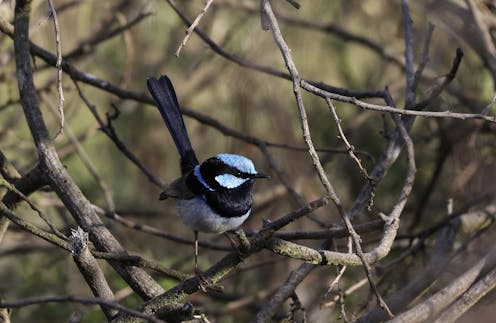
One mystery many biologists want to solve is how complexity develops in nature. And among the many social systems in the natural world, multilevel societies stand out for their complexity. Individuals first organise into families, which are members of bands, which are organised into clans.
At each level, associations between components (individuals, families and clans) are structured and stable. In other words, individuals within families usually stay together, and families usually interact with other specific families in a predictable way, to form stable clans.
Such social organisation has probably characterised much of human evolution (and is still common among many hunter-gatherer societies around the world).
In fact, multilevel societies likely played a fundamental role in human history, by accelerating our cultural evolution. Organising into distinct social groups would have reduced the transmission of cultures and allowed for multiple traditions to coexist.
In our research, published today in Ecology Letters, we studied social behaviours in a wild population of superb fairy-wrens. We found these birds also organise into multilevel societies – a level of complexity once thought to be exclusive to big-brained mammals.
Cooperatively breeding birds
Although we have ideas about the advantages of multilevel societies, we know relatively little about how and why they form in the first place.
Of the few species known to live in multilevel societies, there is one characteristic shared among all. That is, they live in stable groups, in environments where food availability is inconsistent and difficult to predict.
This is also true for many cooperatively breeding birds, including the superb fairy-wren – familiar across southeastern Australia’s parks and gardens. They breed in small family groups, with non-breeding helpers assisting a dominant breeding pair. And this social system is common among Australian bird species.
The superb fairy-wren is a well-studied species and is beloved by Australians, even being crowned bird of the year in this year’s Guardian/BirdLife Australia poll.
These birds are notorious for their polyamorous approach to sex, despite being socially monogamous. Breeding pairs form exclusive social bonds, yet each partner will still mate with other individuals.
Our work now reveals this complex arrangement during the breeding season is just the tip of the iceberg.
Read more: It isn't easy being blue – the cost of colour in fairy wrens
Associating by choice
We tracked almost 200 birds over two years, by attaching different-coloured leg bands to each individual. We recorded the birds’ social associations and, from our observations, built a complex social network that let us determine the strength of each relationship.
We found that during the autumn and winter months, some breeding groups – (which include the breeding pair, one or more helpers and last summer’s offspring), stably associated with other breeding groups to form supergroups. And this was usually done with individuals they were genetically related with.
In turn, these supergroups associated with other supergroups and breeding groups on a daily basis, forming large communities. In the following spring, these communities split back into the original breeding groups inhabiting well-defined territories – only to join again next winter.
Just like humans, these little birds don’t associate with each other randomly during the long winter months. They have specific individuals and/or groups they choose to be with (but we’re currently not sure how they make this choice).
While it’s not yet clear why superb fairy-wrens form upper social units (supergroups and communities), we suspect this might allow individuals to exploit larger areas during winter, when food is scarce. It would also provide additional safety against predators, such as hawks and kookaburras.
This theory is supported by our literature study, which shows that multilevel societies are likely common among other Australian cooperatively breeding birds, such as the noisy and bell miners and striated thornbills.
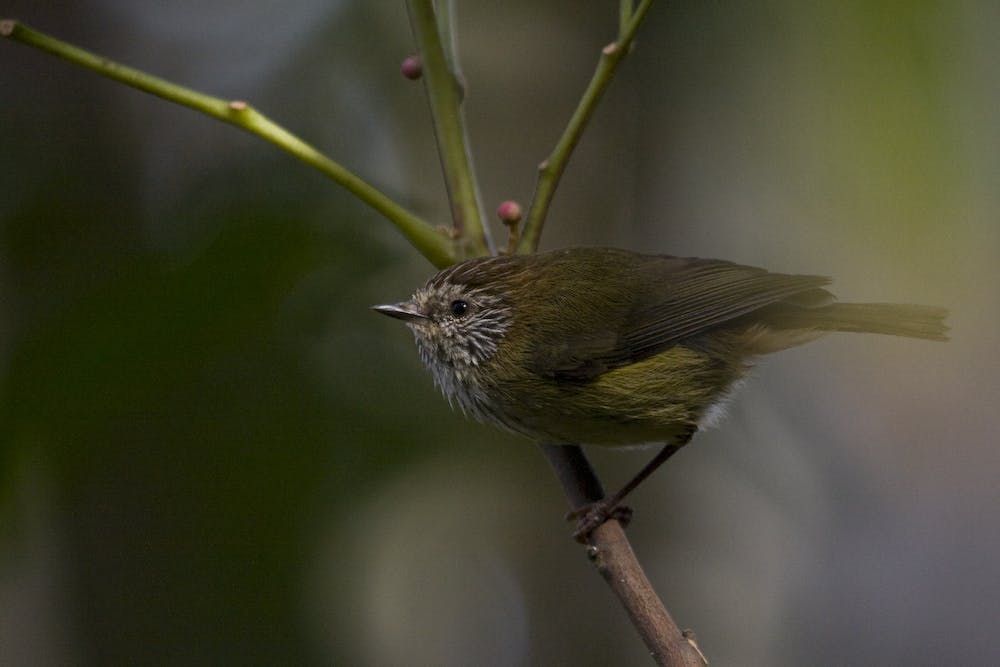
Cooperative breeding is another strategy to deal with harsh condition such as food scarcity. So the conditions that favour cooperative breeding are the same as those that favour multilevel societies.
Multilevel societies in other animals
There are several other species which seem to have a similar social organisation. They include primates such as baboons, and other large mammals that exhibit rich animal cultures, such as killer whales, sperm whales and elephants.
For a long time, researchers thought living in complex societies might be how humans evolved large brains. They also thought this characteristic may be exclusive to mammals with large brains, since keeping track of many different social relationships is not easy (or so the reasoning went).
Consequently, other animals with whom we are less closely related have mostly been excluded from this field of investigation.
This might reflect a bias that we, humans, have towards our own species and species which are similar to us.
As it turns, you don’t need to be a mammal with a big brain to evolve complex multilevel societies. Even small-brained birds such as the tiny superb fairy-wren can do this – as well as the vulturine guineafowl a chicken-like bird from northeast Africa.
We strongly suspect quite a few birds will join their ranks in the coming years as more research is done.
Acknowledgement: we would like to thank our colleagues Alexandra McQueen, Kaspar Delhey, Carly Cook, Sjouke Kingma and Damien Farine who are co-authors on this research.
Authors: Ettore Camerlenghi, PhD student, Monash University


















