How the kidnapping of a First Nations man on New Year's Eve in 1788 may have led to a smallpox epidemic
- Written by Toby Raeburn, Associate Professor in Nursing (mental health), University of Notre Dame Australia
First Nations people please be advised this article speaks of racially discriminating moments in history, including the distress and death of First Nations people.
Research continues to show that First Nations people’s burden of disease is more than double that of non-Indigenous Australians. This is despite widespread awareness of health inequalities experienced by First Nations people and successive governments’ efforts to “Close the Gap.”
Strengthening our awareness of history can help us understand how historical trauma contributes to the poor health of First Nations people today.
This New Year’s Eve, Sydney once again hosted an extraordinary party with a fantastic display of light and colour. However, many Australians were probably unaware that New Year’s Eve also marks the anniversary of the British invaders’ first capture of a First Nations person in Australia in the 1700s.
This kidnapping preceded a smallpox epidemic that killed more than 50% of the Aboriginal people in the Sydney Basin, along with large numbers further inland.
In our new research published in the international journal History of Psychiatry, we describe evidence supporting the theory that smallpox was deliberately unleashed by the British invaders.
We also introduce a new theory that ground zero for the smallpox epidemic of 1789 began during the kidnapping of Aboriginal man Arabanoo on New Year’s Eve in 1788.
Read more: Friday essay: it's time for a new museum dedicated to the fighters of the frontier wars
Deception leading to kidnapping and death
When the British invaded in early 1788, they struggled to survive. As they were establishing their colony, British convicts stole fishing nets and canoes from local Aboriginal people of the Eora nation, causing minor altercations.
The colonists were concerned about future quarrels with Aboriginal people when their early expeditions indicated much higher numbers of Aboriginal people inhabiting the Sydney Basin than they had anticipated.
As 1788 drew to a close, British food supplies were dwindling and, although land-clearing had begun at Parramatta in November, the colonists were unsure if they would be able to cultivate crops. By December, it had been several months since any Aboriginal people had come near the colonists’ camp, and Governor Arthur Phillip became anxious they might attack his fledgling colony.
So, on New Year’s Eve he decided to go on the offensive, sending a group of soldiers to take Aboriginal people as prisoners in order to gain information.
Led by lieutenants Henry Ball and George Johnston, a squadron of British marines rowed to Manly Beach, where they began handing out gifts to a group of Aboriginal people gathered on the shore. Using the gifts as a distraction, the soldiers captured a young Aboriginal man named Arabanoo.
When word spread about the deceptive kidnapping of Arabanoo, animosity towards the British increased. Then, a few weeks after receiving the gifts at Manly, fear broke out when several Aboriginal people fell ill with smallpox.
Referred to by the Eora as “galgalla”, smallpox was well known by the British, who used a process called variolation for immunisation. The treatment involved either sniffing smallpox scabs into the nose, or inserting scabs under a small cut in a person’s skin in order to contract a mild form of the disease and trigger the immune system.
There was no record of anyone suffering smallpox during the voyage of the First Fleet. However, as a precautionary measure, British surgeons on the First Fleet carried jars of smallpox flakes in their medical cases.
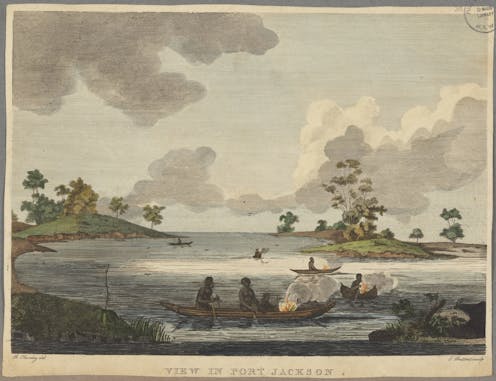
When the colonists received news smallpox had broken out among the Eora, Judge Advocate David Collins took a surgeon and Arabanoo to inspect the effects of the disease around Port Jackson. Collins described Arabanoo’s reaction as an expression of agony impossible to forget.
The expedition looked anxiously for survivors, but found nothing besides rotting corpses of people who had fallen victim to smallpox all around the harbour. When the colonists ventured north and south of Manly over the coming months, they continued to find dead bodies.
It remains unclear whether the British deliberately infected the First Nations people they encountered. Historians have posited a range of theories about what caused the outbreak.
Following exposure to the smallpox virus, it takes one to two weeks for symptoms to appear. Our theory is the epidemic had been spreading for several weeks before the British became aware of it, and it may have originated from the gifts handed out when Arabanoo was kidnapped about 12–13 weeks earlier.
This theory is supported by Aboriginal oral history from the Manly area. According to other research, several British marines had also previously fought battles in North America, where they may have heard stories about spreading smallpox as a strategy against First Nations people there.
Read more: Oral testimony of an Aboriginal massacre now supported by scientific evidence
The death of Arabanoo
As April passed, a hut near the British tent hospital was used to accommodate two Aboriginal men and two children suffering from smallpox. The men died, but with Arabanoo’s care, a young girl named Abaroo (also known as Boorong), and little boy named Nanbaree, managed to recover. Sadly, in the process of nursing them, Arabanoo contracted smallpox himself and subsequently died on May 18.
It is important for us to remember that First Nations people’s earliest interactions with British health care did not occur in response to injury, accident or natural disaster. Instead, it occurred because of deception, kidnapping and disease in the context of invasion by the British.
First Nations people’s relationship with white health care has been haunted by this and continuing malpractices ever since.
Remembering Arabanoo each New Year’s Eve may assist Australians to better understand our nation’s traumatic history and the intergenerational effects of colonisation.
Improving our understanding of history also has potential to create better communication with First Nations people. It makes us more ready to listen when Aboriginal people tell us what they need to close the gap in health care, and when they tell us how we can build better relationships through messages such as the Uluru Statement from the Heart.
Authors: Toby Raeburn, Associate Professor in Nursing (mental health), University of Notre Dame Australia