Google AI


Modern Australian

we're now witnessing one of the worst public policy failures in Australia's history

  • Written by: Jim Stanford, Economist and Director, Centre for Future Work, Australia Institute; Honorary Professor of Political Economy, University of Sydney
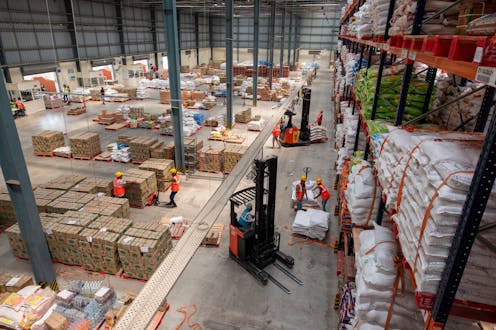
we're now witnessing one of the worst public policy failures in Australia's history

Australians are getting a stark reminder about how value is actually created in an economy, and how supply chains truly work.

Ask chief executives where value comes from and they will credit their own smart decisions that inflate shareholder wealth. Ask logistics experts how supply chains work and they will wax eloquent about ports, terminals and trucks. Politicians, meanwhile, highlight nebulous intangibles like “investor confidence” – enhanced, presumably, by their own steady hands on the tiller.

The reality of value-added production and supply is much more human than all of this. It is people who are the driving force behind production, distribution and supply.

Labour – human beings getting out of bed and going to work, using their brains and brawn to produce actual goods and services – is the only thing that adds value to the “free gifts” we harvest from nature. It’s the only thing that puts food on supermarket shelves, cares for sick people and teaches our children.

Even the technology used to enhance workers’ productivity – or sometimes even replace them – is ultimately the culmination of other human beings doing their jobs. The glorious complexity of the whole economy boils down to human beings, using raw materials extracted and tools built by other human beings, working to produce goods and services.

A narrow, distorted economic lens

The economy doesn’t work if people can’t work. So the first economic priority during a pandemic must be to keep people healthy enough to keep working, producing, delivering and buying.

That some political and business leaders have, from the outset of COVID-19, consistently downplayed the economic costs of mass illness, reflects a narrow, distorted economic lens. We’re now seeing the result – one of the worst public policy failures in Australia’s history.

The Omicron variant is tearing through Australia’s workforce, from health care and child care, to agriculture and manufacturing, to transportation and logistics, to emergency services.

The result is an unprecedented, and preventable, economic catastrophe. This catastrophe was visited upon us by leaders – NSW Premier Dom Perrotet and Prime Minister Scott Morrison in particular – on the grounds they were protecting the economy. Like a Mafia kingpin extorting money, this is the kind of “protection” that can kill you.

NSW Premier Dominic Perrottet's decision to relax COVID-19 restrictions in December has turned into both a health and economic disaster.
NSW Premier Dominic Perrottet’s decision to relax COVID-19 restrictions in December has turned into both a health and economic disaster. Bianca De Marchi/AAP

Effect as bad as lockdowns

On a typical day in normal times, between 3% and 4% of employed Australians miss work due to their own illness. Multiple reports from NSW indicate up to half of workers are now absent due to COVID: because they contracted it, were exposed to it, or must care for someone (like children barred from child care) because of it. With infections still spreading, this will get worse in the days ahead.

Staffing shortages have left hospitals in chaos, supermarket shelves empty, supply chains paralysed. ANZ Bank data, for example, shows economic activity in Sydney has fallen to a level lower than the worst lockdowns.

Spending in Sydney and Melbourne now near lockdown conditions
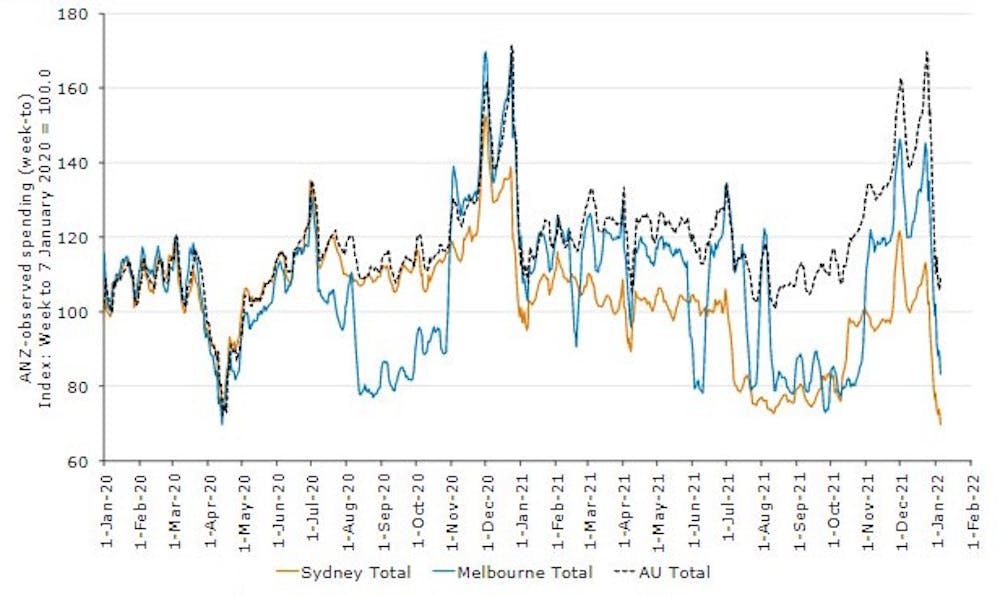
ANZ Bank data shows spending in Sydney and Melbourne has fallen to levels typical of lockdown conditions.
ANZ Research If relaxing health restrictions in December (as Omicron was already spreading) was motivated by a desire to boost the economy, this is an own-goal for the history books. Relaxing isolation rules Now the response to Omicron ravaging labour supply is to relax isolation requirements for workers who have contracted, or been exposed to, COVID-19. The first step was to shift the goalposts on “test, trace, isolate and quarantine” arrangements by redefining “close contact”. On December 29 the Prime Minister said it was important to move to a new definition “that enables Australia to keep moving, for people to get on with their lives”. The next day National Cabinet approved a definition such that only individuals having spent at least four hours indoors with a COVID-infected person needed to isolate. Read more: It's still not too late to fix the rapid antigen testing debacle. Why the national cabinet decision is wrong and must be reversed Australians certainly want supply chains to keep moving. That won’t happen by simply pretending someone with three hours and 59 minutes of face-to-face indoor contact with Omicron is safe. Putting asymptomatic but exposed and potentially infected people back to work will only accelerate the spread. The second step has been to reduce the isolation period for those who do pass this tougher “close contact” test. At its December 30 meeting National Cabinet agreed to a standard isolation period of seven days (ten days in South Australia), down from 14 days. For “critical workers” in essential services including food logistics, the NSW and Queensland governments have gone even further, allowing employers to call them back to work so long as they are asymptomatic. Snatching defeat from the jaws of victory This follows a US precedent, despite scientific evidence indicating contagion commonly lasts longer than 5 days. Employers will use this change to pressure exposed and even sick workers to return to work, risking their own health, colleagues, customers, and inevitably spreading the virus further. Copying US COVID protocols only guarantees US-style infection rates. In fact, since 5 January, Australia’s seven-day rolling average infections per million now exceed that of the US. Daily new confirmed COVID-19 cases per million people, Australia compared to United States. Our Wold in Data, CC BY From one of the best COVID responses in the world to one of the worst, Australia has snatched defeat from the jaws of victory. It’s not to late to limit the carnage The idea that health considerations had to be balanced with economic interests was always a false dichotomy. A healthy economy requires healthy workers and healthy consumers. The Omicron surge has created an economic emergency that will be difficult to endure. But it’s not too late to limit further avoidable contagion. Infection prevention practices (including masks, capacity limits, prohibitions on group indoor activities, PPE and distancing in workplaces, and free and accessible rapid tests) must be restored and enforced. Read more: From COVID control to chaos – what now for Australia? Two pathways lie before us Income supports for workers who stay home must be restored. Staffing strategies need to emphasise steady, secure jobs, rather than outsourcing and gig arrangements which have facilitated contagion. Above all, our policy makers need to remember the economy is composed of human beings, and refocus their attention on keeping people healthy. Protecting people is the only thing that can protect the economy. Authors: Jim Stanford, Economist and Director, Centre for Future Work, Australia Institute; Honorary Professor of Political Economy, University of Sydney


Read more https://theconversation.com/healthy-humans-drive-the-economy-were-now-witnessing-one-of-the-worst-public-policy-failures-in-australias-history-174606

Understanding a dental implant Melbourne Treatment Plan

A dental implant Melbourne patients may consider is one option for replacing a missing tooth, but suitability depends on oral health, bone support a...

How 3PL Logistics Australia Supports Faster and More Efficient Supply Chains

Why Has 3PL Logistics Become Important for Growing Businesses?  Gone are the days when supply chains were simpler and in minimal quantity. Now, the...

Common Skin Concerns and Treatment Options Available in Melbourne

Skin concerns can develop gradually or become noticeable following changes in age, lifestyle, sun exposure or hormonal factors. Pigmentation, rednes...

Why a Code-Compliant Home Can Still Feel Uncomfortable

When people build or renovate a home, they usually expect that meeting current building requirements will also produce a comfortable place to live. ...

Breach of Contract in Business: What Are Your Options?

Contracts are essential to business relationships. They establish expectations, allocate responsibilities and provide a framework for delivering goods...

How Pest Control Companies Can Rank for the Problems Customers Search First

Introduction SEO for Pest Control needs to start with the customer’s problem. Most people do not search for pest services in a neat or technical wa...

What Are the Benefits of Renovating an Older Home in Sydney?

Sydney has plenty of character homes, from Federation cottages to mid-century brick homes. Renovating rather than rebuilding can preserve what makes t...

Pool and Deck Design: How to Plan the Perfect Outdoor Living Space for Your Sydney Home

For many Australians, the backyard is where life happens. Summer barbecues, weekend swims and long evenings outdoors are all part of the lifestyle, ...

Is Solar Pool Heating Worth It? What Sydney Homeowners Should Know

There's nothing quite like a backyard pool on a hot Sydney day. But once autumn rolls in, many pools sit unused for months because the water is simp...

Planning a Luxury House Move: A Week-by-Week Timeline for Prestige Sydney Homes

Selling or buying a prestige home is a major milestone. Whether it's a waterfront residence in Birchgrove, a grand Federation home in Haberfield or ...

Downsizing or Upgrading Your Caravan? Here's How to Sell It Without the Hassle

Selling a caravan can feel like a major task, especially when you are unsure about its value, paperwork, or how to find a buyer. Whether you are dow...

The Best Overseas Adventure Holidays for Australians Who Love the Outdoors

Australia offers no shortage of incredible outdoor experiences, but sometimes the best way to satisfy your sense of adventure is to head overseas. A...

Cape Town Wine Shuttle: Winelands Tasting & Tours

Embark on an unforgettable journey through the picturesque Cape Winelands, where world-class wines and breathtaking scenery await. Our Cape Town Win...

Metal Fabrication: Choosing Metal Fabrication Melbourne Services for Custom Projects

What Modern Metal Fabrication Involves From individual components to complete structures, metal fabrication brings together processes such as desig...

Why Giant Rats Tail Grass Keeps Coming Back After Spraying

Giant Rats Tail Grass (GRT) is one of the most frustrating pasture weeds for farmers and lifestyle property owners. You spray an infested area, see th...

When Custom Cardboard Boxes Make Sense for Your Business

Custom cardboard boxes can be useful when a standard carton does not fit a product, packing method or presentation requirement particularly well. A ...

Full-Height vs. Pop-Top Caravan: Which Is Better for Family Travel across WA?

A pop-top caravan is an excellent choice for travellers who want the comfort of a caravan without committing to a larger, bulkier setup. With a lowe...

Bottle Label Printing: Key Factors for a Professional Finish

Why the Printing Method Matters When businesses need packaging or printed containers developed for a particular application, the right supplier can m...